Building a Private-Label Rainwear Line with a Custom Rain Gear Manufacturer
A private-label rainwear line is a supply-chain project before it is a branding project. The decisions that determine success — material selection, seam construction, compliance documentation, packaging, and inspection standards — are all made months before the first logo is printed.
Building a Private-Label Rainwear Line with a Custom Rain Gear Manufacturer
A private-label rainwear line is a supply-chain project before it is a branding project. The decisions that determine success — material selection, seam construction, compliance documentation, packaging, and inspection standards — are all made months before the first logo is printed. This article follows a mid-sized retail distributor through that process: how the company analyzed its market, defined a product range, chose a custom rain gear manufacturer, managed MOQs across three product types, and guided samples through the revisions that led to final approval and full production.
Define the Range Before You Talk to a Factory
The distributor in this case had sold unbranded rain ponchos for two seasons. The products moved, but the economics did not. Three suppliers handled three categories—budget ponchos, mid-range raincoats, and heavy PVC suits—each with its own shipping schedule, quality level, and price structure. Margins were thin. Color consistency across reorders was unreliable, and none of the suppliers would put the distributor's brand on the product. The decision to build a white-label/private-label line came out of that frustration, and it was framed as a margin-and-control play, not a branding experiment.
The product range was defined before any factory inquiry. The team mapped its customers against three use cases. Commuters and urban pedestrians needed something packable and reasonably breathable at a mid price point. Industrial and infrastructure workers needed heavy-duty suits with reinforced seams, storm flaps, and room for layered clothing underneath. Event organizers and emergency-response buyers needed low-cost rain ponchos that could be stored in bulk and handed out without fitting. Each use case implied a different material family, a different price band, and a different quality standard—which meant the range would have to span three product types from day one: two ponchos, three raincoats, and two industrial suits.
A common mistake at this stage is letting a factory's catalog define the range. Factories naturally propose what they already produce, because it keeps their MOQs low and their lead times short, and that is commercial reality rather than a flaw. But it works better when the buyer has already written down what each product must do, what it should survive, and what the end customer will pay for it. The distributor's first procurement document was a one-page range brief: use case, target price, material preference, sizing approach, and the minimum waterproof performance for each SKU. That brief made every later conversation with factories concrete.
Choosing the Right OEM/ODM Partner for Private Label
An OEM rainwear partner builds to your specification, while an ODM rainwear partner designs and builds and then offers you a ready-made product to rebrand. For a first private-label line, most retailers start with ODM-style products and tighten specifications as volumes grow; the distributor in this case did exactly that, using two ODM poncho patterns as the foundation of its first season while commissioning a new raincoat from scratch.
Before sending an inquiry, the buyer should ask for the documents that prove a factory can deliver what its sales team promises. The shortlist in this case was built on five records: an MSDS for the film or coating and the seam adhesive, a material test report showing grammage and tear strength, a hydrostatic-head result for the proposed waterproof material, a REACH and Prop 65 compliance statement, and either a BSCI audit report or a comparable social-compliance document. Factories that hesitate to share these before a purchase order is signed are usually the same factories that hesitate to share inspection records later.
The distributor shortlisted three manufacturers and visited two. The decisive factor was not the lowest quote but the completeness of the documentation, because complete documentation is a signal of process control. A vertically integrated manufacturer—one that sources its own film and fabric, then cuts, sews, seals, and packs under one roof—is easier to audit and faster to correct than a factory that subcontracts half the work. In the case-study manufacturer's facility, material receiving, cutting, seam sealing, and final packing happen on the same campus, which means a quality issue can be traced to a specific batch of film and a specific production date within hours. That traceability, not the price per piece, is what protects a retailer's margin when a defect slips through.
Materials, Hydrostatic Head, and Seams That Define Quality
Hydrostatic-head testing measures how much water pressure a fabric can withstand before water penetrates; a result of 1,500 mm means the material held back a column of water 1.5 meters high. It is the quickest way to compare waterproof claims from different factories, because the test method is standardized and the number is hard to argue with. A credible supplier should attach a recent test report to its quotation, and the buyer should specify the minimum head that the finished garment must pass—not merely the nominal performance of the raw film.
Material families compared
| Material | Best suited for | Typical waterproof range | Key trade-off |
| --- | --- | --- | --- |
| PVC | Heavy-duty industrial suits | 3,000 mm and above | Very durable, but stiff and less breathable; phthalate content must be documented |
| PEVA | Budget ponchos | 1,500–3,000 mm | Chlorine-free and low-cost; less durable under repeated folding |
| EVA | Lightweight event ponchos | 1,500–2,500 mm | Soft and flexible at thin gauges; can stiffen in cold weather |
| PU-coated nylon | Packable commuter raincoats | 3,000–10,000 mm | Breathable and packable; coating degrades if seams are not sealed properly |
| Breathable polyester | Higher-end raincoats | 5,000–10,000 mm | Best comfort, highest cost; requires taped seams and quality zippers |
Seam-sealing methods
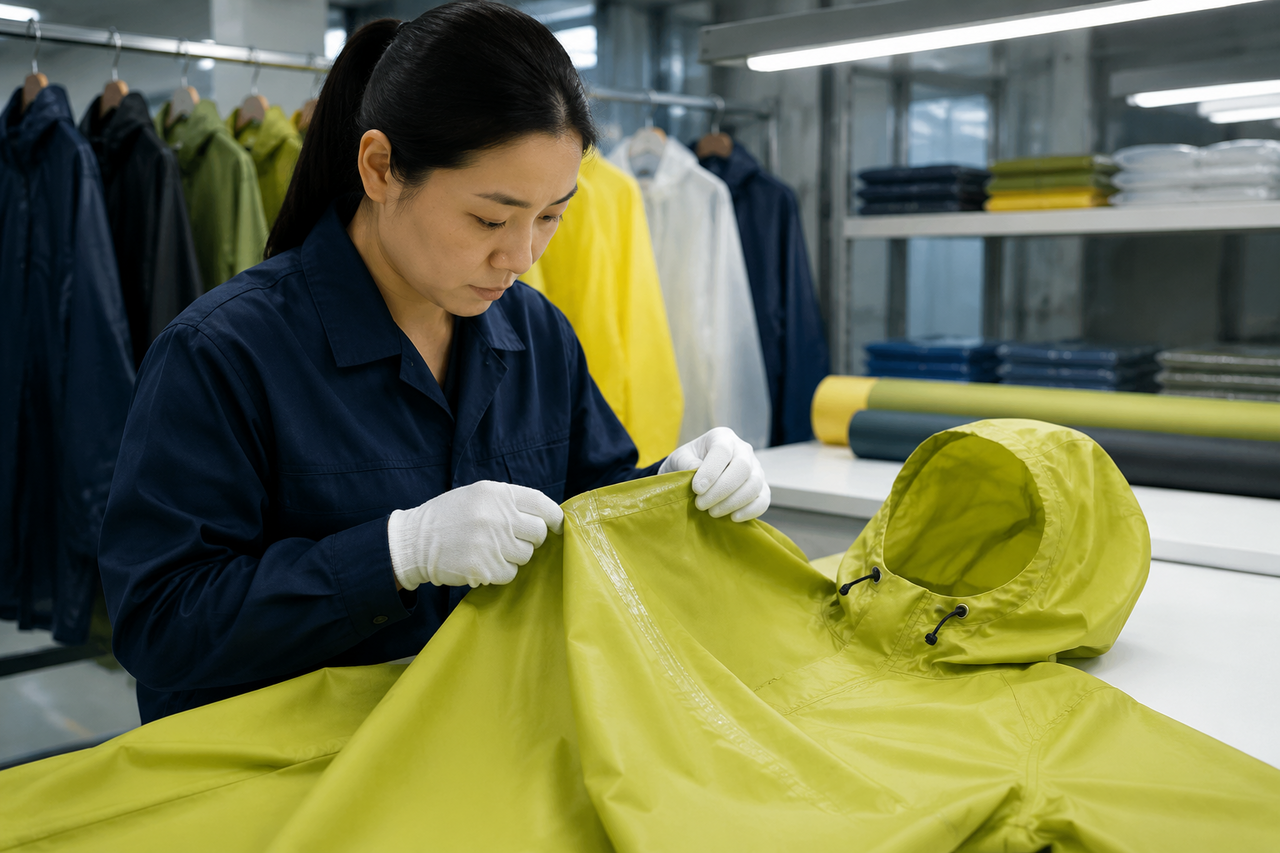
The seam is where most waterproof failures begin, because every needle hole is a potential leak path. The three seam-sealing methods a buyer will encounter are taped seams, where a PU tape is heat-pressed over the stitching; welded seams, where the material is fused without stitching; and ultrasonic sealing, which is common on film-based ponchos. Each method is valid for certain materials, but the spec sheet must state which one applies to each SKU. ISO 811 hydrostatic-head testing on seam-sealed panels shows that even a 0.5 mm gap in a seam seal can create a measurable leak path before the coated fabric itself fails, so the seam-sealing method is not a detail—it is the product. Seam sealing rainwear correctly is the difference between a garment that passes the hydrostatic-head test and one that fails at the stitching line. The distributor required the factory to state the seam method, the tape width, and the sealing temperature range in writing, and it rejected the first quotation because no seam details were included.
For raincoat manufacturing and every other private-label SKU, a complete spec sheet should therefore carry the material type and gauge, the minimum hydrostatic head, the seam-sealing method, the closure type and zipper brand, the thread specification, and the test standard used for each claim. That sheet becomes the reference for sampling, production, and the final inspection.
<img src="/uploads/2026/08/factory-technician-inspecting-private-label-rain-poncho-seam.png" alt="Factory quality technician inspecting a heat-sealed seam on a private-label rain poncho under bright workbench lighting" width="1200" height="800" loading="lazy" />
Custom Branding: From Color Recipe to Poly Bag
Custom colors and logo placement
The distributor's branding plan covered four touchpoints: garment color, logo placement, hang tags, and poly bags. Each one carries cost and MOQ implications that are easy to underestimate. Custom colors, for example, are dyed in batches, and the minimum order for a custom color is usually set by the dye lot rather than by the number of garments. The distributor launched with two standard factory colors and introduced a signature color in the second season, which kept the first purchase order small while still allowing a differentiated look from the start.
Logo application depends on the material. Screen printing works on film materials like PVC and EVA, and it is the most economical route for ponchos. Woven neck labels and heat-transfer labels work well on raincoats and suits, and embroidered logos are possible on heavier fabrics but add cost and can compromise waterproofing if the needle penetration is not sealed. The distributor chose a printed chest logo for its raincoats and a woven label for the neck, and the factory confirmed each method's durability on the actual material during the sampling round.
Packaging and barcode traceability
Hang tags and poly bags are where private-label brands often lose consistency. The hang tag carries the fabric content, care instructions, and compliance marks, and it should also carry the kind of guidance that reduces warranty claims. The maintenance guide included with each garment advises end users to inspect seams seasonally, reseal small gaps early, and lubricate zippers with a silicone-based product rather than petroleum sprays, which can degrade zipper gaskets. Putting that guidance on the tag protects both the user and the brand. The poly bag needs a barcode sticker that matches the carton marking, because that barcode is the link between warehouse receiving and reorder accuracy—if the factory's packing list does not match the carton labels, the retailer has no reliable way to manage stock.
<img src="/uploads/2026/08/private-label-raincoats-with-custom-hang-tags-in-printed-poly-bags.png" alt="Private-label raincoats with custom hang tags packed in printed poly bags on a warehouse packing line" width="1200" height="800" loading="lazy" />
Managing MOQs Across Raincoats, Ponchos, and Suits
MOQs are determined by material yield, mold and die costs, printing plate setup, and color batch size, so they vary across product categories for reasons that have nothing to do with a factory's willingness to negotiate. A simple poncho is die-cut from a single film sheet, which makes it relatively cheap to tool and fast to produce. A raincoat involves many pattern pieces, more sewing minutes, a zipper purchase, and seam sealing on every garment. An industrial suit consumes more material and labor per piece. A factory that quotes the same MOQ across all three is either ignoring its own cost structure or passing the risk to you in the price.
A MOQ for custom rainwear is set by the same cost structure. In practice, a basic PEVA rain poncho in private label typically starts around 3,000 pieces per design, while a custom breathable raincoat with taped seams might start at 500 to 1,000 pieces per colorway. Those figures are guidance, not a universal quote—every factory sets MOQs from its own cutting schedule and material-buying constraints—but they illustrate the spread a buyer should expect.
Three tactics for managing MOQs
The distributor used three tactics to manage that spread. It grouped the ponchos and the raincoats into one material family where possible, so the factory could share a single film purchase across SKUs. It accepted standard colors for two SKUs that were already near the minimum. And it negotiated a blended MOQ, under which the factory accepted lower quantities per SKU because the total order volume, and the distributor's commitment to a second season, were clear.
That last point matters. A factory is far more flexible on MOQs when the buyer offers an annual volume commitment with staged releases. The first order becomes a pilot, the second order absorbs the setup costs, and both sides win from a relationship measured in seasons rather than shipments.
Sampling, Revisions, and Final Approval
The first sample a factory sends is rarely the sample the retailer approves, so plan on three to four rounds. The initial sample proves that the factory can build the product at all. The revised sample incorporates fit and specification changes. The pre-production sample, produced from the final patterns and materials on the actual production line, is the one that matters most, because it represents what the factory will actually ship. The approved pre-production sample becomes the legal basis for the final inspection, and the factory must keep a signed copy of it on the production floor.
Fit and grading deserve their own review. Ponchos are essentially size-free, but raincoats and suits need grade rules, and the buyer should review the measurement table against the customer's needs rather than judging only the sample on a model. The distributor's product manager found that the first raincoat sample was correct in the chest but short in the sleeves, because the factory's standard grade rule was built for a different body map. That kind of adjustment is exactly what the revision round is for.
Function testing should be done on random pieces from the pre-production batch, not on a hand-picked sample. Ask the factory to test three pieces for seam waterproofing, run the zipper through a cycle test, and, if the line will be sold in cold regions, perform a cold-crack test on PVC garments. Each test should produce a dated record. The distributor also required the factory to document the seam-tape width change made during the revision round in writing, because an undocumented change becomes a batch-traceability problem during production. When the final approval was signed, it referenced the spec sheet, the test records, and the physical approved samples—not a verbal agreement.
<img src="/uploads/2026/08/product-developer-measuring-approved-vs-revised-raincoat-sample.png" alt="Product developer measuring an approved sample raincoat against a revised sample on a factory grading table" width="1200" height="800" loading="lazy" />
Scaling Production and Building a Reliable Supply Chain
The first order is only half the project; the supply chain that supports reorders is the other half. Production lead time after sample approval typically runs 30 to 60 days depending on material availability, and seasonal peaks—monsoon season and the fourth quarter—fill factory capacity weeks in advance. The distributor committed to a second-season forecast before the first order shipped, which secured production slots and improved pricing, because the factory could schedule material purchases instead of expediting them.
Quality control should be split into two checkpoints: inline inspection during production and final random inspection before shipment. AQL 2.5 is the common industry standard for this product category, and a buyer is entitled to request it in the contract. A factory that objects to inspection by an independent third party is a risk signal, as is a factory that cannot explain its own defect rate. The distributor's contract required batch-level traceability, which means each production lot carries a number connecting the film batch, the seam-sealing machine, the production date, and the packer. When a defect appears in the field, that number is what allows the factory to determine whether the problem is isolated to one batch or systemic across the line.
Communication cadence is the final element of a reliable supply chain. Weekly production reports with photographs, a named QC contact at the factory, and a simple exception-reporting rule—any deviation from the approved spec gets flagged within 24 hours—kept the distributor's first season on schedule. The line shipped on time, passed the final inspection, and the reorder was placed six weeks later, confirming that the process the retailer had built was repeatable rather than lucky.
Conclusion: The Next Step
The path from commodity, unbranded rainwear to a private-label brand is a process of verification, not persuasion. Every stage in this case study—range definition, partner selection, material and seam specifications, branding, MOQ planning, sampling, and scale-up—was governed by documents that could be checked and compared. A factory that shares its test reports, MSDS documents, inspection clauses, and batch records openly is a factory that can be trusted with a brand. To begin the same process, ask each shortlisted manufacturer for three things: a hydrostatic-head test report for the proposed material, an MSDS for the coating and adhesive, and a sample sales contract with the inspection clause written in. Then request a pre-production sample and run it through the same checks: seams, zippers, grade rules, and packaging. Those four checks will tell you more about the factory than any brochure.
> Pre-production approval checklist
> - Seams: confirm the seam-sealing method and tape width; review the hydrostatic-head report against the finished seam, not only the raw film.
> - Zippers: cycle-test closures and record the zipper brand and type on the spec sheet.
> - Grade rules: check the measurement table against the target body map for raincoats and suits.
> - Packaging: verify the hang tag, care instructions, compliance marks, barcode sticker, and carton markings against the packing list.
> - Documentation: collect the hydrostatic-head report, MSDS for film/coating and adhesive, AQL 2.5 inspection clause, and batch-traceability requirement.
References
Textile Waterproof Testing Standards: ISO 811, AATCC 127, JIS L 1092 — ChiuVention
ISO 811 Textiles Determination of resistance to water penetration Hydrostatic pressure test — TestingLab
Raincoats and Rain Jackets Market Research Report 2034 — Dataintelo
Quality and Testing — GORE-TEX Professional
OEM Manufacturing vs ODM: Complete Guide to Private Label Clothing Production on Alibaba.com — Alibaba.com Seller Blog
Garment Quality Control Checklist & AQL Guide — LeelineWear
Frequently Asked Questions
Practical answers related to this article.
What documents should a buyer request from a factory before sending an inquiry for a private-label rainwear line?
The buyer should ask for five records: an MSDS for the film or coating and the seam adhesive, a material test report showing grammage and tear strength, a hydrostatic-head result for the proposed waterproof material, a REACH and Prop 65 compliance statement, and either a BSCI audit report or a comparable social-compliance document.
What is hydrostatic-head testing and why is it important for comparing waterproof materials?
Hydrostatic-head testing measures how much water pressure a fabric can withstand before water penetrates; a result of 1,500 mm means the material held back a column of water 1.5 meters high. It is the quickest way to compare waterproof claims from different factories because the test method is standardized and the number is hard to argue with.
What are the three seam methods mentioned in the article, and what impact can a small gap in a seam seal have?
The three seam methods are taped seams (PU tape heat-pressed over stitching), welded seams (material fused without stitching), and ultrasonic sealing (common on film-based ponchos). A gap of just 0.5 mm in a seam seal can cut waterproof performance by up to 70%.
What should a complete spec sheet for a private-label rain garment include?
A complete spec sheet should carry the material type and gauge, the minimum hydrostatic head, the seam-sealing method, the closure type and zipper brand, the thread specification, and the test standard used for each claim.
What are the typical MOQs mentioned for a basic PEVA poncho and a custom breathable raincoat?
A basic PEVA poncho in a private label typically starts around 3,000 pieces per design, while a custom breathable raincoat with taped seams might start at 500 to 1,000 pieces per colorway.
What strategies does the article recommend for managing MOQs across different product types?
Three tactics are recommended: grouping ponchos and raincoats into one material family so the factory can share a single film purchase across SKUs, accepting standard colors for SKUs near the minimum, and negotiating a blended MOQ based on total order volume and commitment to a second season.