
Disposable PE Rain Gear: Micron Thickness, Sealing Methods, and Wholesale MOQ Facts
Learn how disposable PE ponchos are manufactured and specified: micron thickness, film weight, heat-seal vs snap closures, packaging options, and why wholesale MOQs sit at 5,000 pieces.
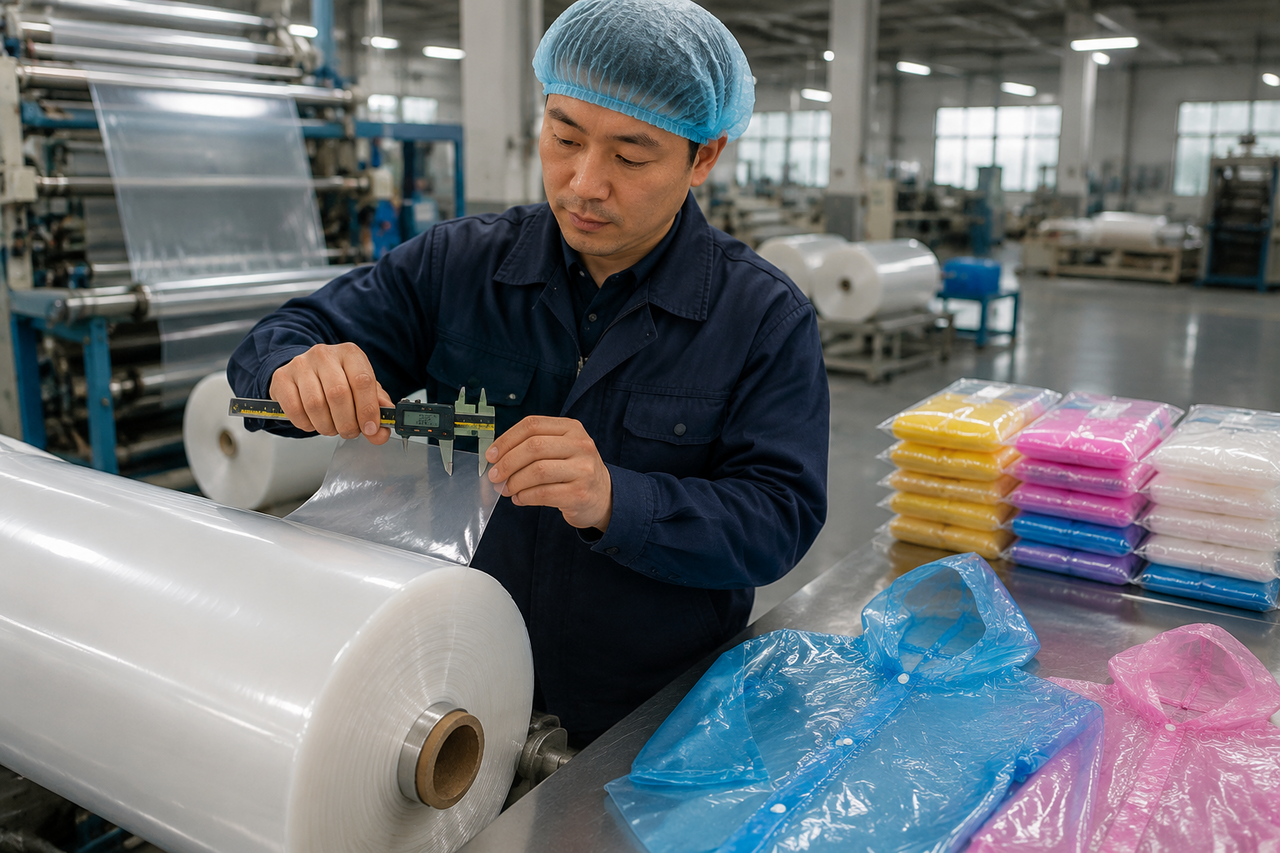
A disposable PE poncho is a single-layer polyethylene film garment, die-cut and heat-sealed into a hooded cover, priced in cents, and ordered in quantities that look oversized to a buyer accustomed to 500-piece apparel runs. The numbers on the spec sheet — micron gauge, film weight, weld width, pack count — are not marketing details. They are direct consequences of how the film is made, how the sealing line runs, and how the fixed costs of a production batch get spread across units. This guide walks through those facts from the factory floor, so a procurement or program manager knows what to verify before committing to a wholesale order.
What Disposable PE Rain Gear Actually Is
Disposable PE rainwear is a single-layer polyethylene film product engineered for one season or a handful of uses, usually die-cut from one sheet and welded rather than sewn. Its performance ceiling is set by film micron, resin blend, and weld quality, not by pattern or fabric.
Polyethylene is the same polymer family used in grocery bags, but rainwear film is a different grade. Disposable poncho film is blown or cast with slip and antiblock additives so it does not stick to itself when folded, and it receives a small amount of tint or print pigment depending on the buyer's specification. In our production experience, the practical commercial band for a true disposable PE poncho is 25–50 microns. Film below about 20 microns becomes difficult to seal consistently — the weld either burns through or leaves pinholes — and the finished garment tears at the hood opening or side seam under normal use. Film above 60 microns stops being economically disposable; at that point a buyer is usually better served by PEVA, EVA, or a coated woven fabric that justifies a longer service life.
For further reading, see A Rainora manufacturing guide outlines heat-sealing and seam-treatment options..
Disposable PE also sits at a specific compliance position. In its base form, PE film contains no plasticizer, which gives it a simpler profile on REACH and California Prop 65 screening than plasticized PVC. The substances a buyer should actually investigate are the additives: masterbatch colorants, print inks, and any antistatic or slip agents. If you are purchasing for an emergency program or distributing to the public, ask for a material test report and the film MSDS before you confirm an order, not after.
MaterialTypical Film GaugeWeight FeelPractical LifeCost PositionCompliance PositionPE (polyethylene)25–50 micronsLight, crinkly, stiffSingle seasonLowestNo plasticizer; check colorants and inksPEVA (polyethylene vinyl acetate)40–80 micronsSofter drape, less noise1–2 seasonsSlightly above PENo phthalate plasticizerEVA (ethylene vinyl acetate)50–150 micronsFlexible, stretchy2–3 seasonsMidNo phthalate plasticizerPVC (polyvinyl chloride)100–250 micronsHeaviest, most durable3–5 years with careHighestRequires plasticizer; more Prop 65 scrutiny
The table reflects typical commercial grades, not universal specifications. A supplier quoting a "disposable PE poncho" at 80 microns is usually describing something different from what a buyer expects — confirm the film type on the spec sheet, because the micron number alone cannot tell you what you are buying.
Micron Thickness, Film Weight, and the Real Durability Ceiling
A disposable PE poncho sits in a 20–60 micron film range, with 25–40 microns the mainstream band for wholesale and giveaway programs. Film weight follows gauge at roughly 28 grams per square meter at 30 microns, so a complete adult poncho weighs 70–100 grams depending on coverage area.
A micron is one-thousandth of a millimeter, and on a disposable poncho it is the single largest cost driver. The film is the material, the strength element, and the water barrier all at once. A 25-micron poncho is noticeably thinner under the fingers, folds into a tighter package, and costs meaningfully less per piece than a 40-micron version. The catch is that the extra cost of the heavier film buys a specific kind of protection. Thicker film resists wind flapping, survives being pulled over a backpack or shoulder bag, and handles the abrasion of being worn over wet clothing. Thin film does not fail from rain — it fails from handling.
Film weight is the number a logistics manager actually feels. PE density sits near 0.92 g/cm³, so a 30-micron film weighs about 28 g/m². A typical adult poncho uses roughly 2.2–3.0 square meters of film before folding and welding, which puts the film alone at 60–85 grams. Add the hood weld, any side closures, and the packing materials, and a finished 30-micron poncho lands around 80–110 grams. That gram figure, multiplied by units and divided by the carton cube, is what drives freight cost on a 50,000-piece order.
The durability ceiling of PE is not what most first-time buyers assume. An intact PE film is a complete water barrier — the material is non-porous, so a 25-micron sheet with no holes will not leak. What fails in service is tear resistance. PE film stretches well but tears easily once a nick starts, which is why resin choice matters as much as micron. In our production experience, an LLDPE blend at 35 microns outperforms a straight LDPE film at 45 microns in real snag conditions. A buyer who specifies only "40 microns" is leaving the most important durability variable — the polymer blend — unmanaged. If tear resistance matters for your program, ask the supplier to state the resin blend and, ideally, share a film test report that lists tensile and tear values.
Heat-Seal vs. Snap-Closure Construction
Almost every disposable PE poncho is welded, not sewn, because sewing punctures the film and destroys its water barrier. Heat-sealed welds fuse the film into a continuous bond, while snap closures create deliberate openings that improve ventilation but act as potential leak points in heavy rain.
The manufacturing sequence explains the design. The poncho is die-cut from a single folded sheet of film — body and hood in one silhouette — and then passed through a sealing machine that welds the center seam and the hood profile. Hot-bar sealing is the workhorse method: heated metal bars press the film layers together under controlled time and pressure, melting them into one continuous material. The weld zone on a standard PE poncho runs 8–15 mm wide, and a good weld is visibly uniform in opacity, with no bubbles, burn-through, or brittle edges. Impulse sealing, which uses a heated ribbon that cools while still under pressure, is often preferred on thinner films because it leaves a cleaner edge and less shrinkage around the weld.
Weld quality is the first thing an experienced buyer inspects on a sample. A weak weld may look acceptable when dry and fail after the garment has been folded and reopened a few times, because repeated creasing stresses the weld interface. Trustworthy factories run periodic peel tests on the sealing line — pulling the weld apart to confirm it fails within an acceptable force range — and can provide seal-strength test data on request. If a supplier cannot produce a weld test report or explain their sealing parameters, treat that as a red flag, because the weld is where disposable PE ponchos most often fail in the field.
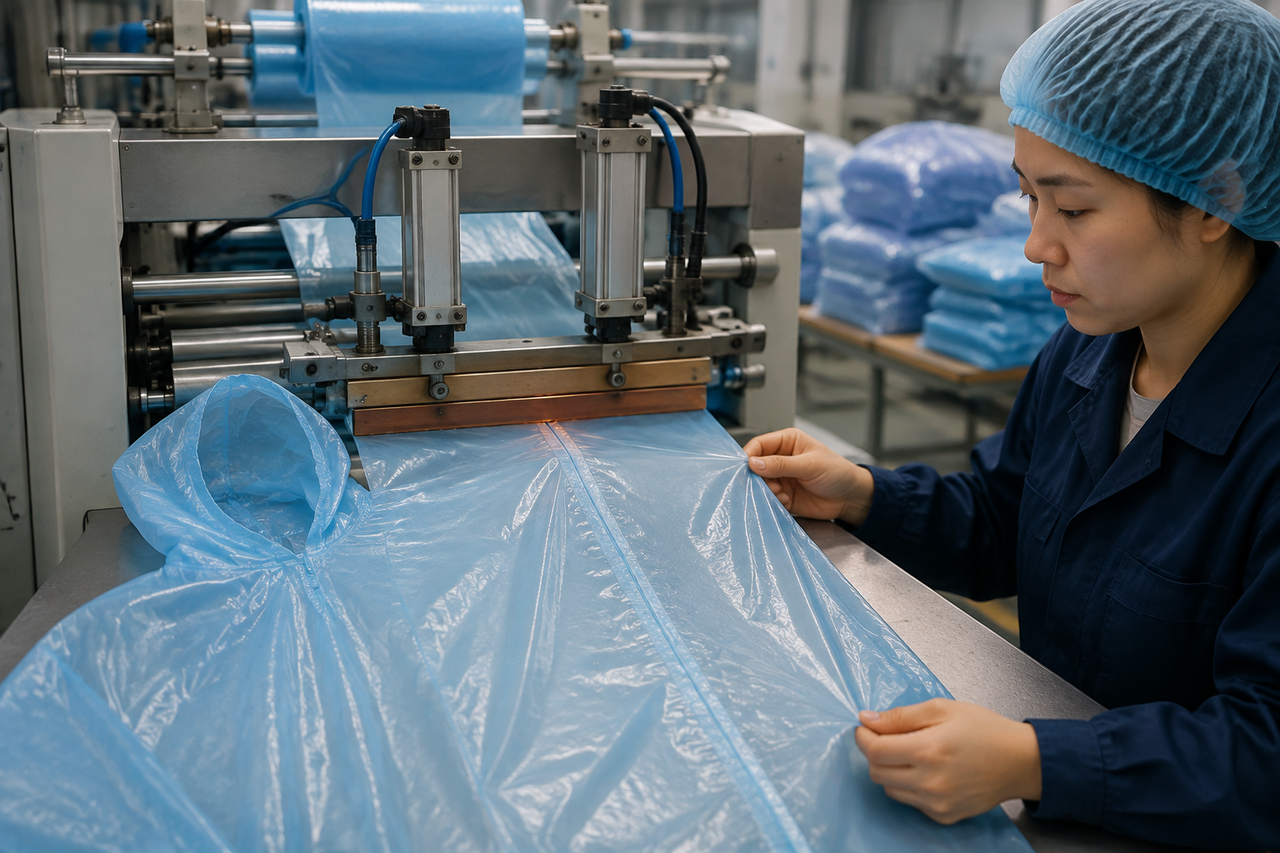
Snap closures are the main construction alternative, and they serve a specific purpose. A fully sealed PE poncho traps heat and condensation quickly, which is uncomfortable for active users. Some buyers prefer side slits or side openings closed with plastic snaps, allowing the wearer to ventilate. The trade-off is honest and unavoidable: every snap is a hole in the film, and water running down the shoulders will find those openings in sustained rain. For emergency distribution where people may stand in weather for hours, a fully welded poncho with no snap openings provides more certain protection. For event staff, sports spectators, or festival giveaways where mobility and airflow matter more than complete waterproofing, snap closures are a reasonable compromise. The term side fold refers to something else — it describes how the poncho is folded flat at the sides for packing, not a seam. Side folds affect pack count, carton cube, and how quickly a volunteer can open and hand out the garment, which is why folding pattern belongs on the spec sheet alongside micron and weld width.
Packaging Formats: Bulk Cartons, Polybags, and Retail-Ready Folding
Disposable PE ponchos are packed in three standard forms — individual polybags, multi-piece polybag bundles, and bulk cartons — and the choice between them changes freight cost, distribution speed, and the labor cost of giving the product away. Retail-ready folding shrinks the packed footprint to roughly a tenth of the opened garment.
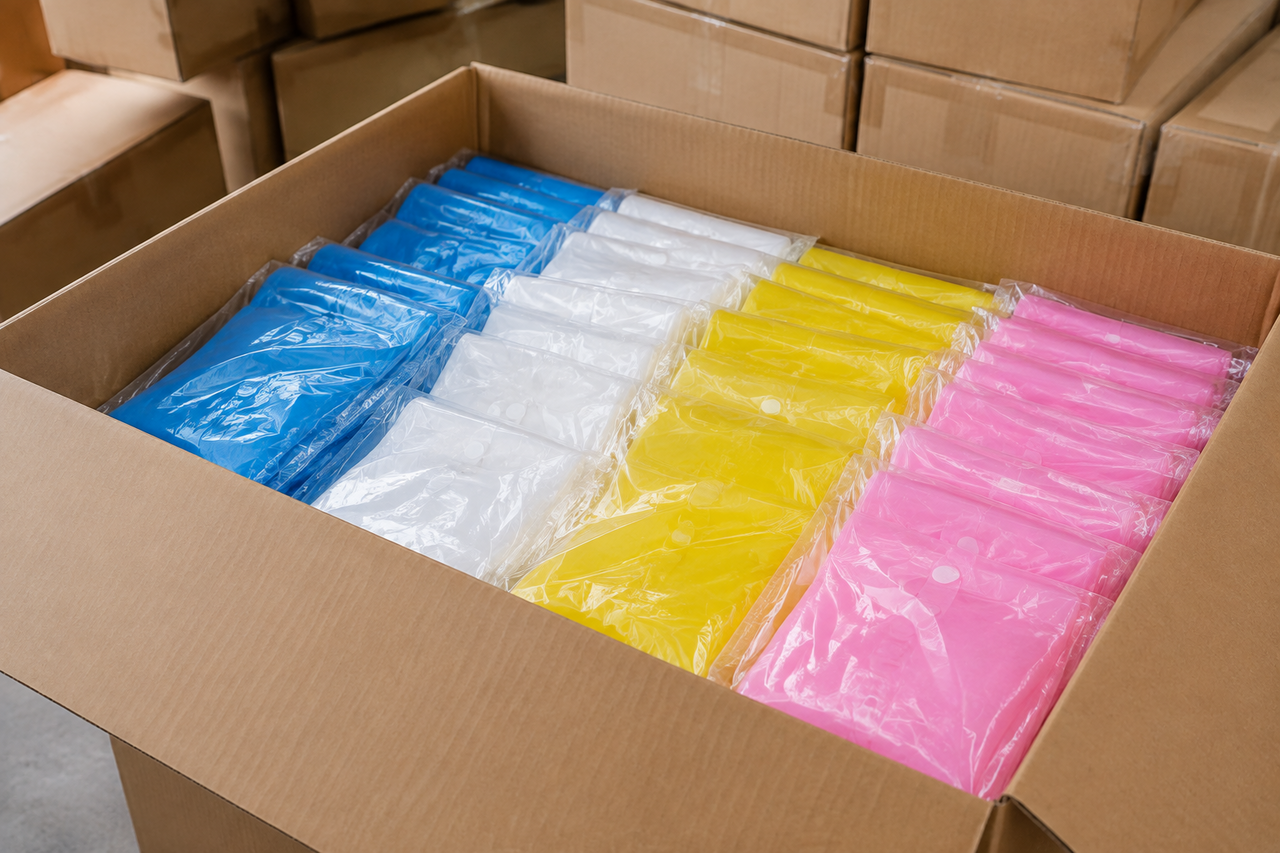
Most wholesale disposable ponchos ship in clear PE polybags, either one per bag or in counted bundles of 10, 25, or 50. Individual polybags protect the poncho from dust and rough handling and make for a clean single-unit handout, but they multiply packing labor and add plastic waste at the distribution site. Bundles of 10 or 25 are the default for emergency programs because they let one volunteer hand out a counted stack in seconds without opening each bag. Bulk cartons are the cheapest per-piece packing — loose folded ponchos in a liner bag inside a five-layer carton — and work well for staged inventory that will be unpacked and repacked by the receiving team.
For further reading, see A Made-in-China supplier listing confirms 5,000-piece MOQs for ponchos..
Packing FormTypical ContentsBest FitIndividual polybag1 piece per bagRetail display, resale, premium giveawayPolybag bundle10–50 pieces per bagEmergency handouts, event distributionLoose in carton100–500 pieces per cartonStaged inventory, lowest unit cost
A buyer planning distribution should compute the packed-unit cost, not just the poncho cost. A 30-micron poncho folded to roughly 10 × 12 cm takes up about as much space as a paperback book; at 40 microns the same fold is thicker and slightly larger. Multiply that by 50,000 units and the difference between 25- and 40-micron film can be a measurable difference in ocean freight and warehouse pallets. Retail-ready folding adds a header card or hang hole so the poncho can be displayed on a peg or shelf without secondary packing. It raises unit cost by a few cents but eliminates repacking labor for distributors that sell rather than give the product away.
Why the Disposable PE MOQ Sits at 5,000 Pieces
A 5,000-piece MOQ on a disposable PE poncho is a cost-recovery threshold, not a sales tactic. Because each poncho sells for pennies, the fixed costs of film sourcing, color masterbatch, die tooling, print plates, and machine setup must be spread across enough units to make the order economically viable.
The logic inverts what most apparel buyers expect. A custom breathable raincoat might start at 500–1,000 pieces per colorway because each unit carries $5–10 of material and labor — a 500-piece order still represents a meaningful revenue batch. A disposable PE poncho at $0.30–$0.60 per piece needs 5,000 units to reach the same $1,500–3,000 order value. The tooling is not the problem; a simple poncho is die-cut from a single film sheet and the sealing dies are relatively cheap. The costs that cannot be avoided are the setup around the tooling: sourcing a dedicated film roll in the right gauge and color, tinting a masterbatch batch, mounting print plates for a logo, running the sealing line for several hours, and inspecting the output. Those fixed costs are similar whether the order is 1,000 or 10,000 pieces, which is why the per-piece price climbs steeply below the MOQ.
Color and print are the biggest levers. A masterbatch bag colors a full film roll, and a small order can leave most of a tinted roll unused — film that may never match another order. A stock clear or single-stock-color poncho with no printing can often be quoted at a lower MOQ, in the 3,000-piece range, because the factory runs those configurations regularly and carries the film in inventory. Custom color, custom print, or retail packaging pushes the practical minimum up toward 5,000 pieces per design. Emergency programs and government tenders almost always order 20,000–100,000 units at a time, so from the factory's perspective a 5,000-piece run is a short, efficient production day — not an unreasonable demand.
The MOQ structure also explains why a factory that quotes identical minimums on ponchos, raincoats, and industrial suits is not looking at its own cost structure. Each category has different material yield, labor minutes, and fixed cost per batch. A buyer comparing suppliers should ask how the MOQ was derived and whether it applies per design, per colorway, or per order consolidation. The answer will tell you more about the factory's planning than about its willingness to negotiate.
Setting Buyer Expectations: Tear Resistance, Shelf Life, and Giveaway Realities
A disposable PE poncho will keep a person dry through a typical downpour but will not survive repeated folding, sharp contact, or high-wind flapping. Plan for single-season life, store it for no more than a few years in cool dark conditions, and budget for a small percentage of film defects regardless of the supplier.
The tear behavior deserves to be stated plainly. PE film has good tensile strength and stretch, but once a nick or puncture begins, the tear propagates easily. The hood weld and the fold creases are the usual first failure points, because they concentrate stress. In our experience running longevity tests, a disposable PE garment is realistically reusable up to about ten times before crease fatigue at the folds or weld degradation becomes visible; after that, expect leaks. That makes disposables unsuitable for any program that implies repeated use. They are designed for a person caught in rain — a commuter, a spectator, a festival attendee, an evacuee — not for a worker who needs rain protection every shift.
Shelf life is the second expectation to calibrate. Stored below 30°C, away from direct light, a PE poncho will typically keep its flexibility and weld integrity for two to four years. Heat is the real enemy. Film stored in a warehouse or vehicle that regularly exceeds 40°C embrittles, and welds lose peel strength long before the calendar suggests a problem. The actual failure mode is oxidation — the polymer chains degrade and the film stiffens — so a hot, sunny storage environment shortens life faster than simple elapsed time. A buyer staging a multi-year emergency reserve should rotate stock, check welds on samples annually, and request film with UV stabilizer if long storage is planned.
For giveaway and emergency programs, set expectations about sizing and coverage rather than fit. Most disposable ponchos are one-size-fits-most, sized by coverage area in the spec sheet rather than by garment measurements. A program serving a broad adult population should choose a larger coverage area even at slightly higher film cost, because the most common field complaint is not leakage — it is a poncho that barely covers the shoulders. And because leaking in a disposable PE poncho almost always originates at welds, snap openings, or pinholes rather than through the intact film, buyers should spend their quality-control attention on construction verification: weld uniformity, closure integrity, and pinhole inspection standards.
What a Buyer Should Verify Before Placing the Order
The procurement sequence for disposable PE ponchos is short, but every step should be tied to a document or a physical test. Start with a pre-production sample, then verify the spec sheet against that sample, then confirm the packing and compliance documents, and finally align the MOQ with your distribution plan.
Take the sample out of the polybag and test it the way an end user will. Fold and reopen it ten times, tug the hood weld, wet it and check the seams, and pull at the side openings if snaps are present. This five-minute exercise reveals more than most spec sheets, because it exposes weld quality and film flexibility — the two properties that determine whether a free poncho actually works when it rains. Then verify the claimed micron with a simple caliper check on a folded edge, and ask the supplier to confirm the resin blend so you are judging tear resistance on the right variable.
The document set should include a spec sheet stating film type, micron, film weight per square meter, weld width, packed fold size, pack count, and carton cube; a material test report covering tensile and tear values; the film MSDS; and a REACH or Prop 65 declaration where your distribution region requires it. If the poncho carries a printed logo, ask for the ink compliance documentation, because print inks and masterbatch colorants are where heavy-metal issues can appear in a product whose base film is clean. Agree on the quality acceptance level in writing — a common standard for these programs is AQL 2.5 for major defects and 4.0 for minor ones — and confirm whether the 5,000-piece MOQ applies per design, per colorway, or across a consolidated order.
Conclusion
Disposable PE rain gear is a simple product with sharp economics, and every important decision — micron, weld method, snap closures, packing form, and order quantity — traces back to how the film is sourced and how the sealing line is run. The buyers who get this product right are the ones who verify the sample, read the material test report, and understand why a 5,000-piece minimum is a cost-recovery number rather than a negotiation posture. Request a sample and a spec sheet from your supplier, run the fold-and-wet test yourself, and confirm the compliance documents before you scale the program.
References
• Raincoat Manufacturing Process for B2B Rainwear Orders
• Film Gauge Thickness: Understanding Conversion and Guide
• Lightweight Emergency Raincoat ...
Frequently Asked Questions
Practical answers related to this article.
What is the typical micron thickness for a disposable PE poncho?
The practical commercial band for a true disposable PE poncho is 25–50 microns, with 25–40 microns as the mainstream band for wholesale and giveaway programs.
Why are disposable PE ponchos welded instead of sewn?
Almost every disposable PE poncho is welded, not sewn, because sewing punctures the film and destroys its water barrier. Heat-sealed welds fuse the film into a continuous bond.
What are the standard packaging forms for disposable PE ponchos?
Disposable PE ponchos are packed in three standard forms: individual polybags, multi-piece polybag bundles (10, 25, or 50 pieces), and bulk cartons. Individual polybags suit retail display, bundles suit emergency handouts, and loose cartons suit staged inventory.
Why is the MOQ for disposable PE ponchos typically 5,000 pieces?
A 5,000-piece MOQ is a cost-recovery threshold, not a sales tactic. Because each poncho sells for pennies, fixed costs of film sourcing, color masterbatch, die tooling, print plates, and machine setup must be spread across enough units to be economically viable.
How do snap closures affect waterproofing compared to fully welded ponchos?
Every snap is a hole in the film, and water running down the shoulders will find those openings in sustained rain. For emergency distribution where people may stand in weather for hours, a fully welded poncho with no snap openings provides more certain protection.
What compliance issues should buyers investigate for disposable PE rain gear?
PE film contains no plasticizer, giving it a simpler profile on REACH and California Prop 65 screening than plasticized PVC. Buyers should investigate additives: masterbatch colorants, print inks, and any antistatic or slip agents, and ask for a material test report and film MSDS.