
How a Southeast Asian Aquaculture Buyer Matched Wader Types to Working Conditions
An aquaculture distributor solved a wader complaint problem by mapping work zones and matching PVC, nylon, and breathable wader types to pond cleaning, netting, and processing tasks.
How to Match Wader Types to Aquaculture Working Conditions
In a typical Southeast Asian aquaculture operation, a familiar benchmark for wader performance is the return pattern. A buyer sells an entry-level PVC chest wader as the budget waterproof option. Returns concentrate in certain zones — harvesting, processing, and a few pond tasks. The complaints usually mention the same things: heat, stiffness, and water inside the boots. In many cases, the waders are not poorly made; they are the wrong type for two of the three jobs they are being used for.
This article uses that pattern as an illustrative scenario. It explains how to match aquaculture workwear — specifically waders, which are a key piece of PPE for aquaculture — to each work zone, and how to consolidate the resulting product mix into a single factory order.
Why One Wader Type Cannot Cover a Working Farm
A common starting point is a catalogue built around one entry-level PVC chest wader, priced for volume sales. It is the cheapest waterproof option in many markets, and it sells accordingly. For one of the three work zones it is the right product. For the other two, it generates complaints that replacements cannot fix.
The error is not manufacturing. It is assuming that "waterproof" is a single requirement. On a working farm, waterproofing is four different requirements: resisting depth, resisting temperature, resisting sustained movement, and resisting chemicals. No single wader construction wins on all four.
Pond Cleaning — Abrasion, Chemicals, and Long Immersion
Pond cleaning happens between harvest cycles. Workers enter drained or partially drained ponds to remove sediment, scrape algae from concrete walls, repair liner sections, and push sludge toward the drainage point. The job is done on the knees as much as on the feet, and a session can run three to four hours without a break.
The conditions punish waders in four ways at once. Abrasion comes first: knees and shins grind against rough concrete and compacted clay. Chemical exposure comes second: lime and chlorine-based disinfectants sit in the remaining water and attack the weakest part of any wader, which is nearly always the seam. Sustained immersion comes third: even shallow water exposes a seam flaw for hours, and a pinhole leak becomes a soaked leg long before the shift ends. Posture comes fourth: bending and kneeling pull a waist-length garment below the waterline, which is why this zone demands a chest-height design even though the water itself is rarely deep.
In the illustrative return pattern, the pond cleaning zone is not where the failures concentrate. The problems begin when the same wader is used for jobs it was never designed to handle.
Netting — Mobility and Quick Changes
Netting and harvesting are nearly the opposite of pond cleaning. A netting crew moves constantly along the pond banks, wades into shallow water to position the net, pulls it toward the bank, and sorts the catch into baskets. Working depth stays below mid-thigh. The pace does not stop, and in Southeast Asia the sun is overhead for most of the shift.
Under those conditions, a PVC chest wader becomes a liability. The material holds heat against the upper body. The tall bib restricts bending when a worker reaches for net floats. The weight tires a crew that walks all day. It is common to see crew members improvise with lighter waist waders bought from a local hardware shop. They prefer those waders because they are lighter and easier to move in. The same waders then fail quickly when they are used for pond tasks that demand abrasion resistance the thin nylon coating cannot provide.
The lesson from this zone is that mobility and quick donning matter as much as waterproofing. A netting crew is in and out of the water dozens of times per shift. Every minute spent adjusting straps is a minute lost from the harvest.
Processing — Heat and Sweat, Not Water
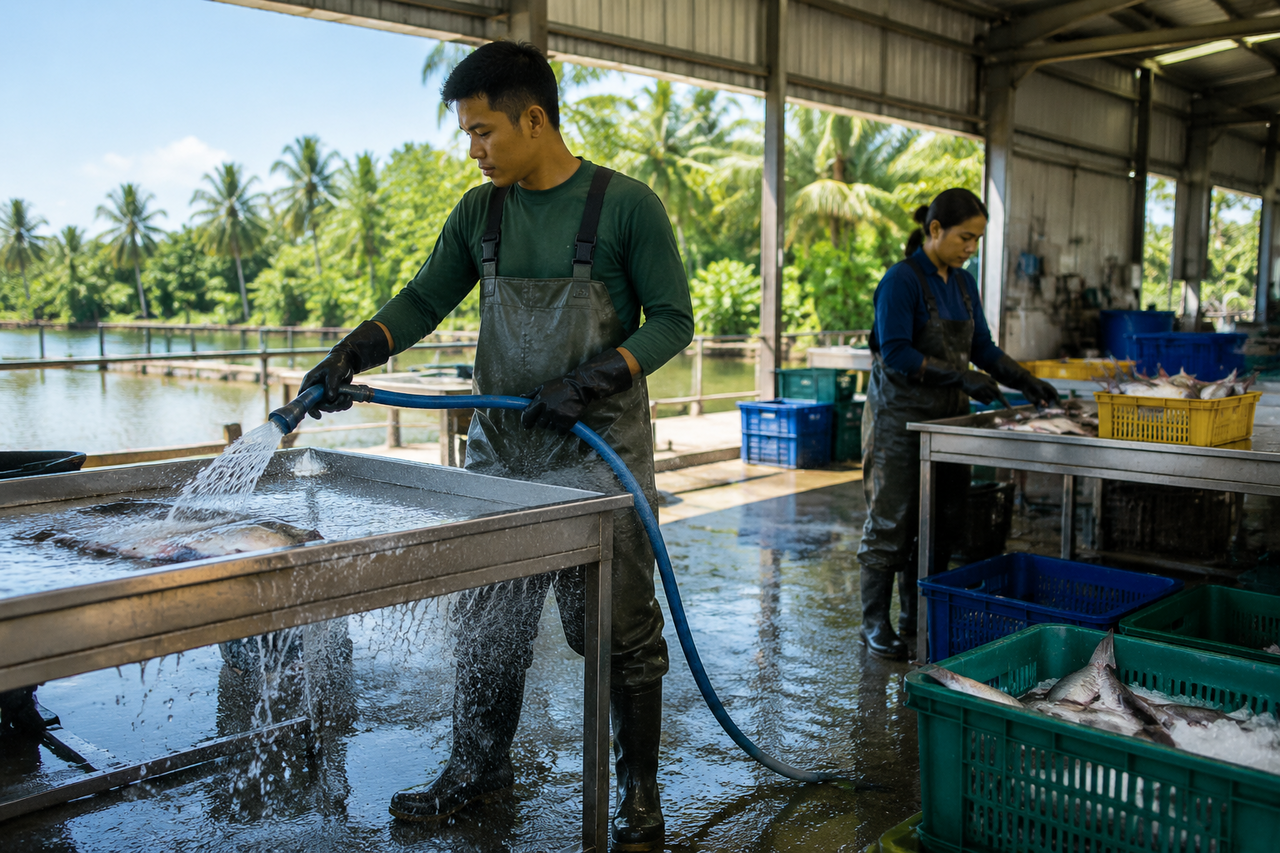
The third zone is the covered processing and packing area. Fish are sorted, washed, and packed on wet concrete floors, with hoses running all shift. Workers stand in place for six to eight hours, and in a tropical processing shed the air temperature regularly passes 30°C.
The complaints from this zone are rarely about leakage. The common complaint is condensation. Workers inside non-breathable waders end their shifts with sweat pooling inside the boots. In a humid climate, prolonged wet skin can contribute to occupational skin irritation, according to the U.S. National Institute for Occupational Safety and Health (NIOSH). Workers in this zone reported discomfort, and the operational concern was time lost to that discomfort. One way to summarize the feedback: the waders kept water in as much as they kept water out.
The processing zone reverses the usual selection logic. The enemy here is not outside water. It is inside water — the sweat the garment traps against the worker's skin.
Matching Aquaculture Workwear to Working Conditions
This framework applies to any aquaculture operation. Four criteria decide the right wader, in order of importance: wading depth, water temperature, working duration and activity level, and chemical exposure. Each of the three common wader constructions — solid PVC, coated nylon, and breathable membrane — wins on at least one criterion. None wins on all four.
Start with depth. Chest waders belong where water comes above the knee. Waist waders suit depths that stay below mid-thigh, where waterproofing is needed without the heat load of a chest garment. Past the knee, a breathable chest wader is the workable option for long tasks, because the alternative is extended time inside a non-breathable shell.
Then temperature. When the workday is warm, roughly above 20°C air temperature, breathable construction should be the priority for anyone who will be moving. In cold conditions, PVC's heat retention is an asset, and its stiffness is the constraint to manage. Coated nylon sits between the two: moderate flexibility, moderate heat retention, and a waist-height form factor that keeps the heat question manageable.
The PVC-versus-breathable decision, in other words, is really a duration-and-activity decision dressed up as a material debate. Finally, exposure. Solid PVC has the strongest chemical resistance of the three common materials, which is why it belongs in zones where disinfectants and lime are part of the daily routine.
PVC Chest Waders for Abrasive Pond Work
For the pond cleaning zone, specify a purpose-built PVC chest wader rather than an entry-level model. The material can be similar; the difference is in construction details.
The first detail is the seam. High-frequency welding — also called radio-frequency welding — uses radio waves to fuse two PVC layers into a single bond. RF welding creates a fused bond with no needle holes, removing a common failure point. This is the first thing a buyer should confirm when ordering PVC waders for aquaculture work.
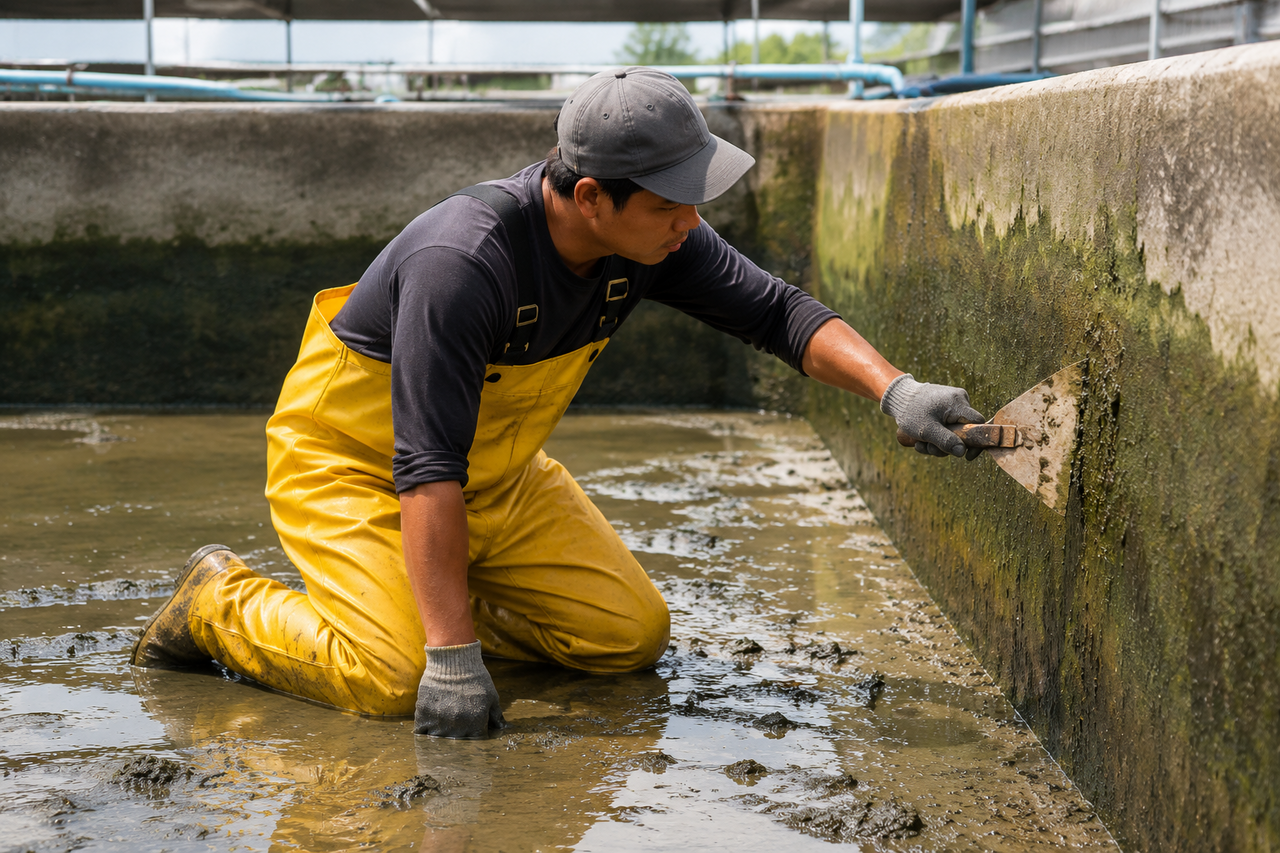
The second detail is reinforcement: an extra PVC layer at the knees and shins, exactly where a worker grinds against concrete. The third is the outsole: a molded, non-slip pattern designed for wet concrete. The fourth is the PVC compound itself. PVC stiffens in cold and softens in heat. A general-purpose compound that works in temperate climates can feel board-like in the tropics, so a softer compound can make a wader flexible enough to kneel in and durable enough to survive the season.
Nylon Waist Waders for Mobile Netting Crews
For the netting zone, choose nylon waist waders. Coated nylon offers moderate flexibility and moderate heat retention, and the waist-height form factor keeps the heat question manageable in a warm climate. The decisive advantages are weight, speed, and freedom of movement.
A waist wader uses far less material than a chest wader, so it is noticeably lighter on a crew that walks pond banks all day. Removing the bib lowers the heat load on the upper body and makes bending easier. A simple drawcord or buckle waist lets a worker pull the waders on in seconds, without adjusting chest straps. For a crew that shifts between dry bank work and shallow water dozens of times per shift, those seconds add up to real productivity.
The trade-offs are equally clear. Nylon waist waders offer less abrasion resistance than PVC, no chemical-grade protection, and a practical depth limit around mid-thigh. Crew leaders should respect that limit, because a waist wader in deep water is a safety hazard rather than a convenience.
Breathable Waders for Warm, Stationary Processing Shifts
For the processing zone, choose a garment that keeps the worker dry on the inside as well as the outside. Breathable waders solve this with a waterproof membrane laminated to an outer nylon shell. The membrane contains microscopic pores — small enough to block liquid water from entering, but large enough to let water vapor from sweat escape. The same principle drives high-end outdoor rainwear, applied here to a standing worker in a tropical shed.
Breathable waders cost more per unit than PVC. The business case is that dryer working conditions reduce reported skin discomfort and support worker retention. That case should be tested with worker-reported feedback before scaling. The practical measure of success in this zone is not a lab result; it is whether workers end a shift with dry socks.
Seam Types and Quality Benchmarks Every Buyer Should Know
Because a buyer may purchase three constructions, it helps to understand three seam technologies. These terms matter because a buyer who cannot describe the seam type cannot compare quotes from different factories fairly.
For PVC waders, the standard is high-frequency welding (RF welding). The machine generates radio waves that heat the PVC molecules and fuse two layers into one. A correct weld contains no holes and creates a fused bond. For EVA, a related material used in lighter waders, a similar heat-fusion process applies.
For coated nylon waders, the usual construction is a polyurethane or PVC coating applied to the inner face of the nylon fabric, with seams either welded or stitched and taped. Stitched-and-taped seams are watertight under light use, but the needle holes remain a weak point under heavy abrasion and chemical exposure. Chene Gear's guide to materials and seams explains the different coating and seam options in detail.
For breathable waders, the membrane is laminated to the fabric and the seams are bonded with waterproof tape. The critical quality point is the joint between boot and leg, which on breathable waders must be both bonded and taped. On PVC waders, the boot is typically fused to the leg in a single molding step, which is why this joint rarely fails there.
The common benchmark for waterproofness is the hydrostatic head test, which measures the water pressure a fabric can resist before leaking; the test method is defined in ISO 811. A higher value means the fabric withstands more pressure. Aquaculture work rarely requires extreme values, because the water pressure on a standing worker is low. What matters more is that the seams and boot joint match the durability of the fabric itself. SITKA Gear's guide to wader types also compares how different constructions are rated and used.
Consolidating Three Wader Types into One Factory Order
Once a buyer has matched a wader type to each zone, the procurement decision begins. The first instinct is to buy each type from the cheapest specialist source: a PVC factory in one country, a nylon garment maker in another, and a breathable wader brand from a third. Three suppliers means three quality audits, three sampling cycles, three sets of labelling requirements, and three shipping schedules that rarely align.
Instead, consider consolidating the entire mix into one factory order. The condition that makes this work is a separate minimum order quantity (MOQ) for each wader type, not one container of a single style. A vertically integrated manufacturer may be able to consolidate these lines within one production cycle.
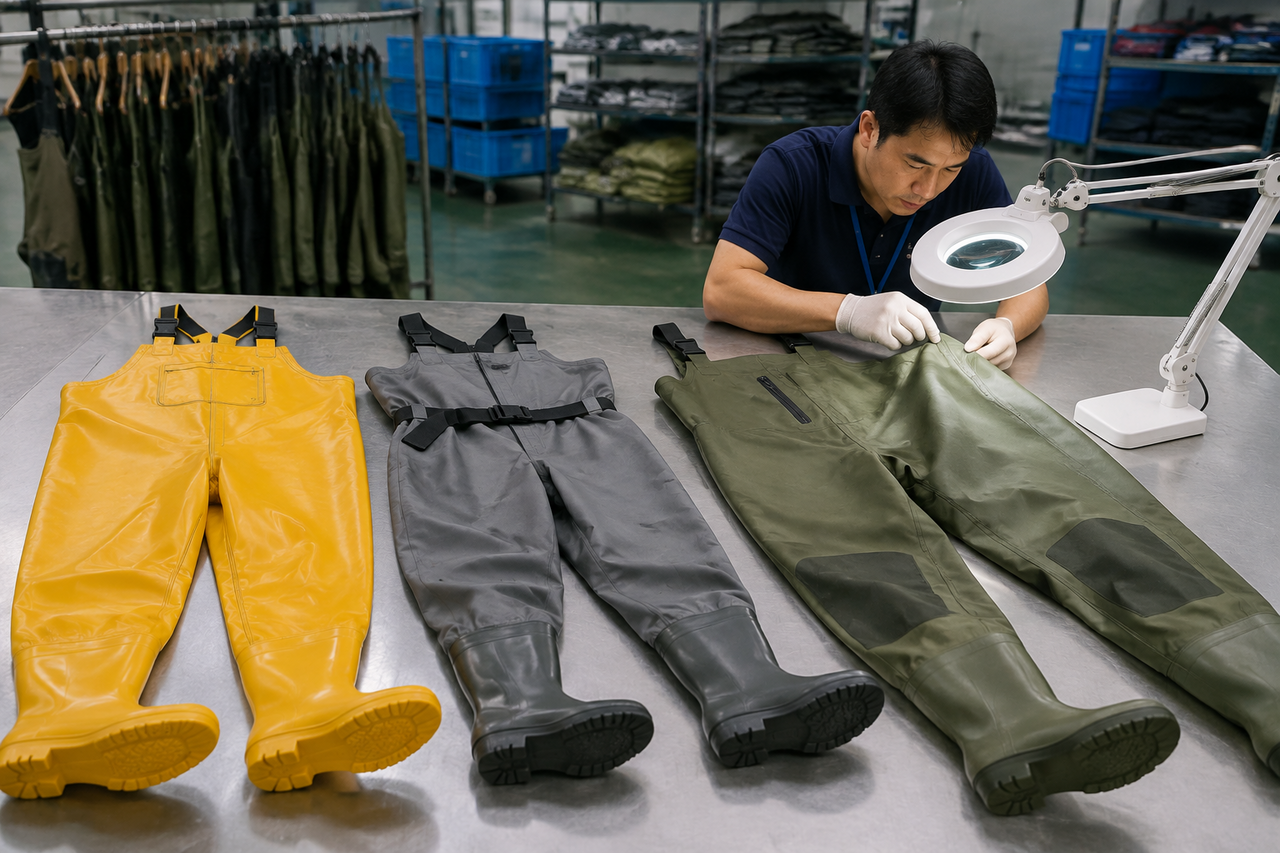
The savings from a consolidated order are not only financial. A consolidated order means one quality-control procedure, one packing specification, and one set of shipping documents. For a buyer planning a regular ordering cycle, that simplification can be worth as much as the unit price difference.
Work zoneDominant conditionsWader typeCritical featuresPond cleaningAbrasion, chemicals, long immersion, kneelingPVC chest waderRF-welded seams, reinforced knees and shins, softened tropical compound, non-slip molded outsoleNettingShallow water, constant movement, frequent donningNylon waist waderCoated nylon, waist-height cut, light weight, quick-adjust waistProcessingWet floors, warm air, stationary long shiftsBreathable chest waderWaterproof membrane, taped seams, bonded boot joint, vapor-permeable construction
The separate-MOQ structure also leaves room for a trial. The breathable line may be new to a market, and the buyer may not know whether customers will accept the higher price. A trial run with a smaller MOQ lets the buyer place the product with a limited number of farms, collect feedback on workers' reported comfort, and adjust the specification before committing to a full season. If the trial results show fewer skin complaints and better retention, the buyer can scale the order in the next season — but those outcomes need to be measured, not assumed.
TianCiGear is a vertically integrated manufacturer: the same factory compounds and cuts the PVC, welds the seams, attaches the boots, and packs the finished garments. According to the company, adding a coated nylon line and a breathable line does not require a second supplier — only a second production station. For a buyer, the potential benefit is one inspection report and one consolidated shipment.
This is a company claim. Ask us for production-line evidence, a recent audit report, or third-party inspection results before basing a sourcing decision on it. A credible supplier should be able to show those documents.
Action Points for Aquaculture Buyers
This scenario does not mean every aquaculture buyer needs three wader types. It means the product mix should follow the work zones, not the other way around. A buyer who runs only pond cleaning has no reason to order breathable waders. A buyer who runs only processing has no reason to pay for reinforced knees.
The practical process is to audit first, then specify. Walk each work zone and record four things: the maximum working depth, the air and water temperature, how long workers stay in the water and how much they move, and whether chemicals are present. Only then choose between PVC, nylon, and breathable construction. Once the mix is clear, look for a single manufacturer that can produce all three types in one order, with separate MOQs per line and one inspection standard.
Wader Specification Checklist
Use this checklist when you walk a farm or compare quotes:
• Maximum working depth per zone
• Air and water temperature by season
• Typical shift length and activity level
• Chemical exposure and cleaning schedule
• Seam type required for each wader construction
• Boot joint construction
• MOQ per product line
• Inspection and testing requirements
Take this checklist to your next factory conversation. For sourcing inquiries, ask TianCiGear to walk you through how it would structure a mixed-MOQ wader order for aquaculture workwear.
Key Takeaways
• No single wader type can cover pond cleaning, netting, and processing on the same farm. Each zone has different depth, temperature, activity, and chemical conditions.
• Choose wader construction by four criteria in order: wading depth, water temperature, working duration and activity level, and chemical exposure.
• Solid PVC chest waders with welded seams suit abrasive, chemical, long-immersion pond work. Nylon waist waders suit shallow, mobile netting tasks. Breathable chest waders suit warm, stationary shifts where sweat is the main complaint.
• Consolidating mixed wader types into one factory order with separate MOQs reduces logistics complexity, keeps quality standards consistent, and lets buyers trial new lines with smaller commitments.
References
Chene Gear. "Materials and Seams." https://chenegear.com/blogs/explore-chene-gear/materials-and-seams
U.S. National Institute for Occupational Safety and Health. "Skin Exposures and Effects." https://www.cdc.gov/niosh/topics/skin/default.html
SITKA Gear. "6 Types of Waders: A Hunter's Guide." https://www.sitkagear.com/experience/types-of-waders
Frequently Asked Questions
Practical answers related to this article.
What are the four criteria for choosing the right wader in aquaculture?
The four criteria, in order of importance, are wading depth, water temperature, working duration and activity level, and chemical exposure.
Which wader type is recommended for pond cleaning work?
A purpose-built PVC chest wader with high-frequency welded seams, extra PVC reinforcement at the knees and shins, a molded non-slip outsole, and a softer PVC compound for tropical climates.
Why are nylon waist waders preferred for netting crews?
They are lighter, allow faster donning, and provide freedom of movement. They reduce heat load and make bending easier, which suits crews that move constantly and shift between dry bank and shallow water.
What is the main concern for workers in the processing zone?
The main complaint is condensation or sweat pooling inside non-breathable waders, not leakage. Breathable waders are recommended to keep workers dry on the inside.
What seam technology is standard for PVC waders?
High-frequency welding (RF welding) is the standard; it fuses PVC layers without needle holes.
How can a buyer consolidate three wader types into one factory order?
Consolidate the entire mix into one factory order, with a separate minimum order quantity (MOQ) for each wader type, rather than using multiple suppliers.