
How an E-commerce Brand Launched a Private Label Rainwear Line with a 500-Piece MOQ
Discover how an e-commerce brand used a 500-piece minimum order quantity on standard raincoats to test demand, verify quality, and scale into a private label rainwear line.
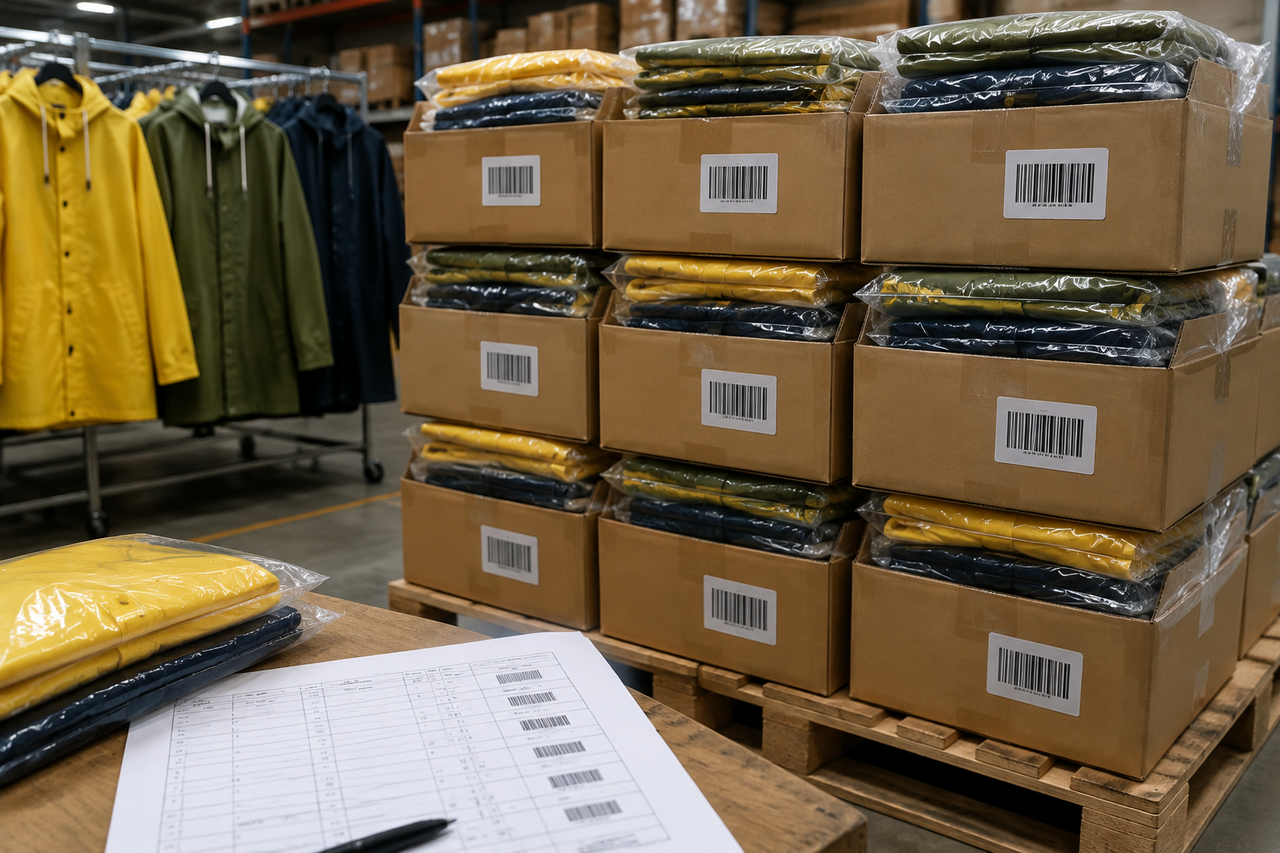
Private Label Rainwear for E-Commerce: A 500-Piece MOQ Launch Strategy
A 500-piece minimum order quantity is enough to launch a private-label rainwear line when the product is chosen from a factory's standard range rather than developed from scratch. For e-commerce rainwear, this approach sits between drop-shipping and a container commitment: an e-commerce seller can order a first batch of standard raincoats, brand the packaging, verify the product against a pre-production sample, and use actual sell-through data to decide whether a scale-up into OEM raincoats is justified. Rainwear manufacturing is structured around standard configurations — stock material, stock colors, and packaging the factory already runs regularly — which is why the MOQ can stay small for a first test. To understand how a manufacturer structures this work, see our OEM and private label rain gear services page.
The example used throughout this article is an illustrative composite, not a single documented client case. The decisions and numbers are typical of how a B2B buyer approaches a seasonal category, and the results are described as conditions to test rather than events that have already occurred.
For an online retailer, the problem is familiar to any seller looking at a seasonal category. Rainwear demand is real, but it is weather-dependent, and weather does not follow a forecast the way a purchase order does. A seller might have an established outdoor-gear store on a major marketplace, steady search volume for raincoats in spring and autumn, and no way to know which styles, colors, and price points would actually convert. The obvious response, importing a container of rainwear, is also the risky one.
Rainwear Manufacturing MOQs for E-Commerce Brands
An e-commerce brand entering rainwear faces a supply chain built for large institutional orders, where minimums of 5,000 to 100,000 pieces are common in some segments. These ranges vary widely by factory and are illustrative only. A container-size first order forces the seller to forecast weather-dependent demand before any real sales data exists, which is exactly the risk a test batch is designed to remove.
Most rain-gear factories structure their economics around big buyers. Emergency programs and government tenders order 20,000 to 100,000 units at a time, and from the factory's perspective a 5,000-piece run is a short, efficient production day. Disposable PE ponchos in a custom color or with printing typically start at 5,000 pieces per design, because a masterbatch bag colors a full film roll and a small tinted run leaves film that may never match another order; again, these figures are illustrative and vary by supplier. None of that matches the risk profile of an online retailer that is still proving demand.
A container of raincoats represents cash tied up in inventory, warehouse space, and a forecast the brand is not yet equipped to make. Raincoat sales are lumpy. A wrong bet on color, on sleeve length, or on the balance between packable lightweights and heavier industrial styles can sit in storage for a season or more. A seller might see competitors list raincoats with thin margins and weak product photography — an apparent opening — but the same observation warns that the category punishes careless buying.
The alternative is a test batch: a few hundred pieces, branded, photographed, listed, and measured against real customer behavior. The only question is whether any rain-gear factory will take such a small order seriously. That is where a factory's standard raincoat program and a 500-piece example MOQ change the calculation.
Why a 500-piece MOQ on standard raincoats works for a first order
The 500-piece MOQ in this illustration exists because standard raincoats use stock material, stock colors, and established patterns that the factory runs regularly, so the fixed costs of a production run are already understood. The minimum is not a one-size-fits-all number; it is tied to a specific configuration (in this example, the factory's standard raincoat range — not a named supplier's actual price sheet).
A factory derives an MOQ from its own cost structure, not from what the market will tolerate. Each product category has different material yield, labor minutes, and fixed cost per batch, and the minimum is the point at which those fixed costs can be absorbed. The disposable PE range sits at 5,000 pieces because a masterbatch bag colors a full film roll, and a short custom-tinted run leaves expensive film sitting idle. A standard raincoat in a stock color is a different calculation: the material is on the shelf, the pattern is already graded, the seam-sealing station is already set up, and the cutting and sewing times are known from previous runs. The marginal cost of a short run is much lower, so the MOQ can be too.
The table below shows how different configurations change minimums, using the illustrative numbers discussed above.
ConfigurationWhat changes the MOQIllustrative minimumStandard raincoat, stock material and stock colorsMaterial on hand; pattern already graded; sealing station set up500 pieces (example)Disposable PE poncho, custom color or printMasterbatch colors a full film roll; partial tinted runs may not be reusable~5,000 pieces per designInstitutional or emergency contractTender volume and specification drive the run20,000–100,000 units
For further reading, see Argus Apparel's guide to MOQ in clothing manufacturing.
This is why a buyer comparing suppliers should ask how the MOQ was derived and whether it applies per design, per colorway, or per order consolidation. A factory that quotes identical minimums on ponchos, raincoats, and industrial suits is probably not looking at its own cost structure. The 500-piece raincoat MOQ is meaningful precisely because it is scoped to a standard configuration. The moment a buyer requests custom colors, custom print, or retail packaging, the practical minimum moves up, because the factory must now account for setup, plates, and material that might not be reused.
For further reading, see New Asia Garment's small-batch private label guide.
For the e-commerce seller, the 500-piece MOQ changes what a first order can prove. Five hundred units is small enough to fund without a credit line and large enough to split meaningfully across a limited size run. In the composite example, the seller chose two stock colors and five sizes, which gave roughly fifty units per size-color combination. That is not enough to win a category, but it is enough to learn which color carries the season, which sizes cluster, and whether customers keep the product or send it back.
Selecting materials, colors, and packaging from the factory's existing range
Entry-level private label should start with the factory's existing range because custom color, custom print, and custom retail packaging raise the practical minimum order. For rainwear, the buyer's first decision is material, and each material carries a different waterproof rating, cost, and consumer feel. You can compare standard stock options in our rainwear category.
Material options
The factory's standard raincoat range typically offers three main material families. PU-coated polyester is the closest to what a consumer thinks of as a real raincoat: a woven face, a measurable hydrostatic head, a better hand feel, and a price point that supports retail margins. PVC is heavier, tougher, and more industrial, with a higher perceived durability but a stiffer drape that photographs less flatteringly. PEVA is lightweight and low-cost, but it reads as disposable, which limits the price a brand can attach to it. For an online seller selling to consumers, PU-coated polyester is usually the right entry point, because the product feels worth the price when the customer opens the package.
Choosing from the existing range is what keeps the MOQ at 500. A custom color requires a masterbatch run, which colors a full batch of material; custom print requires plates and setup time; custom retail packaging with hang tags and inserts pushes the practical minimum toward the thousands. A seller might select two stock colors, a safety yellow and a navy, and keep the packaging simple: a standard polybag with the brand's own label and a barcode sticker. That small packaging decision preserves the 500-piece MOQ and still gives the product a branded feel at unboxing.
Material weight and coating matter for claims too. A 190T PU-coated polyester with a higher coating weight will support a stronger waterproofing claim than a thinner film laminate, and the hydrostatic-head test report will say so. The buyer's job at the selection stage is to match the material to the claim it intends to make, not to guess from the fabric swatch. That is why the next stage, the pre-production sample, is the point where the whole program stands or falls.
Verifying quality through pre-production samples
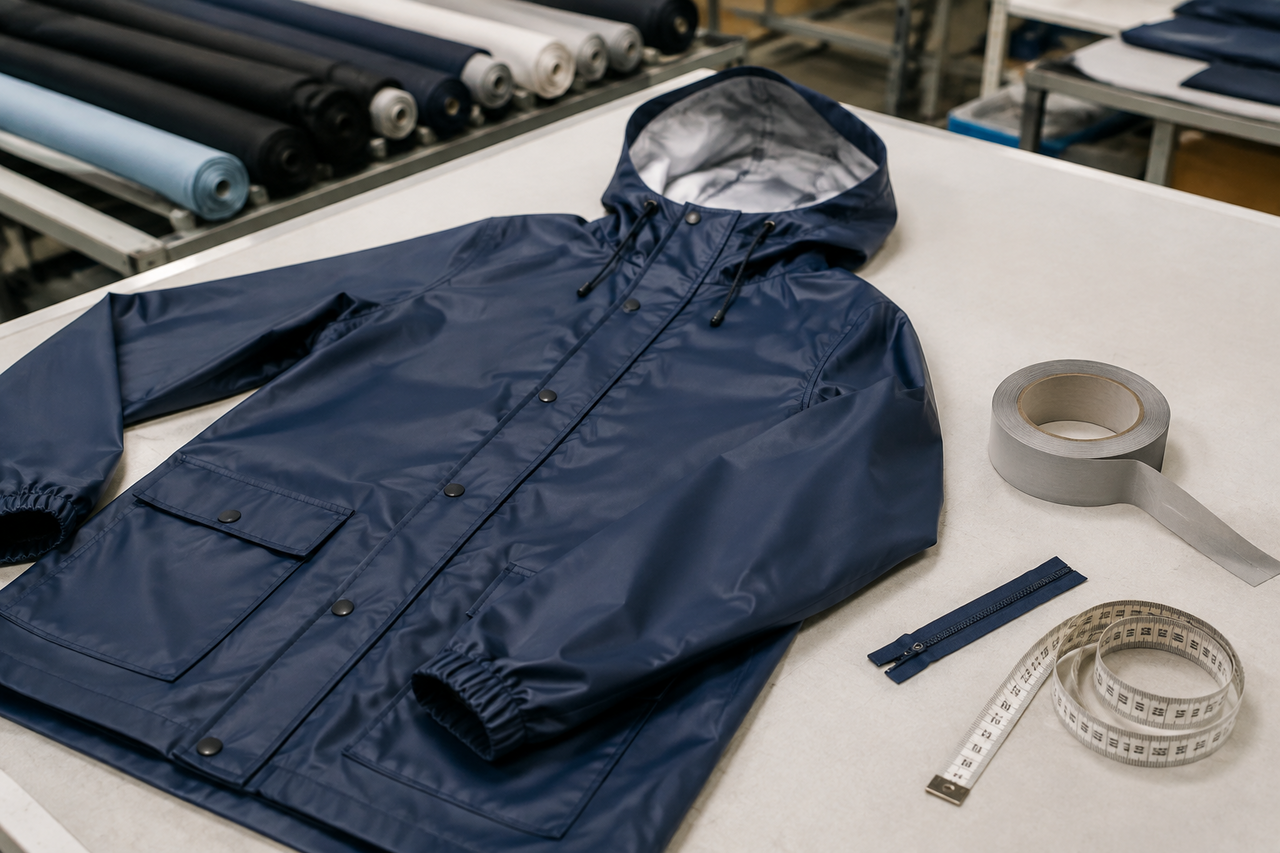
A pre-production sample is the verification point where every listing claim is tested: seam construction, zipper durability, grade rules, and packaging. The factory should provide a hydrostatic-head test report for the finished seam, an SDS for coatings and adhesives, and a contract with the inspection clause included.
Hydrostatic Head Testing: Verifying Waterproofing Claims
Hydrostatic head testing measures the height of a water column a material can support before water penetrates, expressed in millimeters. The raw film typically tests better than the finished garment, because sewing needle holes create the weakest path for water. The test that matters is the one run against the finished seam, after sealing. A buyer should ask the factory for the seam-level hydrostatic-head report before approving the sample, alongside the material test for the raw film. Comparing the two numbers shows exactly how much performance the seam-sealing process preserves.
The pre-production sample should then be run through the same four checks the factory uses for its own quality control, in this order:
Seams
Confirm the seam-sealing method and tape width, and review the hydrostatic-head report against the finished seam rather than only the raw film.
Zippers
Cycle-test every closure repeatedly and record the zipper brand and type on the spec sheet so later batches can be checked against it.
Grade rules
Measure the sample in every size against the grade rule table. Size drift is a common cause of fit-related returns, which is why measuring grade rules on each sample is important.
Packaging
Verify the polybag, label, barcode, and carton dimensions before committing to printed packaging for a full run.
The buyer should also request two documents before the sample ships: the Safety Data Sheet for the coating and adhesive, and a sample sales contract with the inspection clause written in. The SDS matters because marketplace compliance teams and customs brokers occasionally ask for chemical documentation, especially for coated materials. The inspection clause matters because it defines, before production, what constitutes an acceptable batch and who pays for an unacceptable one. A factory that shares these documents openly is a factory that can be trusted with a brand.
Building listings on claims you can verify
Product listings for rainwear live or die on claims about waterproofing, and every claim should trace to a document. Photo detail shots of sealed seams and tested zippers reduce returns, while copy that overstates a hydrostatic-head rating creates chargeback risk.
The listing photography should be built around the verification work done earlier. The main image might show the raincoat worn by a model in a neutral studio setting, which is the shot that tells a customer how the garment fits and moves. Secondary images zoom into the taped seams, the zipper hardware, and the size chart derived from the grade rules. Those detail shots are not decorative. They answer the two questions that drive rainwear returns: does it look like the photos, and will it keep me dry.
The copy team should be held to a simple discipline: every claim must be traceable to a document the brand actually holds. The table below shows how a listing can be mapped before publishing.
Mapping listing claims to documents
Listing claimVerification documentWhat to checkWaterproof ratingHydrostatic-head test reportConfirm the test covers the finished seam, not only the raw filmSeam-sealed constructionSeam-sealing spec and tape widthVerify the method matches the approved pre-production sampleZipper durabilityZipper brand, type, and cycle-test recordCompare incoming batch samples against the recorded zipper specSize accuracyGrade rules and size spec sheetMeasure every carton size against the approved grade rules
The waterproofing claim should be worded carefully. Where the hydrostatic-head report supports "waterproof," the listing can use it; where the number is marginal, the listing should say "water-resistant" and let the test report back the distinction. This matters more on marketplaces than on a brand's own site, because marketplace policy teams and customer disputes are both document-driven. Accurate listing claims and a retained test report reduce the risk and can strengthen a seller's defense in a dispute; the test report is the evidence that the product did what the listing said.
Photography also carries the seller's limited color choices. Safety yellow photographs vividly and reads as serious rainwear; navy reads as more urban and versatile. Neither color requires retouching to look accurate, which reduces the risk of customers receiving a product that does not match the screen. If reviews within the first weeks mention the taped seams and the accurate fit, those are precisely the attributes the sample was chosen to prove — but they are confirmation criteria, not guaranteed outcomes.
The sales data that justifies a larger OEM raincoats program
A 500-piece test batch generates the data that no survey can provide: actual sell-through, return reasons, and review language from customers who paid the seller's price. That data, not the initial demand estimate, is what justifies the move to a larger OEM raincoats program.
A test batch is never going to make a brand rich. Its job is to answer specific questions, and the answers come from the marketplace dashboard rather than from the sales forecast. Sell-through within the season tells the seller whether the product moved at its price point. Return reasons tell it whether fit, perception, or performance was the problem. Review language tells it which attributes customers noticed and repeated, which feeds directly into both ad copy and product development. Behavioral sell-through data is hard to capture before a listing; a small test batch is one of the fastest practical ways to obtain it.
A buyer should set three conditions before reordering. First, sell-through should be strong enough in the core sizes to indicate genuine demand rather than curiosity. Second, the return rate should stay low enough that the waterproofing claim is not causing disputes. Third, at least some customers should mention the raincoat in reviews or return to the store to buy a second color. Those conditions are deliberately measurable, and they should be reviewed against the actual data rather than against hopes for the category.
When a reorder is justified, it is no longer a 500-piece standard run. The recommended scale-up path is a larger OEM raincoats program with negotiated changes: an additional colorway, a slightly refined cut based on the return-size analysis, and branded packaging that a first order's economics cannot support. Custom colors and custom packaging raise the practical MOQ because they involve masterbatch runs, setup, and material that may not be reused, but the volume behind the reorder absorbs those fixed costs. What was once a risk becomes a documented decision.
The reorder should also keep the discipline of the first batch. The factory should produce a new pre-production sample for the refined cut, record the zipper spec and seam-tape width against the prior batch, and provide a hydrostatic-head report for the new material lot. Scaling up does not mean relaxing verification; it means applying the same checks to a larger commitment. The result is a private-label rainwear line with real sales history, a supplier relationship built on documents, and a category position earned with 500 pieces rather than a container of guesses.
The next step: turning verification into a scale-up plan
The path from a 500-piece test to a private-label rainwear line is a process of verification, not persuasion. Every stage — from range definition to sample approval to reorder — is governed by documents that can be checked and compared: test reports, spec sheets, inspection clauses, and batch records. The sales data decides the scale, but the documents decide the trust.
For a brand starting the same process, the first move is to ask a shortlisted manufacturer for three things: a hydrostatic-head test report for the proposed material, an SDS for the coating and adhesive, and a sample sales contract with the inspection clause written in. Then request a pre-production sample and run it through the four checks: seams, zippers, grade rules, and packaging. Those checks tell you more about the factory than any brochure, and they tell you more about your product than any supplier presentation.
The 500-piece MOQ on standard raincoats is not a limitation; it is an invitation. It lets an e-commerce brand test a seasonal category with a modest, bounded risk, learn from real customer behavior, and return to the factory with data instead of guesses. When the reorder comes, the same verification process scales with it, and the brand's rainwear line becomes something it owns rather than something it merely imported.
References
• Private Label Apparel Manufacturing: MOQ & Costs
• Argus Apparel's guide to MOQ in clothing manufacturing
• New Asia Garment's small-batch private label guide
Frequently Asked Questions
Practical answers related to this article.
What is the advantage of a 500-piece MOQ for an e-commerce brand launching rainwear?
A 500-piece MOQ allows the brand to order a first batch of standard raincoats, brand the packaging, verify the product against a pre-production sample, and use actual sell-through data to decide whether a larger OEM program is justified, rather than committing to a container-size order.
Why can the MOQ be as low as 500 pieces for standard raincoats?
Because standard raincoats use stock material, stock colors, and established patterns that the factory runs regularly, so the fixed costs are understood and the marginal cost of a short run is lower. Custom colors, prints, or retail packaging raise the practical minimum.
Which material is recommended for an online consumer rainwear line?
PU-coated polyester is usually the right entry point because it offers a woven face, a measurable hydrostatic head, a better hand feel, and a price point that supports retail margins. PVC is heavier and more industrial, while PEVA reads as disposable.
What four checks are performed on the pre-production sample?
The checks are: 1) Seams: confirm seam-sealing method and tape width, and review the hydrostatic-head report against the finished seam. 2) Zippers: cycle-test and record the zipper brand and type. 3) Grade rules: measure the sample in every size against the grade rule table. 4) Packaging: verify the polybag, label, barcode, and carton dimensions.
How should product listings be built to avoid overpromising?
Every claim must trace to a document the brand holds, such as using "waterproof" only when the hydrostatic-head report supports it and "water-resistant" for marginal numbers. Detail shots of sealed seams, zippers, and size charts help reduce returns.