
What MOQ and Lead Time Should E-Commerce Sellers Expect for Private Label Electric Bike Rain Ponchos?
Semi-custom electric bike rain ponchos start at 500 pieces with 25-30 day lead times, while fully custom designs require 1,000+ pieces and 35-40 days. Learn how material choice, seam type, and compliance testing affect minimums and production schedules.
Direct Answer: MOQ and Lead Time for Private Label Electric Bike Rain Ponchos
Private label manufacturers typically offer e-commerce sellers two entry points for private label electric bike rain ponchos. Semi-custom ponchos—where a logo is printed on a stock EVA or PVC rider poncho design—commonly start at 500 to 1,000 pieces with lead times of 25 to 35 days from deposit to shipment. Fully custom designs, where the buyer specifies material, color, cut, handlebar coverage width, and proprietary features, generally require 1,000 to 2,000 pieces and take 35 to 45 days. Most manufacturers can produce samples within 7 to 12 days for either path, allowing e-commerce brands to confirm fit, branding placement, and water resistance before committing to bulk production.
These minimums sit well below the thresholds used in disposable poncho manufacturing, where orders often require significantly higher minimums—in some cases 3,000 pieces or more. Rider ponchos occupy a different segment, involving reusable materials, smaller batch dye lots, and pattern pieces engineered for handlebar coverage and extended back length. The MOQ reflects the cost structure of those specialized elements rather than the simpler die-cut films used in emergency rainwear.
Why Rider Poncho MOQs Differ from Standard Raincoats and Disposable Ponchos
Electric bike rain ponchos are not scaled-up versions of pedestrian raincoats or simplified disposable ponchos. The design demands extended front length to cover handlebars and controls, a rear flap that drapes over a cargo rack or backpack, and sleeves angled to accommodate forward-leaning riding posture. These pieces are cut from EVA or PVC film that is thicker than disposable PE, which changes material consumption per piece and requires different sealing equipment.
A standard raincoat uses a front panel, back panel, two sleeves, a hood, and a zipper closure. Each garment typically consumes approximately 1.8 to 2.2 meters of fabric depending on size and pattern, and assembly involves sewing seams, attaching the zipper, and heat-sealing critical joints.
A rider poncho uses one large front panel that extends below the knees, a similarly long back panel, extended sleeves, and a visor hood. Material consumption per piece may reach 2.5 to 3.0 meters due to extended front and rear panels. Actual consumption varies by manufacturer and design. That difference alone pushes the MOQ breakeven point lower than it would be for a disposable PE poncho, where a single die-cut operation produces the garment in one pass.
Disposable PE ponchos are optimized for emergency distribution and event programs, where buyers order 5,000 to 100,000 pieces at a time. Disposable PE ponchos commonly use film in the 0.02 to 0.03 mm range, while reusable EVA rider ponchos are typically manufactured from 0.15 to 0.20 mm film, though some heavy-duty models use thicker material. The entire garment is sealed in one heat-press cycle without sewing. The masterbatch (a concentrated pigment mixture used to color plastic film) that tints the film colors a full roll, so a custom-color order below 5,000 pieces leaves unused material that cannot be economically held for a future reorder. Rider ponchos use pre-colored EVA or PVC stock purchased in smaller rolls, and each order can draw from standing inventory if the buyer selects a standard color. That flexibility allows manufacturers to offer 500 to 1,000 piece minimums for semi-custom orders without leaving waste on the line.
The cutting pattern itself also affects MOQ. A disposable poncho is a flat rectangle with a head opening, so a factory can nest dozens of pieces per meter of film and run thousands in a shift. Rider poncho patterns include contoured sleeves, a hood with a brim, and front and back panels that are wider at the shoulders than at the hem. Nesting efficiency drops, which increases the material cost per piece and raises the threshold at which a custom order becomes profitable. When a manufacturer quotes 500 to 1,000 pieces for a semi-custom poncho, they are absorbing some of that inefficiency because the buyer is only requesting logo printing rather than a new pattern or material color.
MOQ Tiers and What Each Customization Level Includes
MOQ structure ties directly to the number of production variables the buyer wants to change. The tiers reflect setup cost, material procurement minimums, and the complexity of quality control across a batch.
500 to 1,000 Pieces: Semi-Custom Branding
The buyer selects a standard EVA or PVC rider poncho design in an existing color—typically black, navy, army green, or fluorescent yellow—and provides artwork for screen printing or heat-transfer logo placement. The factory uses film already in inventory, runs base production on a regular schedule, and adds the branding step at the end of the line. Lead time is 25 to 35 days because no new tooling or material ordering is required. This tier suits an e-commerce seller testing a new SKU or a brand launching its first private-label rainwear without committing capital to a container-sized order.
1,000 to 1,500 Pieces: Custom Color and Material
At this threshold, manufacturers order a masterbatch to tint EVA or PVC film to the buyer's specified Pantone color, or source a different base material such as TPU-coated polyester or PEVA with a matte finish. The dye lot is sized to color enough film for the full order plus a small buffer, but smaller quantities leave excess that is difficult to match in future runs. Buyers can also request specific material thickness—0.15 mm for lightweight city riding or 0.20 mm for touring and cargo bike use—and factories adjust sealing temperature and dwell time accordingly. The buyer can still choose a standard rider poncho pattern, or request minor modifications such as sleeve length adjustment or additional reflective piping. Lead time extends to 35 to 40 days to allow for film production, incoming QC on the custom material, and sample approval before bulk cutting begins.
2,000+ Pieces: Fully Engineered Design
This tier is for brands that want proprietary features: a patented handlebar sleeve closure, an integrated phone pocket with a waterproof zipper, underarm venting grommets, or a two-layer construction with a breathable inner lining. Manufacturers develop a new pattern, create custom cutting dies if shapes differ significantly from stock templates, and run trial samples to verify seam strength and water-penetration resistance under simulated rain. The MOQ reflects the cost of that development work, the need to purchase specialty materials such as YKK waterproof zippers or 3M Scotchlite reflective tape, and the additional QC steps required to confirm that every piece meets specification. Lead time can reach 40 to 45 days if compliance testing is required—for example, EN 343 waterproofness and breathability certification for a European buyer, or EN ISO 20471 high-visibility testing if the poncho includes reflective elements for road safety.
These minimums are set by the cost structure on the production floor, not by arbitrary negotiation limits. A factory that offers the same MOQ for logo printing and for fully custom design is either subsidizing the development cost in the unit price or skipping the sample and testing steps that prevent quality problems in the bulk order. When an e-commerce buyer asks whether a manufacturer can lower the MOQ, the answer depends on which variables they are willing to freeze. If they accept stock color, existing pattern, and standard packaging, 500 to 1,000 pieces is workable. If they want everything customized, the fixed costs must be spread over at least 1,000 to 2,000 pieces to keep the unit price competitive with alternatives.
Lead Time Breakdown: From Sample Request to Final Shipment
Lead time is not a single figure. It is the sum of every milestone in the production sequence, and each milestone has a range that depends on how quickly the buyer responds to proofs and whether any revisions are needed.
Sampling: 7 to 12 Days
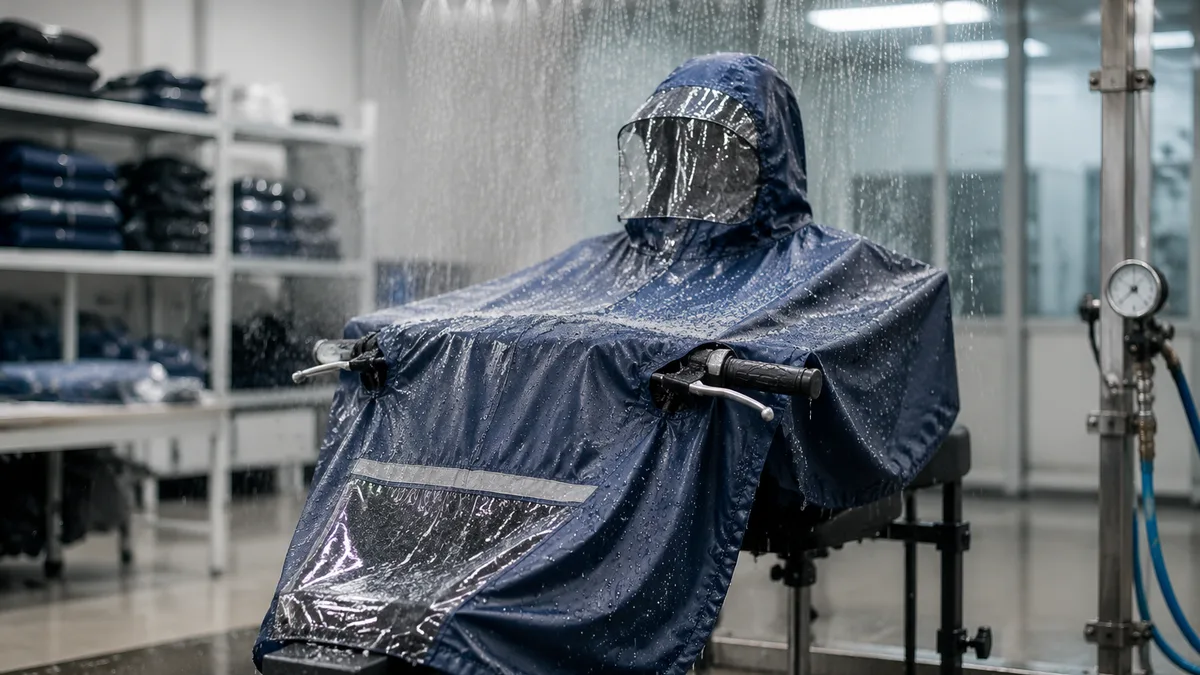
When a manufacturer receives a sample request with artwork, material preference, and size specifications, material is pulled from stock or a small custom film run is ordered. One or two pieces are cut by hand or on a short die-cut run, the logo is applied using standard printing methods, and seams are sealed. The sample is then tested for water penetration by spraying it for five minutes under an in-house shower rig, checked for logo adhesion by stretching the printed area, and photographed from multiple angles. The sample ships with a spec sheet that lists material thickness, total weight, folded dimensions, and waterproof rating. If the buyer requests revisions—such as moving the logo position, increasing sleeve length, or changing the hood drawstring—those changes are incorporated and a second sample is produced. Each revision round adds three to five days, so the total sampling window can extend to two weeks if multiple iterations are needed.
Bulk Production: 20 to 25 Days
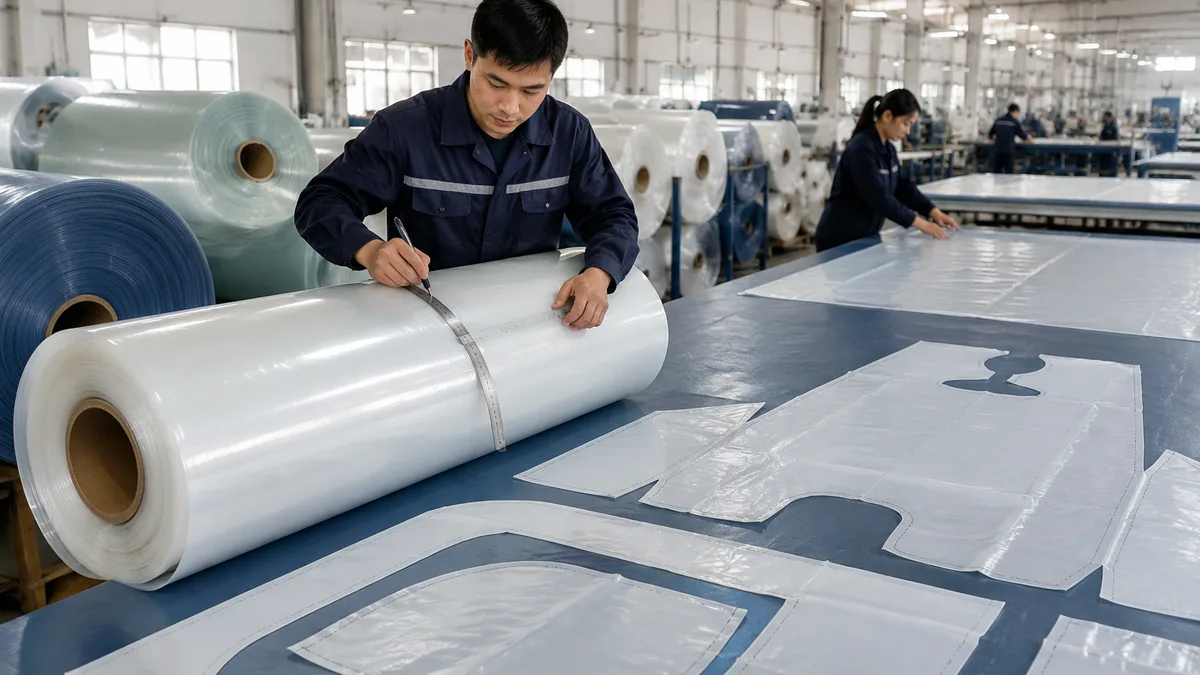
Once the sample is approved, the order is scheduled into the cutting and sealing line. Film is unwound, measured, and marked according to the approved pattern. Panels are die-cut (machine-cut using a shaped metal template) or manually cut depending on order size, then moved to assembly stations where sleeves are heat-sealed to the body, hoods are attached, and reflective tape or logos are applied.
Each piece is inspected in-process for seal integrity—operators run a finger along every seam to confirm that it is flush and uniform—and any piece with a gap or wrinkle is pulled for rework. After assembly, ponchos are folded, inserted into individual polybags, and staged for final QC. The 20 to 25 day window assumes that material is in stock or arrives on schedule, that printing plates or heat-transfer films are ready when the first pieces come off the line, and that no unexpected issues arise during sealing. A custom color order that requires new film adds five to ten days to this phase, because the masterbatch must be mixed, the film extruded, and an incoming inspection completed before cutting begins.
Quality Control and Packing: 3 to 5 Days
Reputable manufacturers typically conduct final QC on a random sample—often 2.5 percent of the order—following AQL 2.5 (Acceptable Quality Limit, an industry-standard sampling method for defect rates) standards for major defects and AQL 4.0 for minor defects. Inspectors check key measurement points, seam integrity, logo placement, and print quality under consistent lighting. Any batch that fails the first inspection is reworked or recut depending on the nature of the defect. Once QC passes, ponchos are packed into master cartons—usually 50 pieces per carton for stock ponchos or 25 pieces per carton for heavier custom designs—and cartons are labeled with SKU, quantity, gross weight, and the buyer's shipping marks. If the buyer has requested custom retail packaging such as printed hang-tag cards or insert labels, those items are placed inside each polybag during this phase, which can add one to two days.
Shipping: Variable
Ocean freight from Chinese manufacturing hubs to a U.S. West Coast port typically takes 18 to 25 days under normal conditions, though transit times can vary due to port congestion and routing. European destinations generally range from 25 to 35 days. Air freight reduces transit to 5 to 7 days but typically costs two to four times the ocean rate depending on order size and destination, making it practical only for urgent reorders. Most e-commerce buyers choose ocean freight for their first order because the 500 to 2,000 piece volume fits comfortably in a shared container, and the extra two to three weeks of lead time can be absorbed into their launch schedule.
Private Label Electric Bike Rain Poncho Production Timeline by Milestone
The table below summarizes each milestone in the production sequence, from sampling through shipment.
| Milestone | Timeline | Notes |
|---|---|---|
| Sampling | 7–12 days | Includes one revision round; additional revisions add 3–5 days each |
| Bulk production | 20–25 days | Standard colors and stock patterns; custom color adds 5–10 days |
| QC and packing | 3–5 days | AQL 2.5 / 4.0 inspection; custom packaging adds 1–2 days |
| Ocean freight (example) | 18–35 days | U.S. West Coast 18–25 days; Europe 25–35 days |
| Air freight (example) | 5–7 days | For urgent reorders only; cost is 2–4× ocean rate |
Total lead time from sample request to delivery at a U.S. port typically ranges from 55 to 80 days.
Next Steps for E-Commerce Buyers
References
April Su. Apparel Manufacturing MOQ & Lead Time Guide – April Su.
Capital World Group. Apparel Manufacturing Lead Times: A US Brand's Guide.
Sino Finetex Textile Technology. What is the Typical MOQ for Private Label Manufacturing? - Sino Finetex Textile Technology Co., Ltd.
Frequently Asked Questions
Practical answers related to this article.
What is the minimum order quantity for private label electric bike rain ponchos?
Semi-custom ponchos with logo printing on stock designs start at 500 to 1,000 pieces. Fully custom designs with proprietary features, custom materials, and unique patterns require 1,000 to 2,000 pieces minimum.
How long does production take from deposit to shipment?
Semi-custom orders with logo printing take 25 to 35 days. Fully custom designs require 35 to 45 days. Sample production takes 7 to 12 days before bulk production begins.
Why are rider poncho MOQs lower than disposable poncho MOQs?
Rider ponchos use pre-colored EVA or PVC stock purchased in smaller rolls, allowing manufacturers to draw from standing inventory for standard colors. Disposable ponchos require masterbatch coloring for full rolls, making orders below 5,000 pieces uneconomical due to unused material waste.
What customization options are available at 1,000 to 1,500 pieces?
At this tier, buyers can specify custom Pantone colors, choose different base materials like TPU-coated polyester or PEVA, select material thickness (0.15 mm or 0.20 mm), and request minor modifications such as sleeve length adjustments or additional reflective piping.
What is included in the lead time breakdown?
Lead time includes sampling (7-12 days), bulk production (20-25 days), quality control and packing (3-5 days), and shipping. Ocean freight adds 18-25 days to U.S. West Coast or 25-35 days to Europe. Custom color orders add 5-10 days to production.
What features require the 2,000+ piece fully engineered tier?
This tier is for proprietary features like patented handlebar sleeve closures, integrated waterproof zipper pockets, underarm venting grommets, two-layer breathable constructions, specialty materials like YKK zippers or 3M Scotchlite tape, and compliance testing such as EN 343 or EN ISO 20471 certifications.