
How to Compare Technical Specifications of PVC, EVA, and Nylon Waders Side by Side
A practical guide to comparing PVC, EVA, and nylon waders by technical specifications, covering hydrostatic head, seam construction, breathability, and more for industrial buyers.
Why the Spec Sheet Is the Only Honest Basis for Comparison
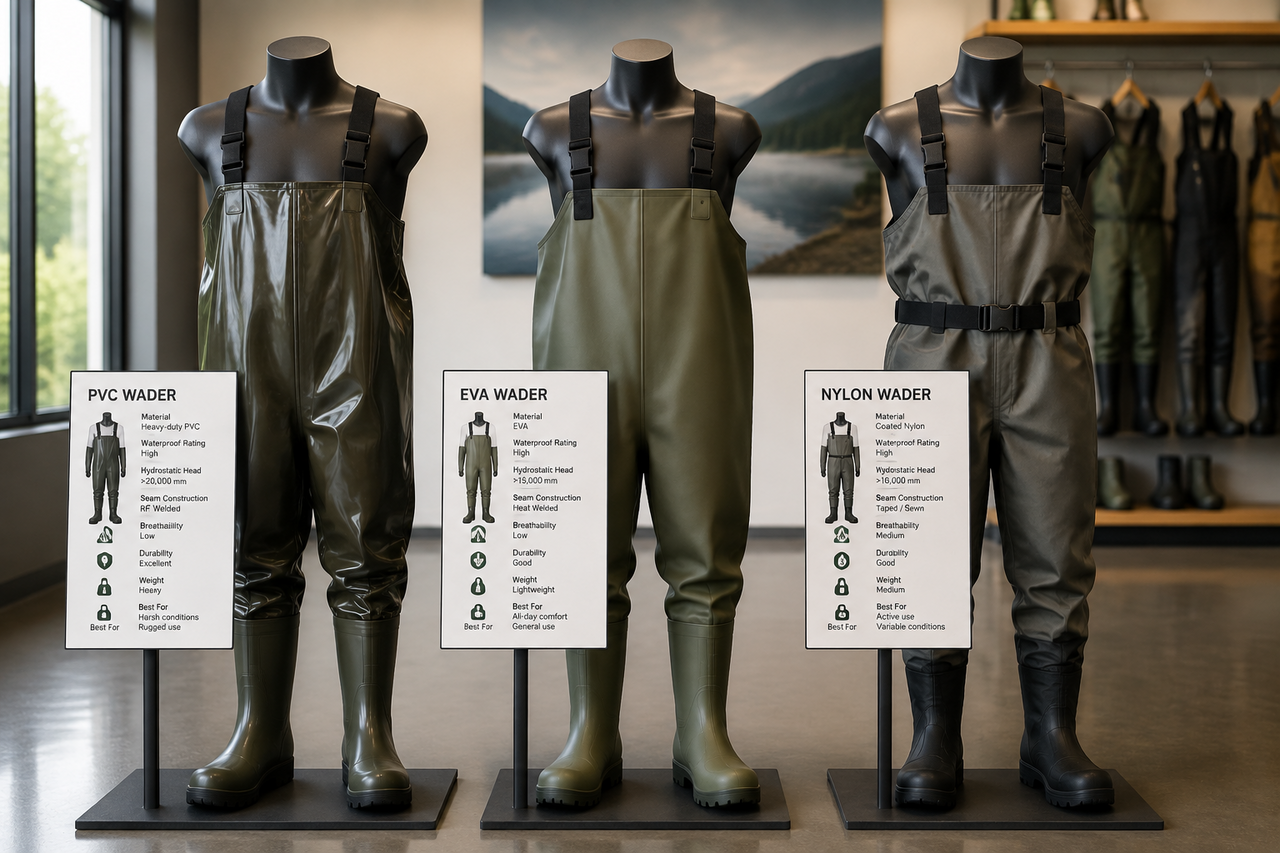
Buying waders in bulk is not like buying a rain jacket. The end user stands in water for hours, often bent over a sorting table or a pump, and the material between the worker and the water decides how long the shift can last. When quotes arrive from three factories, every supplier claims waterproofness, durability, and comfort. Those words cost nothing to print. The only honest way to compare is to line up the technical specifications — hydrostatic head, seam construction, dielectric behavior, weight, breathability, and abrasion resistance — and read them against the working conditions you actually need to cover. This article explains each metric, shows how PVC, EVA, and nylon behave differently, and describes how TianCigear structures its spec sheets so industrial buyers can verify claims before placing a wholesale rain gear order.
The Six Metrics That Decide How a Wader Performs
A wader spec sheet can contain dozens of numbers, but only six of them change a purchasing decision. They are best read in this order.
Hydrostatic head. This is the number behind the word “waterproof.” The test measures how much water pressure a flat material sample resists before water penetrates, expressed in millimeters of water column (mm H₂O). A column of water presses against the sample, and the height at the first sign of penetration is the rating. In EN 343, the European standard for rain-protective clothing, the highest water-column class requires at least 8,000 mm. Solid PVC and EVA sheets are effectively impermeable, so their hydrostatic head is rarely the limiting factor — the seams are. Coated nylon depends on the coating and lamination quality, so its hydrostatic head is a number to check on the test report rather than assume.
Seam type: welded versus stitched. Water enters a wader at the seams long before it pushes through the material. PVC waders are joined by high-frequency welding, sometimes called RF welding: radio waves agitate the polymer molecules until two layers fuse into a single continuous bond with no needle holes. EVA follows the same logic with heat fusion. Coated nylon waders, however, are often stitched and taped, which is watertight under light use but leaves a row of needle holes that becomes a weak point under abrasion or chemical exposure. Genuinely breathable waders use a laminated membrane with seams bonded by waterproof tape, and the most critical joint on those garments is between boot and leg, which must be both bonded and taped.
Dielectric rating. This metric matters when waders are worn around energized equipment, such as in utility maintenance or certain industrial cleaning. PVC and EVA are electrical insulators; a wet nylon fabric conducts and offers no dielectric barrier. That is why non-conductive wader programs traditionally specify solid PVC. The qualification is important: dielectric strength depends on the specific PVC compound and thickness, so the rating must come from a dielectric test report, not from the material name alone. And waders are not arc-flash protection unless explicitly tested and certified.
Weight. A kilogram on a shelf is a fact; a kilogram on a worker’s legs for eight hours is fatigue. Solid PVC chest waders are the heaviest construction, typically 2.5 to 4 kg depending on thickness and boot size. EVA reduces that noticeably, and coated or breathable nylon constructions are lighter still, often 1 to 1.8 kg for a chest model. Heavier is not automatically worse: in cold water, the material itself retains heat.
Breathability index and MVTR. Breathability is a physical measurement, not a product category. The standard method is EN ISO 11092, the sweating guarded-hotplate test, which reports moisture vapor transmission rate (MVTR) in grams of water vapor per square meter per 24 hours (g/m²/24h). Solid PVC and EVA have an MVTR close to zero because they are impermeable membranes. A wader is technically breathable only if it contains a membrane that passes vapor while blocking liquid water. Any spec sheet that says “breathable” without an MVTR number and a test reference is using the word cosmetically.
Abrasion resistance. The material must also survive contact with its environment: gravel, concrete tank walls, brush, rebar. Nylon fabric, especially in heavier deniers, resists this kind of wear best. PVC is moderate — it scuffs and can be cut, but it does not unravel. EVA is the softest and most vulnerable; it flexes well in the cold but abrades quickly under rough contact. Abrasion resistance should appear on the material spec sheet, ideally from a standard test such as Martindale for coated fabrics.
PVC, EVA, or Nylon: What Each Material Delivers in the Field
PVC for chemical exposure and cold water. Solid PVC waders are the workhorse of aquaculture, water treatment, and chemical handling. The polymer resists many acids, alkalis, oils, and biological agents, and because it is a solid sheet rather than a coating, there is no textile to hold chemicals against the skin. Solid PVC also traps body heat, which helps when workers stand in cold water for long periods. The trade-offs are weight and zero breathability: a PVC chest wader is heavy to walk in and retains sweat during physically demanding work. For chemical or cold-water tasks, that trade-off is usually acceptable.
EVA for flexibility in cold conditions. EVA, ethylene-vinyl acetate, is a softer and lighter polymer than PVC. Its defining advantage is flexibility at low temperatures: it does not stiffen the way PVC can when air or water approaches freezing, so movement and dexterity hold up. EVA waders suit tasks such as cold-water aquaculture checks, dairy washing, and cold-storage work where light, pliable protection matters. The limits are low abrasion resistance and eventual surface cracking, so EVA is a poor choice for rocky terrain or sharp-edged work.
Nylon for durability and active work. Coated nylon waders combine a woven textile shell with a waterproof coating or laminate. The nylon face provides the best abrasion resistance of the three, which is why this construction dominates rough-terrain tasks: construction drainage, flood response, field service, and shallow-water aquaculture. When the coating is replaced by a breathable membrane laminate, the same shell becomes a practical all-day garment for active users because sweat vapor can escape. The weak point shifts to the seams and the boot joint, so seam quality, not the brand, determines how long the wader stays dry.
| Property | PVC (solid) | EVA | Coated nylon |
|---|---|---|---|
| Hydrostatic head | Effectively impermeable; limited by seams | Effectively impermeable; limited by seams | Depends on coating or laminate; verify report |
| Seam method | High-frequency (RF) welding | Heat fusion | Stitched-and-taped, or welded and taped |
| MVTR | Near zero | Near zero | 0 to 10,000+ g/m²/24h for membrane versions (industry estimate) |
| Typical weight (chest wader) | 2.5–4 kg | 1–1.5 kg | 1–1.8 kg |
| Abrasion resistance | Moderate | Low | High |
| Dielectric behavior | Insulating; verify compound report | Insulating; verify compound report | Conducts when wet |
| Best-fit use | Chemical exposure, cold water | Cold-weather flexibility | Rough terrain, active full-shift work |
How TianCigear Structures Spec Sheets So Comparisons Stay Honest
TianCigear, as a trade-and-industry integrated manufacturer, builds the spec sheet as a standardized table that keeps the same structure across product lines. Every wader series receives the same columns: material and thickness, construction weight, hydrostatic head, seam type, applicable test standard, and available sizes. The purpose is that a buyer can place a PVC series, an EVA series, and a nylon series side by side and compare cells, not interpretations.
The test standards are named on the sheet rather than hidden. For the Chinese market and most Asian export programs, TianCigear references QB/T 4999-2016, the domestic rainwear standard, and attaches the corresponding test data. For European buyers, the sheet is aligned to EN 343, so the water-column class is visible at the line level. When a claim depends on a physical test — hydrostatic head, MVTR, abrasion — the report is attached to the batch, not to the brochure.
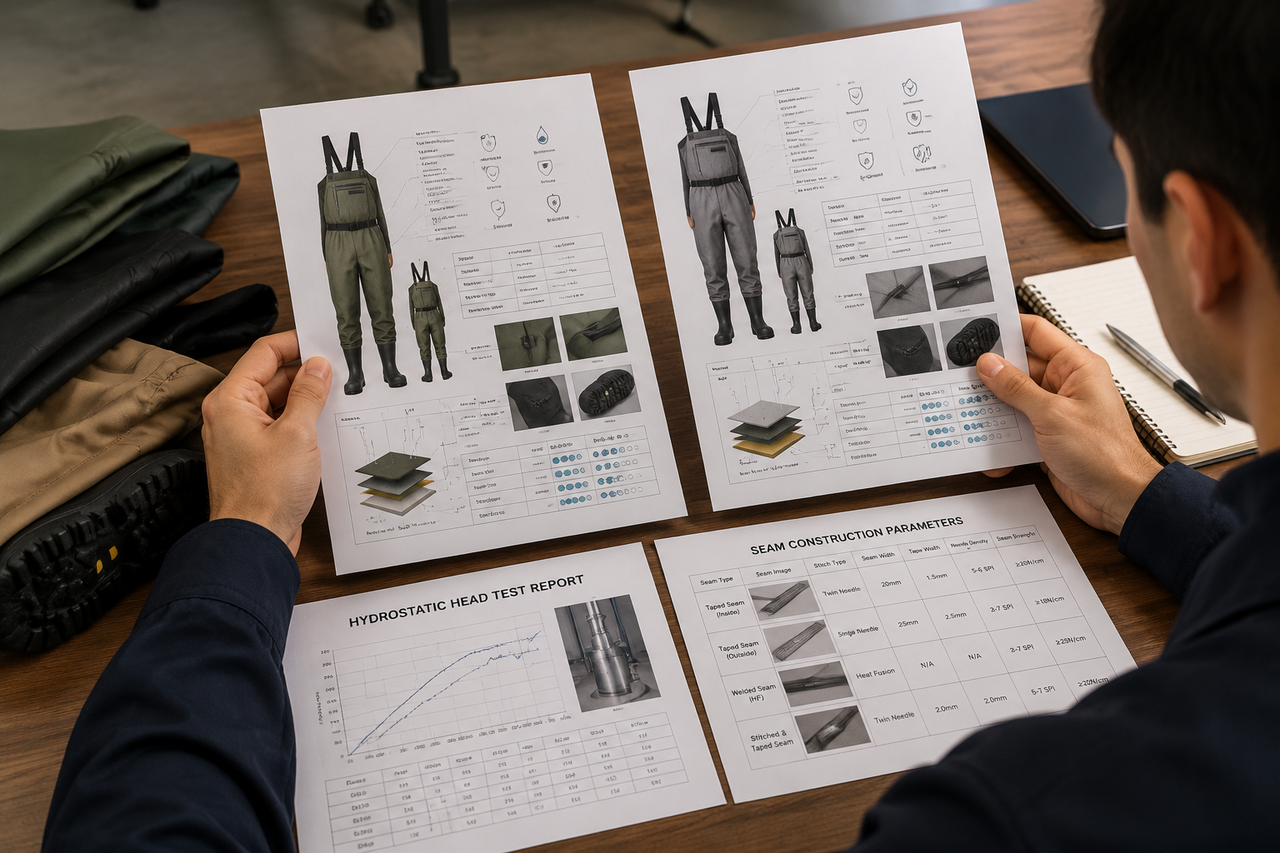
In practical terms, TianCigear asks every buyer to request three documents before sampling: the material spec sheet, the seam parameter sheet, and the hydrostatic-head test report from the most recent production batch. This is not a formality. The material spec sheet tells you what the polymer or laminate is; the seam parameter sheet tells you how the factory welds or tapes it; the batch report tells you whether the last production run actually met the number on the marketing page. A supplier that produces all three without hesitation is a supplier that controls its seams. A supplier that cannot is asking you to trust a photograph instead of a measurement.
The Breathability Trap: Verifying EN ISO 11092 and MVTR
The most common mistake in wader procurement is assuming that every garment labeled “breathable” has been tested for breathability. In practice, the label often means the wader is light or has a textile surface, or that the coating does not feel rubbery — none of which is a technical claim.
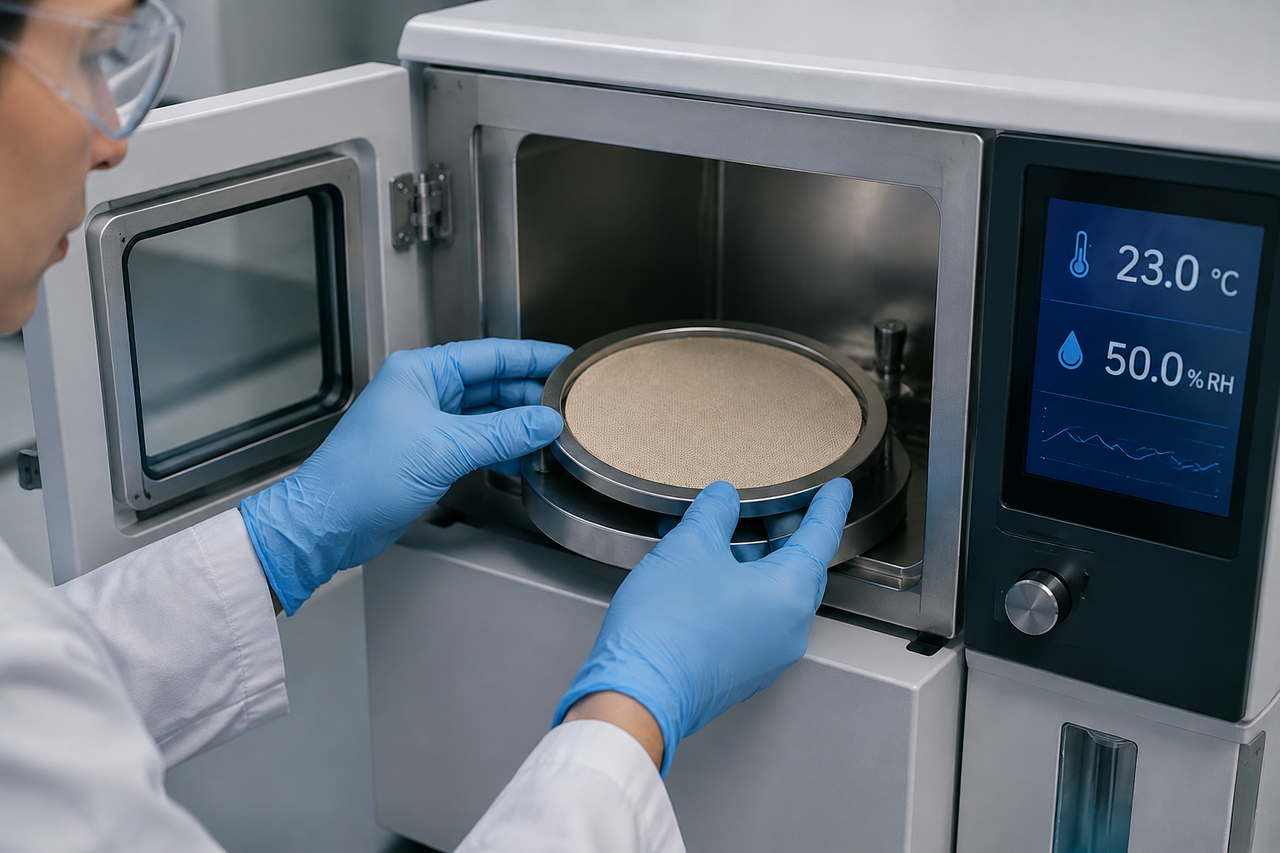
The only recognized way to verify is the EN ISO 11092 sweating guarded-hotplate test, which measures water-vapor resistance under steady-state conditions. The report gives an MVTR value in g/m²/24h, or a resistance value (Ret) in m²·Pa/W. When you receive such a report, check three things: whether the standard is explicitly named, whether the sample was tested in a conditioned state typical for the finished garment, and whether the report date matches a recent production batch rather than an old laboratory exercise. As an industry rule of thumb, coated non-membrane fabrics often show MVTR in the low thousands, while membrane laminates can reach far higher; values above roughly 4,000 g/m²/24h begin to make a perceptible difference to heat stress during active work. A PVC or EVA wader will not produce an EN ISO 11092 report at all, because the material transmits essentially no vapor.
A Working Sequence for Selecting Waders
A structured comparison only works if working conditions are defined first. Before contacting any factory, write down the end-user parameters for each team: wading depth, water temperature, air temperature, hours inside the garment, activity level, and chemical exposure. Then use this sequence:
Map conditions to material class — PVC for chemical or cold-water exposure, EVA for low-temperature flexibility, nylon for rough terrain and active work.
Request the three documents — material spec sheet, seam parameter sheet, and hydrostatic-head batch test report — from every shortlisted supplier.
Compare only values measured on the same standard, and ask explicitly whether a “breathable” claim is backed by an EN ISO 11092 MVTR report.
Sample the wader, then test a full production batch against the same numbers before scaling the order.
Each step removes a layer of guesswork. The goal is not the cheapest wader or the most impressive brochure, but a garment matched to the actual working day — and a factory that can prove that match in every batch.
Key Takeaways
• Hydrostatic head describes the material; seam type and seam workmanship describe the garment. Compare both, in that order.
• Verify every “breathable” claim with an EN ISO 11092 MVTR report; without a test reference, the word is cosmetic.
• Match material to conditions: PVC for chemical and cold-water exposure, EVA for cold-weather flexibility, nylon for abrasion resistance and active work.
• Use standardized spec sheets with named test standards such as QB/T 4999-2016 and EN 343, so supplier quotes can be compared cell by cell.
• Always request the material spec sheet, the seam parameter sheet, and the latest batch hydrostatic-head report before sampling.
References
ISO. (August 20, 2014). ISO 11092:2014. https://www.iso.org/standard/65962.html
GearJunkie. The Best Fishing Waders of 2026 | GearJunkie Tested. https://gearjunkie.com/fishing/best-fishing-waders
Canvas ETC. Denier Fabric Coatings: PU Vs PVC Vs DWR Explained | Canvas ETC. https://www.canvasetc.com/denier-fabric-coatings
Frequently Asked Questions
Practical answers related to this article.
What are the six key metrics that determine how a wader performs, and in what order should they be evaluated?
The six key metrics are hydrostatic head, seam type (welded vs. stitched), dielectric rating, weight, breathability index (MVTR), and abrasion resistance. They should be evaluated in that order.
Why is hydrostatic head not the limiting factor for PVC or EVA waders, and what is the main weak point?
Solid PVC and EVA sheets are effectively impermeable, so their hydrostatic head is rarely the limiting factor — the seams are the main weak point where water enters.
How do PVC, EVA, and coated nylon waders differ in terms of seam construction?
PVC waders use high-frequency (RF) welding with no needle holes; EVA uses heat fusion; coated nylon waders are often stitched and taped, which can leave needle holes that become weak points under abrasion or chemical exposure.
What does the dielectric rating measure, and why is it important for certain work environments?
The dielectric rating measures electrical insulation performance. It matters when waders are worn around energized equipment, as PVC and EVA are insulators while wet nylon conducts electricity and offers no dielectric barrier.
What is the typical weight range for chest waders made from each material, and how does weight affect worker fatigue?
Solid PVC chest waders weigh 2.5–4 kg, EVA weighs 1–1.5 kg, and coated or breathable nylon weighs 1–1.8 kg. A kilogram on a worker’s legs for eight hours contributes to fatigue, though heavier materials may retain heat in cold water.
How is breathability measured, and why is an EN ISO 11092 MVTR report essential for verifying 'breathable' claims?
Breathability is measured by the EN ISO 11092 sweating guarded-hotplate test, reporting moisture vapor transmission rate (MVTR) in g/m²/24h. An EN ISO 11092 MVTR report is essential because PVC and EVA have near-zero MVTR, and any 'breathable' claim without this test data is cosmetic.