
Why Seam Sealing Methods Matter More Than You Think for Rain Gear Durability and Performance
The seam is where rain gear dies first. In field returns and QC rejection logs, seam failure accounts for the majority of waterproofness complaints, and the root cause almost always traces back to the sealing method chosen during production.
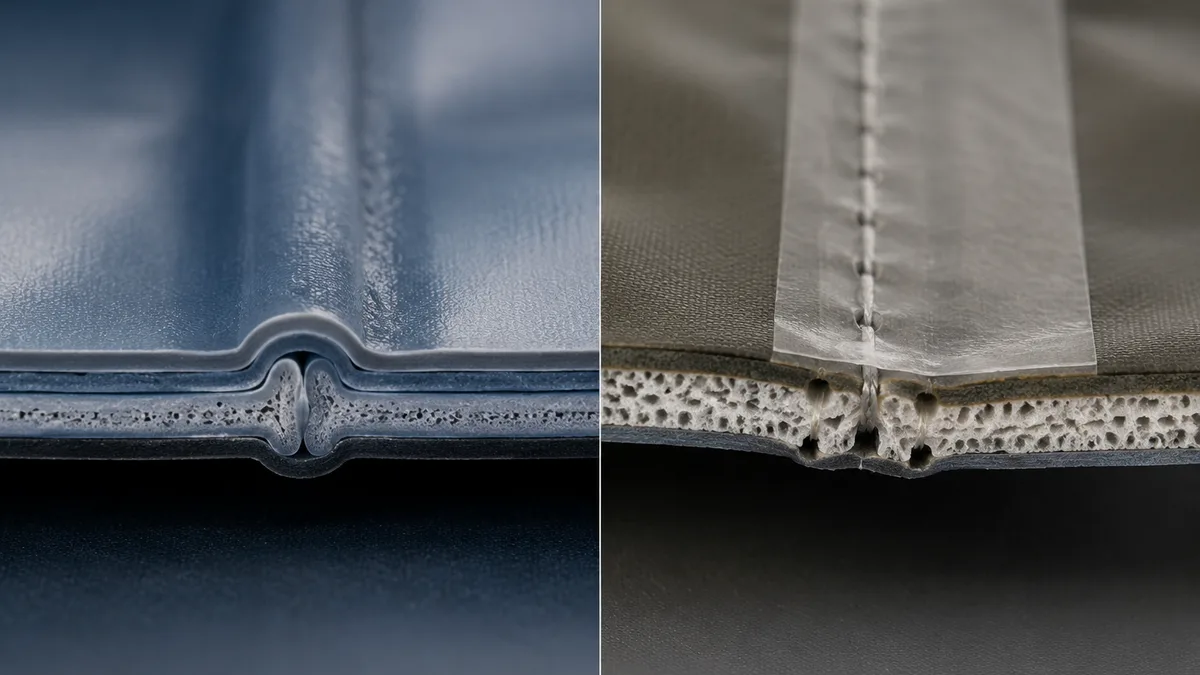
Seam Sealing Methods: The Key to Rain Gear Performance
Why the Seam Matters More Than the Shell
Most buyers focus first on fabric thickness, waterproof ratings, and material type when evaluating rain gear. Yet quality control labs tell a different story. The seam is where rain gear dies first. A poncho may achieve a 5,000 mm hydrostatic head rating on flat film. But if the shoulder seam separates after two washes or leaks under moderate pressure, the garment has failed. Seam integrity determines real-world performance.
Seam failure is a leading cause of waterproofness complaints in rain gear, often outpacing fabric degradation in field returns. The root cause almost always traces back to the sealing method chosen during production.
This pattern repeats across material families and price tiers. A disposable PE poncho sealed with basic heat fusion may hold up for a single outdoor event, but the same method applied carelessly to a reusable EVA raincoat results in brittle seams that crack under repeated folding. Conversely, a premium PVC wader with high-frequency welding can outlast years of chemical exposure and abrasion, while an adhesive-bonded nylon shell delaminates in cold storage before reaching the end user. The sealing method determines whether a product protects or fails when it matters.
How Ultrasonic Welding, Heat-Sealing, and Adhesive Bonding Work
Three core seam sealing methods dominate rainwear production, and each operates on a fundamentally different principle. Understanding the physics and failure modes of each method is essential for matching the right process to the right product and buyer expectation.
Heat-Sealing: Speed and Disposable Applications
Heat-sealing applies controlled temperature and pressure to fuse thermoplastic layers. In PE poncho production, two panels of polyethylene film are placed between heated bars or rollers. Heat softens the polymer chains just enough that they intermingle and bond when cooled. The process is fast, requires no consumables beyond energy, and scales well for high-volume disposable production.
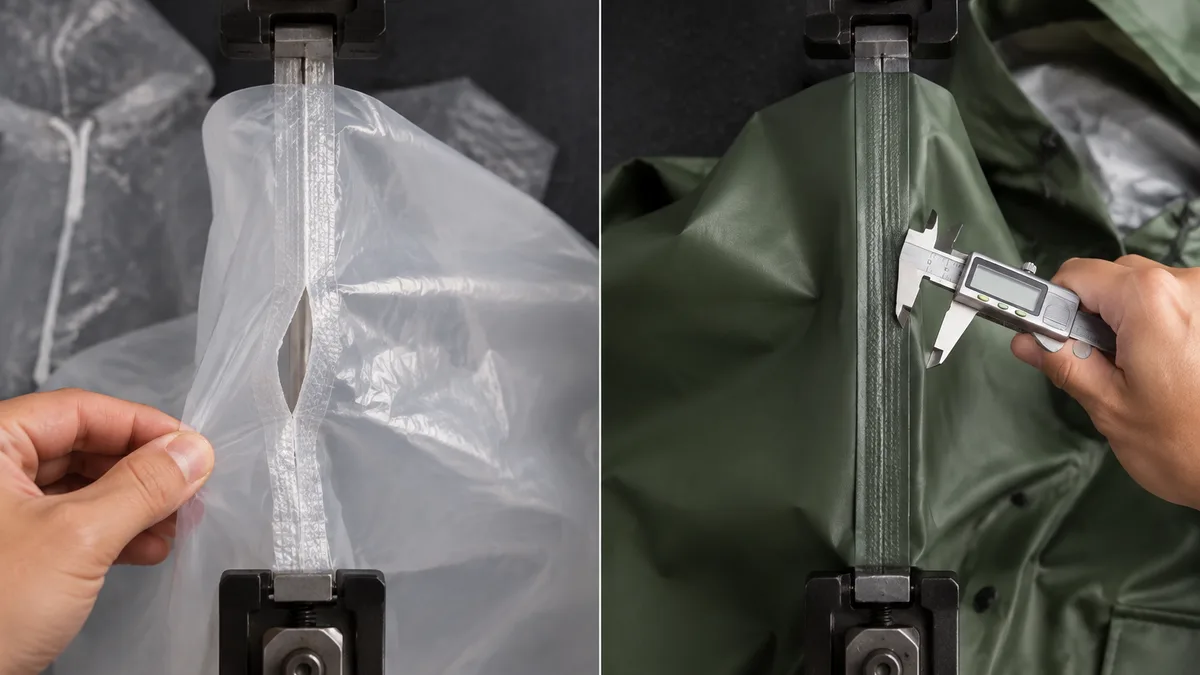
The trade-off is durability. PE has a relatively low melting point, and thin film—typically 20 to 30 microns—means there is limited material to work with. Under repeated mechanical stress such as folding or pulling, heat-sealed PE seams tend to stretch and tear along the weld line before the surrounding film fails. For single-use or short-term applications, this is acceptable. For reusable garments expected to last two or three seasons, it is not.
Ultrasonic Welding: Molecular Fusion for Strength
Ultrasonic welding uses high-frequency vibrations, typically in the 20 to 40 kHz range, to generate localized heat through molecular friction [1]. Two thermoplastic panels are placed under a sonotrode—the vibrating horn—and the ultrasonic energy causes polymer molecules at the interface to excite and melt without external heat. The weld cools in milliseconds, producing a fusion joint that contains no adhesive, no solvent, and no thread.
Manufacturers rely on this method for EVA raincoats and PVC waders because it produces a bond as strong as, or stronger than, the parent material. The welded seam is a single continuous structure. When weld parameters are correct, the seam will not separate under stress—it will tear through the adjacent film first.
The limitation is material compatibility. Ultrasonic welding works well on amorphous and semi-crystalline thermoplastics like EVA, PVC, and certain polyurethanes, but it is ineffective on highly crystalline polymers or multi-layer laminates with dissimilar melting points.
Adhesive Bonding: Flexibility and Environmental Degradation
Adhesive bonding uses a chemical layer—typically polyurethane glue or acrylic adhesive—to join two surfaces. This method appears most often in coated nylon rainwear and breathable membrane laminates, where the fabric structure or coating prevents direct welding. The adhesive is applied as a liquid or tape, pressed between panels, and cured either at room temperature or under heat.
The advantage is flexibility, both in material compatibility and joint geometry. Adhesive can bridge gaps, accommodate surface irregularities, and bond dissimilar materials. The disadvantage is long-term stability. Adhesives are subject to environmental degradation. Polyurethane adhesives are hygroscopic—they absorb moisture from the air—and prolonged exposure to humidity can cause the bond to weaken or delaminate. Cold temperatures can make the adhesive brittle, and heat can soften it.
In QC testing, adhesive-bonded seams that pass initial hydrostatic pressure tests sometimes fail after accelerated aging or thermal cycling, because the adhesive layer has degraded even though the fabric itself remains intact.
Engineering Trade-Offs in Sealing Method Selection
Every sealing method carries trade-offs in longevity, breathability, production speed, and cost. These decisions are based on the product's intended use, buyer quality expectations, and the regulatory or performance standards the garment must meet.
Longevity and Aging Mechanisms
Ultrasonic welding and high-frequency welding create a molecular bond that does not rely on an intermediate layer, so the seam ages at the same rate as the base material. If PVC or EVA film retains its flexibility and tensile strength after two years of outdoor use, the welded seam will as well.
Heat-sealed PE seams often age faster than the film because the weld zone is thinner and has been subjected to thermal stress during bonding. Adhesive-bonded seams face a different aging mechanism: the adhesive itself degrades. Even when the fabric is still sound, the glue can lose tack, absorb water, or become brittle.
Buyers who require multi-year durability—such as emergency services, industrial safety programs, and military supply chains—should specify welded construction in procurement requirements to ensure long-term seam integrity.
Breathability Impact
A welded seam on a non-breathable PVC or EVA shell has no breathability to preserve or destroy, because the base material itself is impermeable. But when working with breathable nylon laminates—fabrics that incorporate a microporous or hydrophilic membrane—the seam sealing method can block the very vapor transmission the fabric was designed to provide.
Adhesive taping over a stitched seam creates a vapor barrier along the seam line. While the flat fabric may achieve a moisture vapor transmission rate of 5,000 g/m²/24h under ISO 11092 testing, the taped seams contribute nothing to that number. Welded seams on breathable laminates are rare because most membrane fabrics cannot withstand the heat or pressure required for fusion without damaging the membrane. Manufacturers typically reserve adhesive bonding for breathable products, accept the vapor transmission penalty along seams, and rely on the large surface area of unsealed fabric to maintain acceptable overall breathability.
Production Speed and Cost
Heat-sealing is the fastest method for thin films. PE poncho production typically operates at 10–20 meters per minute for thin PE films, because the dwell time—the duration the material spends under the heated element—is short, and the equipment is simple and inexpensive.
Ultrasonic welding ranges from 3–8 meters per minute depending on material thickness and weld width, because each weld requires precise alignment, controlled pressure, and a short but fixed vibration cycle. The equipment is also more expensive—a quality ultrasonic sealing system with servo-controlled amplitude and pressure feedback costs several times more than a basic heat-sealing press.
Adhesive bonding falls somewhere in between, depending on whether the adhesive is applied manually, by roller, or as pre-cut tape, and whether it requires a curing oven. For high-volume disposable products where cost per unit is the dominant constraint, heat-sealing wins. For reusable professional-grade rainwear where seam strength and longevity justify a higher unit cost, ultrasonic welding is the better investment.
How EN 343 and ISO 811 Testing Verify Seam Integrity
A fabric's hydrostatic head rating measures the water column height the material can withstand before leaking, typically expressed in millimeters. But buyers often overlook a critical fact: the rating is measured on flat, unsealed fabric. A seam introduces a discontinuity, and unless that seam is properly sealed, it becomes the path of least resistance for water ingress, rendering the fabric rating irrelevant.
EN 343 is the European standard for protective clothing against rain, and it explicitly requires sealed seams to maintain the garment's classification [2]. The standard defines two performance classes for water penetration resistance: Class 2 requires a minimum hydrostatic head of 8,000 Pa (approximately 800 mm) after pre-treatment and washing, and Class 3 requires 13,000 Pa (approximately 1,300 mm).
Critically, these measurements must be taken on seam-sealed samples, not just flat fabric. A raincoat that achieves 1,500 mm on the shell but only 600 mm at the seam fails to meet even Class 2, regardless of how impressive the fabric spec appears on the data sheet. This failure mode appears in audit testing: a supplier ships samples with excellent fabric ratings, but when QC labs test the shoulder seam or side seam under ISO 811 protocol, improperly sealed seams often leak at significantly lower pressures than the base fabric rating—sometimes less than half the rated value—highlighting the importance of seam integrity verification. The garment is non-compliant, and the root cause is always inadequate sealing—either the wrong method for the material, insufficient weld energy, contaminated bonding surfaces, or poorly applied adhesive.
ISO 811 hydrostatic head testing on seam-sealed panels is the reference method for QC verification [3]. The test apparatus clamps a circular sample—usually 100 cm² in area, with the seam running through the center—and applies water pressure from below at a controlled rate, typically 60 mm per minute. The hydrostatic head value is recorded at the moment water penetrates the fabric or seam. Even microscopic gaps in a seam seal can create leak paths under hydrostatic pressure, causing seam failure before the base film reaches its rated limit. This is why manufacturers log welding parameters per batch—power, pressure, dwell time, and temperature for heat-sealing; amplitude, pressure, and weld time for ultrasonic welding—and perform destructive pull tests on random samples in addition to hydrostatic testing. A weld that looks continuous to the naked eye can still harbor micro-gaps or incomplete fusion zones that only reveal themselves under pressure or mechanical stress.
QB/T 4999-2016 is the Chinese industry standard for raincoats, and it includes specific requirements for seam waterproofness and seam strength. Manufacturers apply this standard to EVA and PVC raincoat lines as part of routine QC verification. The standard specifies that sealed seams must withstand a hydrostatic pressure of at least 2,000 mm without leakage, and seam tensile strength must be no less than 80 percent of the base fabric's tensile strength. Well-executed ultrasonic welds typically retain 85–95% of parent material strength, while heat-sealed PE seams may retain 70–85%, depending on film thickness and weld parameters.
Critical Failure Modes in Seam Sealing
Understanding how each sealing method fails is as important as understanding how it works. Every failure mode traces back to a specific process deviation or material incompatibility.
Incomplete Fusion Zones
Incomplete fusion occurs when welding parameters—temperature, pressure, or weld time—are insufficient to create a complete molecular bond. Visual inspection may reveal no defect, but a peel test will separate the seam with minimal force. Detection requires destructive testing: tensile pull tests on sample seams from each production batch.
Adhesive Delamination
Polyurethane and acrylic adhesives degrade over time when exposed to moisture, heat cycling, or UV radiation. Delamination may not appear during initial QC but emerges after weeks or months in storage or field use. Accelerated aging tests—exposing bonded samples to elevated temperature and humidity for 72 to 168 hours—followed by pull tests can predict long-term adhesive performance.
Micro-Gap Leakage
Even when a seam appears continuous, micro-gaps as small as a fraction of a millimeter can create leak paths under hydrostatic pressure. These gaps result from contamination on bonding surfaces, inconsistent pressure during welding, or material shrinkage after cooling. Hydrostatic pressure testing on finished seams per ISO 811 is the primary detection method.
Cold-Temperature Embrittlement
Some adhesives and heat-sealed thermoplastics lose flexibility at low temperatures, causing seams to crack or split when the garment is folded or flexed. This is particularly critical for emergency and outdoor applications where garments may be stored or used in sub-zero conditions. Flex testing at -10°C or lower reveals cold-temperature vulnerabilities.
Contamination-Induced Weak Bonds
Oil, dust, moisture, or release agents on panel surfaces prevent proper adhesion or fusion. Surface energy measurement using dyne pens or contact angle testing can detect contamination before sealing. Cleaning protocols and surface treatment—such as corona or plasma treatment—are standard countermeasures in high-reliability production.
References
Gymhur. Heat Bonding vs. Ultrasonic: Activewear Manufacturing Guide.
ABC Seams. Heat-Sealed Seams vs Traditional Seams: What to Use, When, and Why.
AceAccessory. How to Test the Water Resistance of a Raincoat? - AceAccessory.
Frequently Asked Questions
Practical answers related to this article.
Why is seam integrity more important than fabric waterproof ratings for rain gear performance?
Seam integrity determines real-world performance because the seam is where rain gear fails first. A garment may have a high hydrostatic head rating on flat fabric, but if the seam leaks or separates after minimal use—such as after two washes or under moderate pressure—the product has failed. Seam failure is a leading cause of waterproofness complaints, often outpacing fabric degradation in field returns.
What are the three main seam sealing methods used in rainwear production, and how do they differ?
The three main methods are heat-sealing, ultrasonic welding, and adhesive bonding. Heat-sealing fuses thermoplastic layers using temperature and pressure, suitable for disposable PE films but with limited durability. Ultrasonic welding uses high-frequency vibrations to create molecular fusion without adhesives, producing strong, continuous bonds ideal for EVA and PVC. Adhesive bonding uses chemical glues like polyurethane or acrylic to join surfaces, offering flexibility for complex materials but suffering from environmental degradation over time.
How does ultrasonic welding compare to heat-sealing in terms of durability and suitability for reusable gear?
Ultrasonic welding creates a molecular bond without adhesives, resulting in seams as strong as or stronger than the parent material, with aging that matches the base material. Heat-sealed PE seams are thinner and experience thermal stress during bonding, causing them to age faster and fail under repeated mechanical stress. For reusable professional-grade rainwear expected to last multiple seasons, ultrasonic welding is superior to heat-sealing.
What role do standards like EN 343 and ISO 811 play in verifying seam integrity?
EN 343 requires sealed seams to maintain a garment’s classification, specifying minimum hydrostatic head values (800 mm for Class 2, 1,300 mm for Class 3) on seam-sealed samples—not just flat fabric. ISO 811 is the reference method for QC verification, testing seam-sealed panels under controlled water pressure at 60 mm per minute, recording the hydrostatic head value at the point of penetration. These tests reveal that improperly sealed seams can leak at significantly lower pressures than the base fabric rating.
Why do adhesive-bonded seams often fail in cold or humid conditions, and what are the consequences?
Adhesive-bonded seams fail in cold or humid conditions because polyurethane adhesives are hygroscopic (absorb moisture), which can weaken or delaminate the bond. Cold temperatures make the adhesive brittle, while heat can soften it. In QC testing, such seams may pass initial hydrostatic pressure tests but fail after accelerated aging or thermal cycling, even when the fabric remains intact.
How does the choice of sealing method affect breathability in breathable rainwear?
In breathable nylon laminates, adhesive bonding creates a vapor barrier along the seam line, blocking moisture vapor transmission that the fabric was designed to provide. Welded seams on breathable laminates are rare because most membrane fabrics cannot withstand the heat or pressure required for fusion without damage. As a result, manufacturers accept a breathability penalty along seams and rely on the large unsealed surface area to maintain overall performance.