
How to Choose Between Disposable PE Rain Ponchos and Reusable EVA Raincoats for Event Programs
When an event program needs rain gear, the fastest way to decide between disposable PE ponchos and reusable EVA raincoats is to count how many times the same garment will be used. For one-off events — conferences, festivals, emergency relief deployments — choose disposable PE ponchos. For programs that run repeatedly, such as seasonal events, training drills, or crew kits issued dozens of times, choose reusable EVA raincoats. Unit price matters far less than use frequency, and that principle should drive every procurement decision.
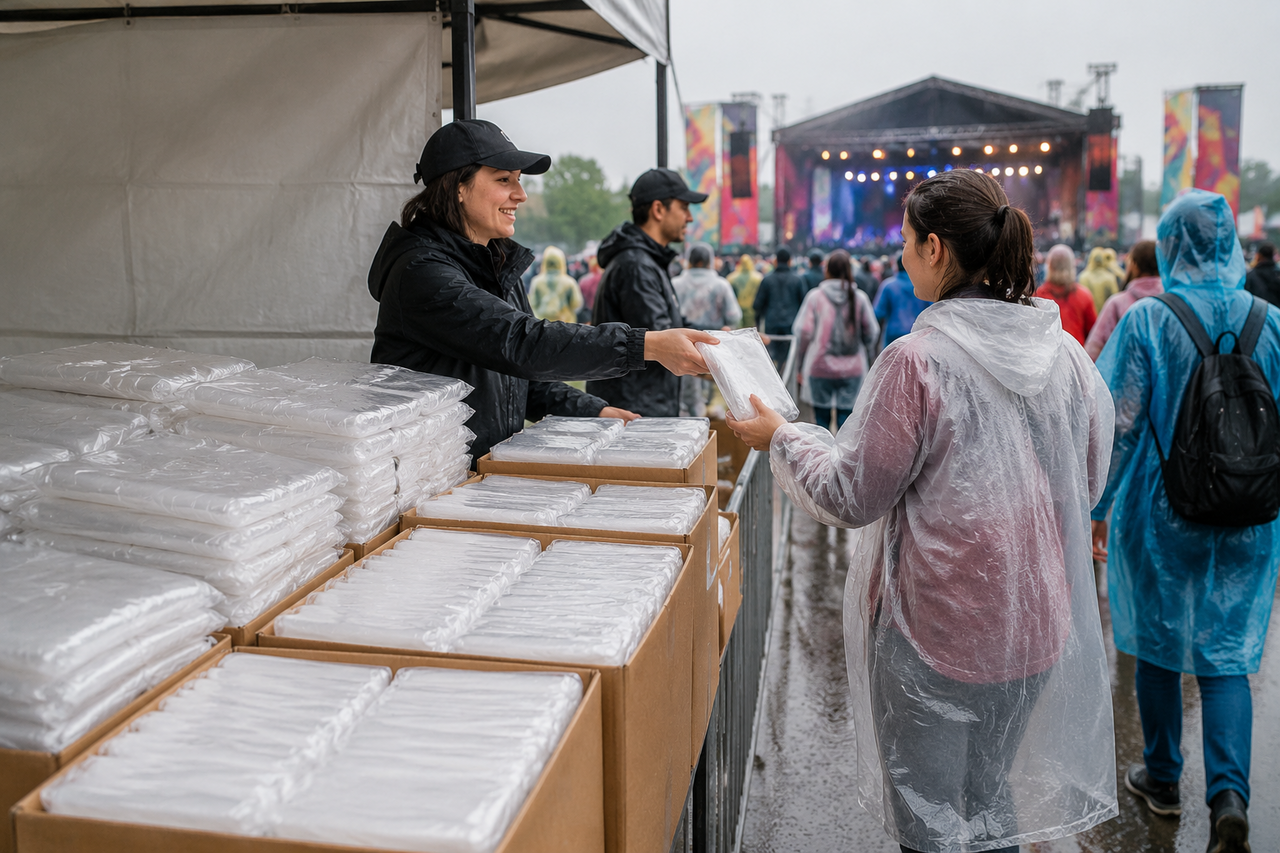
When an event program needs rain gear, the fastest way to decide between disposable PE ponchos and reusable EVA raincoats is to count how many times the same garment will be used. For one-off events — conferences, festivals, emergency relief deployments — choose disposable PE ponchos. For programs that run repeatedly, such as seasonal events, training drills, or crew kits issued dozens of times, choose reusable EVA raincoats. Unit price matters far less than use frequency, and that principle should drive every procurement decision.
Why frequency, not unit price, decides the outcome
Rain gear is different from most event supplies because its value is consumed through use, not ownership. A disposable PE poncho is engineered for one rainy day; every additional use stresses the film and raises the chance of seam failure. An EVA raincoat is built to be issued, collected, dried, and issued again. The more often a program runs, the further the comparison tilts toward EVA.
Cost-per-use is the honest metric. A PE poncho at a bulk price of roughly $0.10–$0.50 per piece (industry estimate) costs that amount per event if used once. An EVA raincoat at $1.50–$4.00 per piece (industry estimate) looks expensive on paper, but used thirty times it can cost well under $0.15 per use. Once a garment crosses roughly ten uses, the reusable option has typically paid for itself. That is why seasonal events, training drills, and crew kits are natural EVA programs, while conferences and festivals, where each attendee is a first-time and likely last-time user, are natural PE programs.
The rule holds even when budgets are tight. A one-off event should not buy reusable raincoats nobody will wear again, and a recurring program should not buy disposables every season when a single EVA purchase would serve the same crew for years. Frequency protects both the budget and the end-user experience.
What actually separates PE and EVA materials
Polyethylene (PE) is the film used in most budget ponchos. It is lightweight, inexpensive, and easy to fold small, which is why it dominates emergency and giveaway segments. But PE has a low tolerance for mechanical stress. It tears easily when snagged, sealed seams are the first point of failure, and the film degrades when exposed to heat, UV light, and repeated folding. PE ponchos are designed for single-season use; as a general rule, they should not be reused beyond ten times.
Ethylene-vinyl acetate (EVA) is a softer, slightly foamed material that is both lighter and more flexible than many buyers expect. EVA raincoats resist tearing better than PE, drape more like fabric, and hold printed logos more cleanly. Under moderate use, an EVA garment typically lasts two to three years, though its lower density makes it more susceptible to moisture absorption and thermal expansion and contraction. Repeated folding is the main enemy: over time, the EVA layer can develop micro-tears around the seams. That is a maintenance issue, not a design flaw, and proper storage manages it.
Specifications matter as much as chemistry. PE film is usually measured in microns, while EVA is specified by weight per square meter, and a reliable supplier should state both in writing. Buyers should also ask about seam construction, because seam width and sealing temperature determine whether the garment survives wind-driven rain. A poncho that leaks at the seam is worse than none, because it gives the wearer false confidence.
Cost-per-use: the table that settles most budgets
The table below compares the two options across the decisions event planners actually face. Price bands are industry estimates and vary by factory, order quantity, and customization.
| Comparison point | Disposable PE poncho | Reusable EVA raincoat |
|---|---|---|
| Typical bulk unit price | $0.10–$0.50 (industry estimate) | $1.50–$4.00 (industry estimate) |
| Intended service life | One event or one season | 2–3 years under moderate use |
| Realistic number of uses | 1, up to 10 with declining quality | Dozens of uses per season |
| Cost-per-use trend | Rises with each reuse as failure risk grows | Falls sharply after roughly 10 uses |
| Storage footprint | Very small, pouch-packed | Larger, needs dry storage |
| Custom printing | Possible, simple, low cost | Better surface for logos, longer-lasting print |
| End-of-life | Discarded after the event | Replaced only after several seasons |
Two numbers deserve emphasis. First, the realistic use range for PE is one to ten times, with quality declining at the top end. Second, EVA's two-to-three-year lifespan means a program that runs ten times per season can expect twenty to thirty uses from one garment. Once expected uses pass ten, the reusable garment is usually the cheaper program.
Ordering minimums and factory economics
Procurement decisions are not made on material science alone; they are shaped by how factories price production. Most rain-gear factories structure their economics around large institutional buyers. Emergency programs and government tenders routinely order 20,000 to 100,000 units at a time, and from a factory's perspective, a 5,000-piece run is a short, efficient production day. Custom-colored or printed disposable PE ponchos typically start at 5,000 pieces per design, because a masterbatch bag colors an entire film roll; a small tinted run leaves leftover film that may never match another order. These figures are illustrative and vary by supplier, so treat them as planning assumptions.
Lead time is the second constraint. Samples should be confirmed before bulk production; a custom run needs weeks for film, printing, cutting, sealing, and packing, on top of freight to the destination. Buyers should also confirm whether the factory supplies sealed pouches, tear-open packs, or bulk cartons, because each format changes both unit price and distribution speed at the venue.
Storage, shelf life, and field behavior
Rain gear spends most of its life in storage, and storage conditions determine whether it performs when needed. PE ponchos are compact and cheap enough to keep in a car trunk or emergency locker, but they are sensitive to heat and sunlight; a box left in a warehouse loft through a hot summer can produce brittle film that splits at the seams. EVA raincoats are bulkier and need dry, cool storage. Moisture is the specific enemy: because EVA has higher permeability, damp storage encourages the material to absorb water and accelerates the thermal expansion cycles that cause micro-tears around folds.
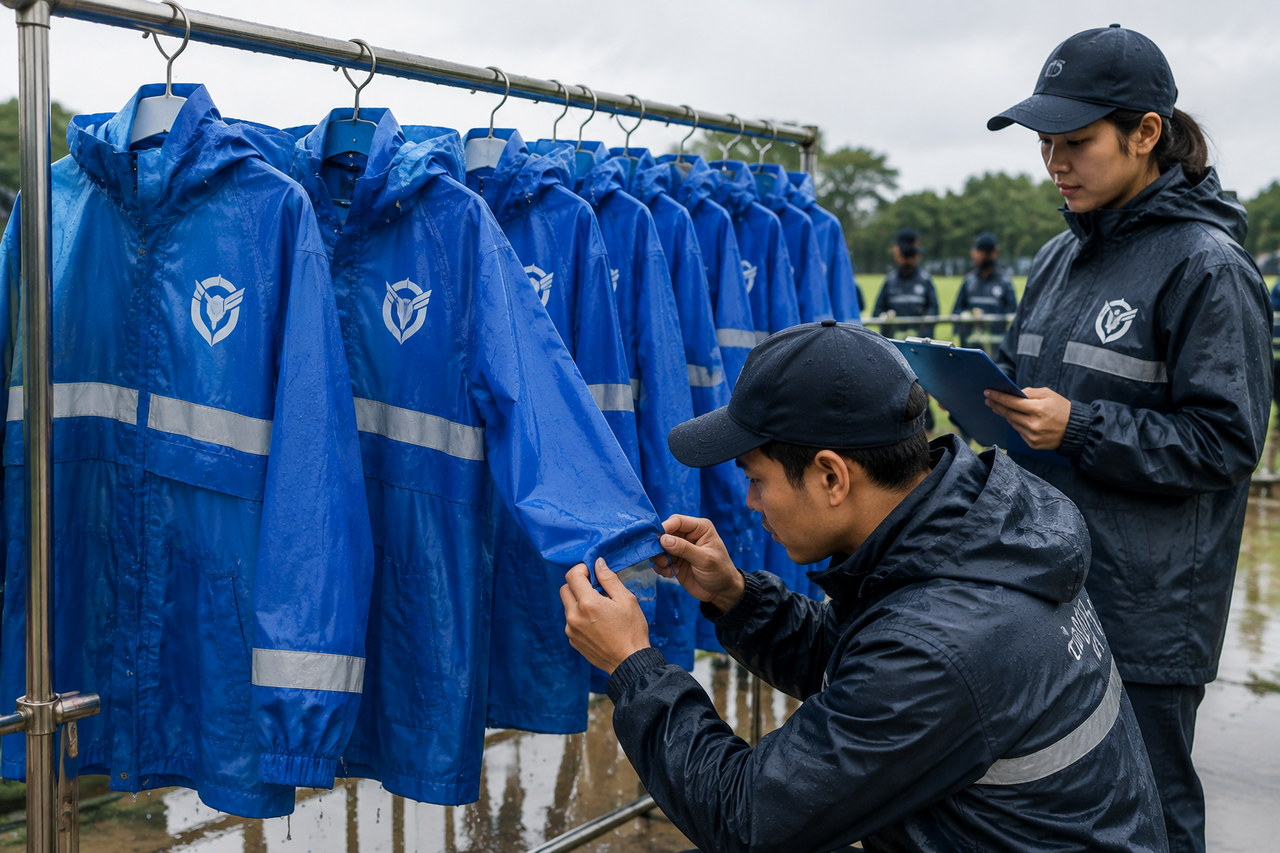
Field behavior also differs. PE ponchos are easy to distribute — one person can hand out hundreds in minutes — but once worn they are usually discarded, creating a cleanup and waste stream at the venue. EVA raincoats require a collect-and-reissue system: staff must gather them, dry them, inspect seams, and store them. That is a real operational cost and should be accounted for honestly. In practice, the programs that succeed with EVA are those that already have uniform or equipment management routines.
A rotation rule protects both materials: new stock goes to the back, older stock goes out first. For EVA, a pre-season inspection of seams and folds takes minutes per garment and prevents most field failures.
Branding, logistics, and the attendee experience
When the rain gear carries a sponsor logo or program name, material choice affects print quality and longevity. PE film accepts basic printing, adequate for a single day's visibility. EVA provides a smoother, more stable surface for logos, and the print survives the wash-and-dry cycle between uses. If the goal is to have crew members look professional across a full season, EVA is the stronger canvas.
Logistics favor PE at distribution and EVA at reuse. PE arrives pouch-packed and can be handed out with zero training. EVA demands a system: who collects the coats, how they are dried, where they are stored, and who inspects them before the next event. Programs that already manage uniforms, radios, and safety equipment will absorb EVA easily; programs that rely on volunteers may find the collection step fails, turning a reusable investment into a one-use product at a much higher price.
Sustainability and end-of-life planning
Disposable PE ponchos create a visible waste stream: thousands of films used for hours, then discarded. For venues with zero-waste mandates, that stream is hard to hide. EVA raincoats last for years and reduce the total material footprint, but they remain synthetic products whose end-of-life depends on local recycling capacity. When sustainability is a scoring criterion in a tender, ask the factory whether materials are recyclable and how packaging can be minimized. The lowest-impact program is usually the reusable one used to the end of its life, not the recyclable one thrown away after a single event.
A five-question check before you order
Rather than memorizing material specifications, work through this short decision sequence:
How many times will each garment actually be used? One to three uses points to PE; ten or more points to EVA.
Who wears it and how much abuse will it take? Crowds and emergencies favor cheap, replaceable PE; crews and repeat users favor tear-resistant EVA.
Do you need custom color or printing? Small PE runs may hit factory minimums around 5,000 pieces per design, so confirm MOQs before budgeting.
Can your team collect, dry, and store reusable gear? If not, the EVA cost-per-use calculation will not hold in practice.
What is the total program cost including disposal or replacement? Compare cost-per-use, not unit price.
If the answers point in different directions, weight actual use frequency above all others; the material that gets used as intended is always the better buy.

Common misconceptions to avoid
The first misconception is that the cheaper unit price always means the cheaper program. A $0.20 poncho used once is cheap; the same poncho reused ten times is cheap but increasingly unreliable. When a program runs repeatedly, the savings from disposables disappear into repeated repurchases.
The second is that disposable PE ponchos can be reused freely. They should not be reused beyond ten times, and every reuse increases the chance of seam failure exactly when rain is heaviest. Treat them as consumables, not garments.
The third is that EVA raincoats are heavy or stiff. Modern EVA formulations are lighter and more flexible than many PVC garments, which is why they work for event staff who must move, bend, and carry equipment. The material's weakness is not weight; it is poor storage discipline.
The fourth is assuming one poncho size fits every attendee. PE ponchos are one-size-fits-most, which can mean poor coverage for tall users and wind-driven rain exposure. EVA raincoats can be cut in graded sizes or unisex fits that cover the body more completely, a key advantage for outdoor events with long exposure times.
Conclusion and action points
The decision between disposable PE ponchos and reusable EVA raincoats is a frequency decision. For one-off events — conferences, festivals, disaster-relief deployments — choose disposable PE ponchos and plan for single use. For programs that repeat — seasonal events, training drills, crew kits — choose reusable EVA raincoats, set up a collection and drying routine, and let cost-per-use do the budget work. Before ordering, confirm factory minimums and lead times, because custom PE runs often start around 5,000 pieces per design and institutional orders range well beyond that. Confirm samples and spec sheets in writing, store all rain gear away from heat and moisture, and inspect reusable garments for seam micro-tears before each event.
Key Takeaways
• Use frequency decides the choice: one-off events suit disposable PE ponchos; repeated programs suit reusable EVA raincoats.
• EVA raincoats typically last 2–3 years under moderate use, while PE ponchos are designed for single-season use and should not be reused beyond ten times.
• Compare cost-per-use, not unit price; once a garment crosses roughly ten uses, a reusable usually pays for itself.
• Confirm MOQs and lead times early; custom printed PE ponchos often start at about 5,000 pieces per design.
• Plan storage and logistics: dry, cool storage extends EVA life, and a collection routine is essential for reusable programs.
References
RAINCOATGIFT. Disposable PE vs Reusable EVA Rain Ponchos for Bulk Event Orders: Which Should Buyers Choose?. https://www.raincoat-gift.com/blog/industry-knowledge-sharing/disposable-pe-vs-reusable-eva-rain-ponchos-for-bulk-event-orders-which-should-buyers-choose
Qstomize. (April 27, 2026). Emergency Rain Ponchos: Bulk Ordering Guide for Events. https://www.qstomize.com/nl/blog/emergency-rain-ponchos-bulk-ordering-guide-events
Frequently Asked Questions
Practical answers related to this article.
What is the main factor in choosing between disposable PE ponchos and reusable EVA raincoats?
The main factor is use frequency: one-off events like conferences and festivals suit disposable PE ponchos, while repeated programs such as seasonal events, training drills, and crew kits suit reusable EVA raincoats.
What are the typical lifespans and reuse limits for PE ponchos and EVA raincoats?
PE ponchos are designed for single-season use and should not be reused beyond ten times. EVA raincoats typically last two to three years under moderate use, allowing dozens of uses per season.
How does cost-per-use compare between the two options?
A PE poncho costs roughly $0.10–$0.50 per piece in bulk, while an EVA raincoat costs $1.50–$4.00 per piece. Once a garment crosses roughly ten uses, the reusable option typically pays for itself; used thirty times, an EVA raincoat can cost well under $0.15 per use.
What are the typical ordering minimums for custom PE ponchos?
Custom-colored or printed disposable PE ponchos typically start at 5,000 pieces per design, because a masterbatch bag colors an entire film roll.
What storage conditions are recommended for PE ponchos and EVA raincoats?
PE ponchos are compact but sensitive to heat and sunlight; storage in hot conditions can cause brittle film. EVA raincoats need dry, cool storage, as moisture absorption and thermal expansion can cause micro-tears around folds.
What is a common misconception about disposable PE ponchos?
A common misconception is that disposable PE ponchos can be reused freely. They should not be reused beyond ten times, as every reuse increases the chance of seam failure.