
How Hydrostatic Head Testing Determines Rain Protection Performance in Waders and Raincoats
Learn how hydrostatic head testing measures the waterproofness of waders and raincoats, why standards like ISO 811 and EN 343 matter, and how seam integrity affects performance.

Hydrostatic Head Testing for Rainwear: Waders & Raincoats
Most rainwear spec sheets use the word "waterproof" as if it were one fixed fact. It is not. A thin PE poncho that leaks after ten minutes in a downpour and a chest wader that holds through a full shift in a drainage channel can both be described as waterproof, yet they share almost nothing in performance. The number that separates them is the hydrostatic head. At TianCiGear, we built our production, quality control, and quoting process around this value because it tells a buyer what a product will actually withstand—and where it will fail.
What Hydrostatic Head Measures and How the Test Works
Hydrostatic head (HH) is the height of a water column, expressed in millimeters, that a fabric can resist before water penetrates through it. The test is deliberately simple and brutally honest. A sample of the material is clamped beneath a transparent tube, water is added above it, and pressure is increased at a controlled rate. The operator watches the underside of the sample. The moment a third drop of water appears, the test stops, and the height of the water column at that point is recorded as the hydrostatic head.
The reference method most of the world uses is ISO 811, which raises pressure at a rate of 60 mbar/min—approximately 600 mm of water column per minute. Chinese rainwear testing follows GB/T 4744, a standard aligned with ISO 811 and used in the QB/T 4999 rainwear series; North American buyers more often see AATCC 127, which applies pressure at a different rate but measures the same physical property. A value of 1,000 mm means the fabric held a column of water one meter high. Because water density is constant, that column is also a pressure: roughly 9.8 kPa, or about 0.1 bar.
This point deserves attention. HH is not a percentage, not a rating of "how much rain" a garment resists, and not a measure of how long a fabric stays dry. It is a pressure threshold measured at the weakest point of the sample. Water does not need a wide opening to pass through; it finds pinholes, thin spots, and coating voids. That is why the test exposes manufacturing defects that a casual "spray and look" inspection will miss. The same physics applies later at every needle hole and weld line, which is why seam testing matters as much as fabric testing.
Why a "Waterproof" Label Is Not a Specification
A garment can be honestly labeled waterproof while withstanding little more than a simulated shower at zero pressure. Field conditions for industrial and outdoor users have nothing in common with a shower head. Rain is driven sideways by wind. A kneeling aquaculture worker concentrates body weight onto a small contact area. A seated angler presses against a wet bench. A backpack strap crushes the shoulder of a raincoat. Each of these actions adds pressure to the water trying to push through.
Immersion adds an entirely different factor. A wader standing in water experiences pressure from depth: each meter of water adds roughly 9.8 kPa, the equivalent of about 1,000 mm of hydrostatic head. Standing in half a meter of water already applies roughly 500 mm of pressure before the person moves a single step, and walking, currents, and the flex of the material add more. A 1,000 mm film may handle light rain at zero pressure, but wading exposes it to roughly 500 mm of hydrostatic pressure at ankle depth plus dynamic pressure, so it is unsuitable for wading. A chest wader therefore needs a material rated in at least the low thousands of millimeters.
Prolonged exposure is the second reason a number beats a word. Industrial rainwear is worn for hours, not minutes, and the longer water pressure is applied, the more likely a weak point emerges. Coatings soften with repeated wetting, films flex and fatigue, and taped seams lift over time. A buyer who chooses a garment whose HH value merely matches the typical rain condition is buying a product with no safety margin. The durable choice is a value that clears the worst expected condition with room to spare, which is exactly how our team selects materials before they are cut.
The Standards Behind Our Production Floor: QB/T 4999-2016 and EN 343
At TianCiGear, we treat HH as the spine of the specification. The two standards that anchor our work are QB/T 4999-2016, the Chinese light-industry standard for rainwear, and EN 343, the European standard for protective clothing against rain.
QB/T 4999-2016 calls up GB/T 4744 for testing, so the numbers on a Chinese factory report are directly comparable to those on an ISO 811 report. For export production, our default internal target is the highest grade in QB/T 4999-2016; if a raw material cannot clear it, it does not reach the cutting table. Buyers should expect the grade to be written on the test report, not buried in a summary email.
EN 343:2019 is the standard most EU importers will cite. It classifies water penetration resistance into three classes: Class 1 requires at least 800 mm, Class 2 at least 8,000 mm, and Class 3 at least 13,000 mm. The standard also grades water vapor resistance separately, which is why an EN 343 certificate should always be read as a pair of classes—one for waterproofness and one for breathability. A certificate that simply says "EN 343 compliant" without a class number is incomplete, because there is an enormous difference between a Class 1 garment and a Class 3 garment.
This grading system is useful for buyers because it forces a conversation about use. A Class 1 raincoat might be acceptable for urban commutes in light rain, but a full-shift outdoor worker needs Class 3. Our quoting process follows the same logic: we do not offer one raincoat for every market. We ask where the garment will be worn, for how long, and under what pressure, and the HH target follows from that answer.
Typical Hydrostatic Head Values Across Product Categories
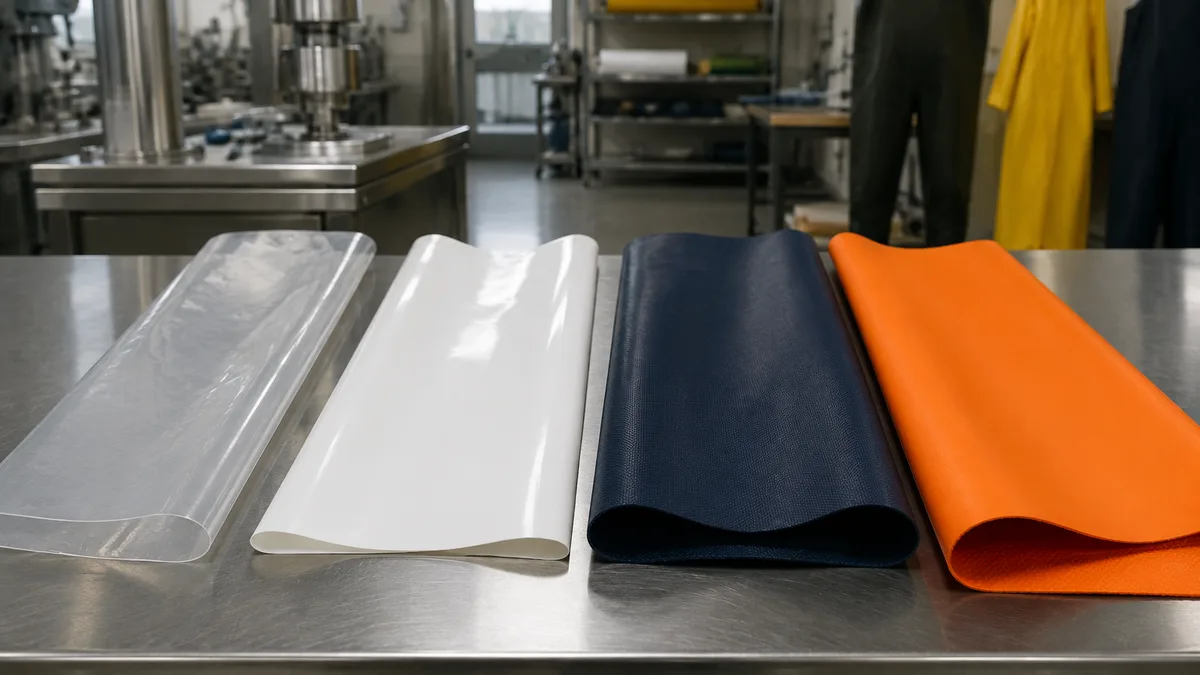
The table below shows indicative HH ranges across the four main product families we produce. The values are indicative and vary by SKU and construction; they are working figures from our production lines, not a guaranteed value for any single order. Buyers should verify the HH value on the specific order's test report.
| Product category | Typical HH range | What it realistically means in the field |
|---|---|---|
| Disposable PE poncho | ~1,000 mm | Light showers and short outdoor events; not built for kneeling, sitting, or wind-driven rain |
| EVA raincoat | ~2,000 mm | Urban commuting and moderate rain for a few hours; heat-fused seams hold up under normal use |
| Breathable nylon/membrane waders | 3,000–4,000 mm | Active outdoor work and fishing, where sweat management matters more than maximum immersion |
| PVC chest waders | 5,000 mm and above | Aquaculture, flood response, industrial cleaning; solid film with a high ceiling, limited mainly by seams |
The pattern is not "higher is better." It is "matched to the job." A breathable wader at 3,000–4,000 mm exists because a non-breathable PVC film at 5,000 mm traps heat and moisture vapor; a worker in a warm climate can be soaking wet inside non-breathable waders within an hour of heavy labor, not from leaks but from sweat. Conversely, a breathable wader is the wrong product for aquaculture ponds full of chemicals and sharp structures, where PVC's abrasion resistance and impervious film matter more than comfort. The HH number only makes sense next to the application, which is why our sales team always asks about working conditions before recommending a construction.
The Seam Is Where the Number Fails First
The flat fabric test is only half the story. In our QC lab, the hydrostatic test that matters most is run on seam-sealed panels, because the seam is where waterproofness usually dies.
The three seam technologies a buyer will encounter map directly to material families. For PVC waders, the standard is high-frequency welding, also called RF welding. A generator produces radio waves that excite the PVC molecules and fuse two layers into one continuous material. A correct weld contains no holes because there is no thread and no adhesive—the weld is the material itself. EVA, used in lighter waders, relies on a similar heat-fusion process. For coated nylon, the common construction is a polyurethane or PVC coating applied to the inner face of the fabric, with seams either welded or stitched and taped. Stitched-and-taped seams are watertight under light use, but the row of needle holes remains a weak point under heavy abrasion and chemical exposure; tape can lift and needle holes can stretch. For breathable waders, a membrane is laminated to the fabric and the seams are bonded with waterproof tape. The most critical joint is where the boot meets the leg; on a breathable wader, that joint must be both bonded and taped.
The reason our team tests seam panels rather than trusting the flat fabric value is simple. In our QC process, seam-sealed panels are tested separately because even small seal defects can create a leak path before the base fabric reaches its HH rating. In plain terms, a garment can have fabric that tests at 2,000 mm and still leak at the seam under a fraction of that pressure. A specification that lists only the fabric HH is therefore incomplete, no matter how impressive the number looks.
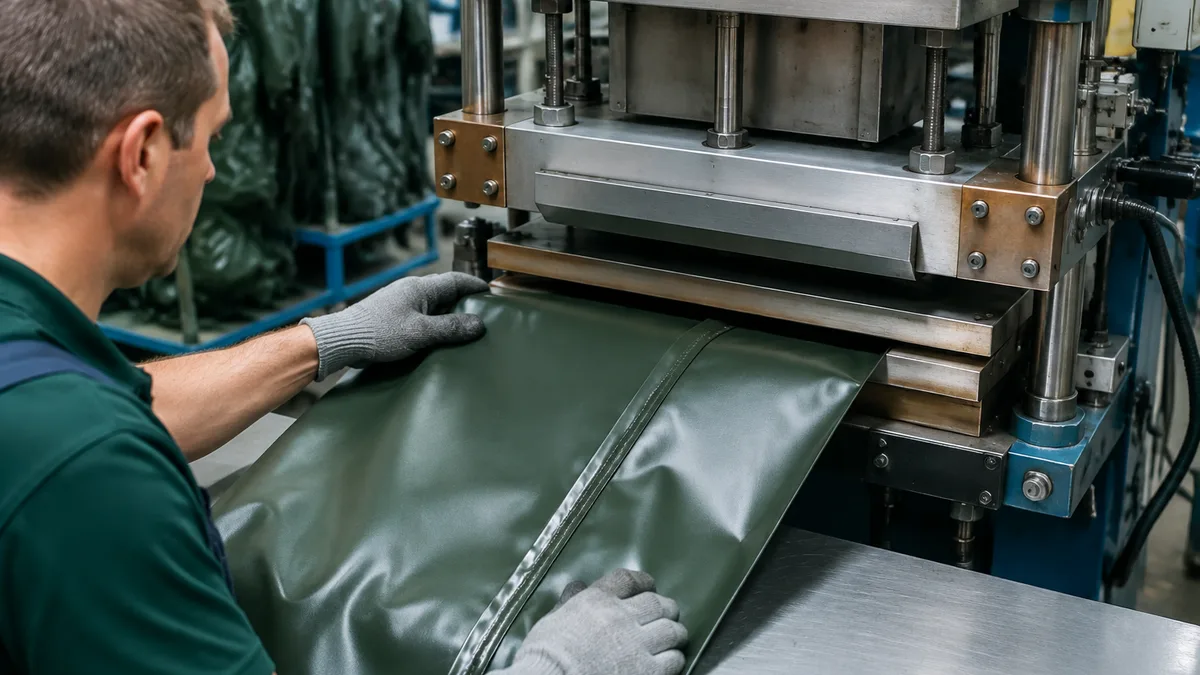
For a buyer, the practical lesson is to compare seam details, not just HH numbers. Ask the factory to state the seam method, the tape width, and the sealing temperature range in writing. Reviewing quotes from different factories, we find that quotations lacking seam details are difficult to evaluate—and if a factory cannot describe its seam process in writing, the buyer cannot fully audit the garment's watertightness.
Conclusion and Action Points
Waterproofness is meaningful only when it is quantified. HH testing gives the number, the standards classify it, and seam construction decides whether a finished garment actually reaches its class.
Ask for the HH value and the test method behind it—ISO 811, GB/T 4744, or AATCC 127. Numbers from different methods are close, but not identical, and a report without a method is a number without context.
Ask whether the value was measured on flat fabric or on a seam-sealed panel. The second number is the one that predicts real-world performance.
Match the number to the working environment. Immersion, kneeling, wind-driven rain, and full-shift wear all demand different thresholds; choose the category by the worst condition, not the average one.
Request seam specifications in writing: seam method, tape width, and sealing temperature range. If a supplier cannot provide these details, the product quality cannot be audited.
If certification is required, demand the class. EN 343 Class 1 at 800 mm is not Class 3 at 13,000 mm, and the gap between them is the difference between a garment that resists light rain and one that protects a worker for hours.
Key Takeaways
• Hydrostatic head is a pressure measurement expressed in millimeters of water column; 1,000 mm equals roughly 9.8 kPa.
• ISO 811 is the international reference method; GB/T 4744 is the Chinese equivalent used in QB/T 4999-2016 rainwear testing.
• EN 343:2019 sets three waterproofing classes: Class 1 at ≥ 800 mm, Class 2 at ≥ 8,000 mm, and Class 3 at ≥ 13,000 mm, with breathability graded separately.
• Indicative category values are about 1,000 mm for PE ponchos, 2,000 mm for EVA raincoats, 3,000–4,000 mm for breathable waders, and 5,000 mm or more for PVC chest waders; verify the figure on the specific order's test report.
• Seam-sealed panels should be tested separately because even small seal defects can create a leak path before the base fabric reaches its HH rating; buyers should demand seam-panel hydrostatic tests, not fabric-only values.
References
SGS United Kingdom. (December 1, 2019). The Background to Rain Resistance in Clothing and Other Textiles | SGS United Kingdom.
James Heal. A simple guide to: Hydrostatic head testing | James Heal.
SATRA. The EN 343 protective clothing standard.
Frequently Asked Questions
Practical answers related to this article.
What does hydrostatic head (HH) measure and how is it tested?
Hydrostatic head measures the height of a water column in millimeters that a fabric can resist before water penetrates. The test involves clamping a fabric sample under a transparent tube, adding water above it, and increasing pressure at a controlled rate until a third drop appears on the underside; the height at that point is recorded as the HH value. The reference method is ISO 811, which raises pressure at 60 mbar/min (approximately 600 mm per minute).
What are the key standards for hydrostatic head testing mentioned in the article?
The key standards are ISO 811 (international reference method), GB/T 4744 (Chinese equivalent used in QB/T 4999-2016 rainwear testing), and AATCC 127 (commonly used in North America). EN 343:2019 is the European standard for protective clothing, classifying waterproofing into Class 1 (≥800 mm), Class 2 (≥8,000 mm), and Class 3 (≥13,000 mm).
Why is a
A 'waterproof' label is not a specification because it lacks quantification. Field conditions like wind-driven rain, kneeling, immersion, or prolonged wear add pressure that a simple shower test does not replicate. HH provides a measurable pressure threshold (in mm of water column) that reflects real-world performance, unlike vague terms like 'waterproof.'
What HH values are typical for different product categories according to the article?
Typical HH ranges are: disposable PE poncho (~1,000 mm), EVA raincoat (~2,000 mm), breathable nylon/membrane waders (3,000–4,000 mm), and PVC chest waders (5,000 mm and above). These values are indicative and vary by SKU and construction; buyers should verify the specific order's test report.
Why is seam testing more important than fabric-only testing for waterproofness?
Seam testing is more important because the seam is where waterproofness usually fails. Even if fabric tests at 2,000 mm, a leak can occur at the seam under lower pressure due to needle holes, tape lifting, or seal defects. Seam-sealed panels must be tested separately, as small seal defects can create leak paths before the base fabric reaches its HH rating.
What should buyers ask for when evaluating rainwear specifications?
Buyers should ask for the HH value and the test method (ISO 811, GB/T 4744, or AATCC 127), whether the value was measured on flat fabric or seam-sealed panel, the seam method, tape width, sealing temperature range, and the EN 343 class (if certification is required). A report without these details is incomplete and cannot be fully audited.