
How Tiancigear's 3-Production-Line Facility Enables Consistent Quality and Scalable OEM Output
A factory's physical layout, the number of independent production lines it runs, and the way quality checkpoints are woven into each stage determine whether a 20,000-piece order ships on time with consistent seam strength, or whether it arrives three weeks late with mixed welding quality across cartons.
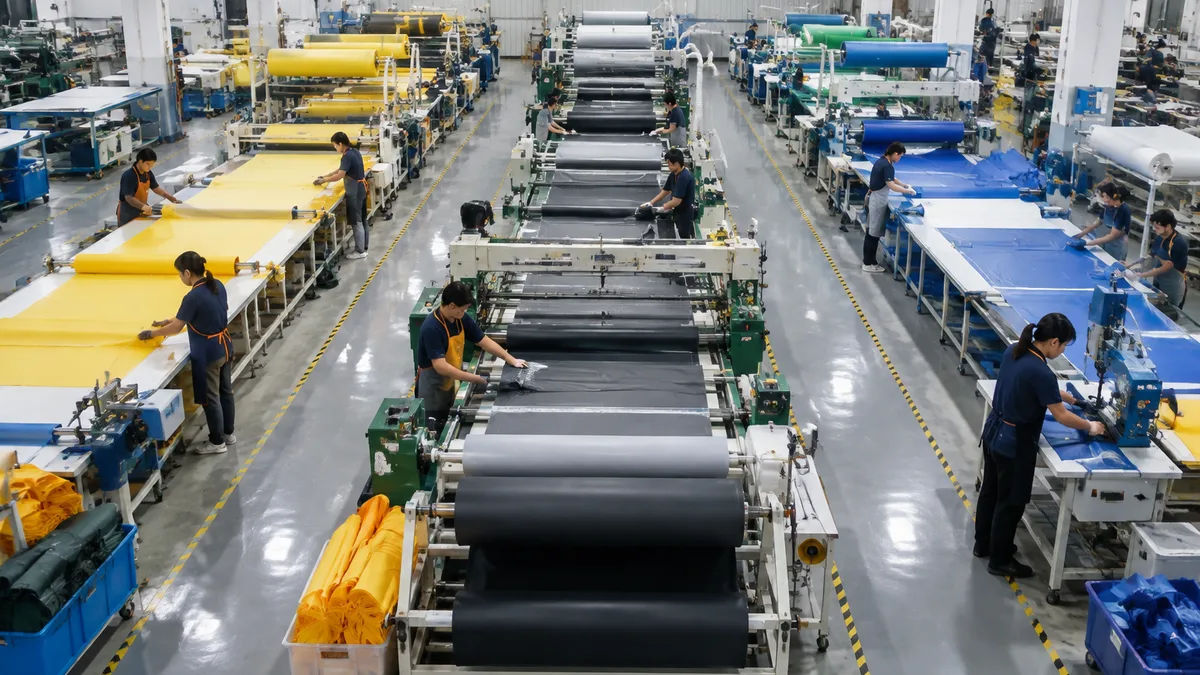
Tiancigear's 3-Line Production System: Quality at Scale
Why Production Infrastructure Matters Before You Place an OEM Order
Most B2B rainwear buyers make their first inquiry through email or a trade platform message. They ask for a catalog, a price list, and an MOQ table. In Tiancigear's experience, many B2B buyers focus initial inquiries on pricing and MOQ, only later discovering that production infrastructure directly affects lead time consistency and quality. A factory's physical layout, the number of independent production lines it runs, and the way quality checkpoints are woven into each stage determine whether a 20,000-piece order ships on time with consistent seam strength, or whether it arrives three weeks late with mixed welding quality across cartons.
As of Q1 2024, Tiancigear's 2,000-square-meter facility in Yuwu operates three dedicated production lines, and that structure is not an operational footnote. It is the mechanical answer to a procurement question buyers should ask more often: can this supplier handle my reorder volume, maintain color consistency across batches, and run my custom design without delaying someone else's standard product? The answer depends on whether the factory runs a single shared line that switches between PVC raincoats, disposable PE ponchos, and EVA rider gear—requiring full teardowns between jobs—or whether it maintains separate, material-optimized lines that can run in parallel without cross-contamination or downtime.
How Tiancigear's Three-Line Layout Separates Material Families and Reduces Switchover Loss
Tiancigear divides its 2,000 square meters into three parallel production zones, each built around a different material system. One line handles PVC-coated fabric raincoats and industrial suits, which require high-frequency welding or heat-sealing equipment capable of bonding plasticized polyvinyl chloride without scorching the substrate. A second line is dedicated to EVA film products—rain ponchos, cycling capes, and translucent fashion raincoats—where the thermoplastic copolymer allows lower-temperature sealing and faster cycle times. The third line processes disposable PE ponchos, which use polyethylene film in the 0.02 to 0.03 mm range and are sealed in a single heat-press cycle with no stitching involved.
This separation is not about prestige. It is about yield and lead time predictability. When a factory runs all three material types on a single shared line, every product changeover costs hours. The sealing temperature must be recalibrated, the cutting dies swapped, the feed rollers cleaned of residual film or fabric dust, and a test batch run to confirm that the new material bonds correctly.
PVC-coated fabric typically seals at 180–200°C, EVA film at 120–150°C, and PE film at 100–130°C, depending on film thickness and equipment type. If those ranges overlap on the same equipment without proper purging and calibration, you get weak seams on the EVA batch or scorched film on the PE run. Tiancigear's three-line structure eliminates that risk. Each line holds its calibration across weeks of continuous operation, so the first piece of a reorder batch comes out identical to the last piece of the previous run.
The layout also allows overlapping schedules. A 10,000-piece PVC raincoat order for a construction distributor can move through Line 1 while a 5,000-piece EVA poncho order for a festival organizer runs on Line 2, and a 20,000-piece PE emergency poncho order for a government relief program occupies Line 3. Without line separation, those three orders would queue in sequence, extending aggregate lead time from 15 days to 35 or more. Single-line factories may experience scheduling bottlenecks when running multiple material types sequentially, which can extend lead times beyond initial estimates.
What Line Specialization Means for Material-Specific Tooling and Process Control
Each of Tiancigear's three lines carries tooling and auxiliary equipment that matches the material it processes. The PVC line includes industrial sewing machines with walking feet and PTFE-coated presser feet (non-stick feet that prevent PVC from jamming), because PVC-coated fabric is too thick and slippery for standard domestic machines. It also has high-frequency welding stations for waterproof seams, which use radio-frequency energy to heat and fuse PVC without external contact, producing seams that are as strong as the base fabric and fully watertight.
The welding electrodes are shaped to match the seam paths on raincoat fronts, hoods, and sleeve cuffs, and they stay mounted on the line. A shared-line factory would need to unbolt those electrodes and replace them with flat-sealing bars when switching to EVA or PE, then recalibrate the power and dwell time.
Tiancigear's EVA line uses rotary heat-sealing wheels and hot-air welding guns, both of which work well with EVA's lower melting point and its tendency to flow smoothly under moderate heat. The cutting dies on this line are designed for the larger, flowing patterns that EVA ponchos require—contoured shoulder coverage, extended back panels for backpack clearance, and snap-button reinforcement holes that must be punched without tearing the film.
Because EVA is thicker than PE (typically 0.15 to 0.20 mm for rider ponchos versus 0.02 to 0.03 mm for disposable PE), the cutting blades are sharpened to a different angle and replaced more frequently to prevent ragged edges that compromise both appearance and seam integrity.
The PE line is the fastest and the simplest in terms of tooling, but it is also the most sensitive to contamination. Disposable PE ponchos are sealed in one heat-press cycle with no stitching, and the film is thin enough that a single speck of dust or a fragment of PVC coating carried over from another line can create a weak spot that splits when the user pulls the poncho over their head.
Tiancigear keeps this line isolated and requires workers to wear lint-free aprons and gloves when handling PE film. The sealing bars are cleaned between every batch, and the film rolls are stored in a separate low-humidity zone to prevent static cling, which attracts airborne particles. These protocols would be uneconomical on a shared line, where the same equipment handles heavy PVC suits one hour and delicate PE film the next.
Where Quality Checkpoints Sit Inside Each Production Stage
Tiancigear integrates quality control at four points within each line, rather than inspecting finished goods in a separate room at the end of the process.
Material Receipt and Testing
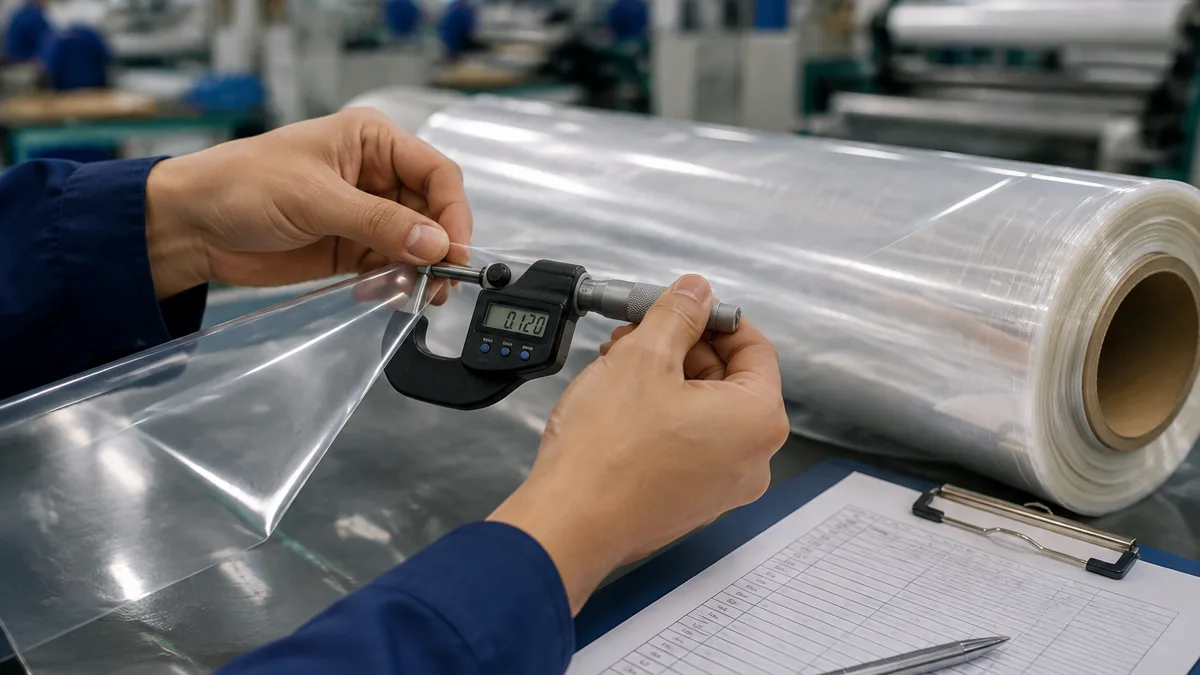
The first checkpoint occurs at material receipt and storage. Incoming rolls of PVC-coated fabric, EVA film, and PE film are logged by supplier, production date, thickness, and color batch code. A sample from each roll is pulled and tested for thickness uniformity using a digital micrometer, and a small strip is sealed on a test press to confirm that the material bonds correctly at the target temperature.
Material that fails either test is flagged and returned to the supplier before it enters the cutting queue. This step prevents an entire production batch from being rejected after cutting and assembly, which would waste both material and labor hours.
Post-Cutting Inspection
The second checkpoint is applied immediately after cutting. Each die-cut poncho or raincoat panel is visually inspected for incomplete cuts, off-center alignment, or edge defects before it moves to the sealing station. On the PVC line, this step also includes checking that snap-button holes and grommet positions are correctly punched, because a misaligned grommet cannot be repositioned after the seam is welded.
Defective panels are pulled from the line and set aside for rework or scrap, depending on the severity of the flaw. This checkpoint is staffed by workers with at least two years of cutting experience, because spotting a subtle alignment error requires familiarity with how the finished garment will be assembled.
Sealing and Assembly Verification
The third checkpoint occurs during sealing and assembly. On the PVC line, each welded seam is tested by pulling a short section under controlled tension to confirm that the bond holds without delaminating. On the EVA line, sealed edges are visually inspected under angled lighting to detect incomplete fusion, which shows up as a faint line where the two film surfaces have not fully merged.
On the PE line, every heat-sealed poncho is inflated briefly with compressed air to reveal pinhole leaks or weak spots that would not be visible in a flat inspection. Garments that fail any of these tests are diverted to a rework station, where the seam is re-sealed or the panel replaced. Tiancigear targets a rework rate below 2%, which aligns with best-practice benchmarks for factories with stable process control.
Final Audit and AQL Sampling
The fourth checkpoint is a final audit conducted on a random sample of finished, packaged goods before they are loaded into export cartons. This audit includes measuring seam strength with a tensile tester, confirming that zippers and snaps operate smoothly, checking that printed logos are aligned and legible, and verifying that the garment matches the approved sample in color, size, and labeling.
The sample size is set according to the AQL 2.5 standard (ISO 2859-1), commonly used in the apparel industry, which specifies that for a 10,000-piece batch, approximately 200 units are pulled for inspection. If the defect count exceeds the allowable threshold, the entire batch is re-inspected and any defective units are replaced before shipment. This final checkpoint protects both Tiancigear's reputation and the buyer's shelf presentation, because a customer who opens a carton and finds three broken snaps or misaligned prints will assume that quality is inconsistent across the entire order.
How Tiancigear's 50-Worker Team and 1.5-Million-Unit Annual Capacity Translate to Buyer-Relevant Metrics
Tiancigear employs 50+ skilled workers across its three production lines, and that headcount is not evenly distributed. The PVC line, which handles the most complex garments—multi-panel raincoats with hoods, storm flaps, and reflective trim—requires more assembly labor per unit than the EVA or PE lines.
The facility typically assigns 20 to 22 workers to this line, organized into paired stations where one worker feeds panels into the sewing machine or welding electrode while a second worker trims thread ends, attaches snaps, and stacks completed sections. The EVA line runs with 15 to 18 workers, because EVA ponchos have fewer seams and no stitching. The PE line operates with 12 to 15 workers, since each heat-sealed poncho requires only seconds of press time and minimal finishing.
As of 2024, Tiancigear's annual output exceeds 1.5 million units across all product categories, which breaks down to approximately 125,000 units per month or roughly 6,000 units per working day when accounting for maintenance shutdowns and holiday closures. That figure is a blended average; actual daily output varies by product type.
The PE line can produce 3,000 to 4,000 disposable ponchos per eight-hour shift when running a single design in a stock color, because the heat-seal cycle is fast and the garment requires no assembly steps beyond sealing and folding. The EVA line produces 1,500 to 2,000 ponchos per shift when the design includes contoured cuts and snap closures. The PVC line produces 800 to 1,200 raincoats or suits per shift, depending on the number of seams, the complexity of the hood, and whether the design includes reflective tape or printed logos that must be aligned during assembly.
These output rates allow Tiancigear to offer a standard lead time of 15 to 25 days for most OEM orders, measured from deposit confirmation to ready-for-shipment status. The 15-day end of that range applies to orders that use stock materials in standard colors with minimal customization—plain EVA ponchos, solid-color PE emergency ponchos, or PVC raincoats in the core palette. The 25-day end applies to orders that require custom Pantone-matched colors, screen-printed or heat-transferred logos, or non-standard sizing that demands new cutting dies.
For buyers, this lead time structure is a planning tool. If you are a retail chain preparing for a spring promotion and you need 10,000 branded EVA ponchos, you should place the order at least 30 days before your shelf date—25 days for production, plus 5 days for quality audit, packing, and handover to your freight forwarder. If you are an emergency relief organization responding to a forecast storm event, you can often secure 5,000 stock-color PE ponchos within 10 days, because those units may already be in finished-goods inventory from a previous large batch.
Why Line Capacity Matters More Than Headline Output When Evaluating OEM Scalability
Tiancigear's 1.5-million-unit annual capacity sounds large, but B2B buyers should interpret that figure in the context of order size and product mix. A factory that produces 1.5 million PE ponchos per year is running a single-product, high-volume operation. This differs significantly from a factory that produces 500,000 PVC raincoats, 600,000 EVA ponchos, and 400,000 PE ponchos in the same period.
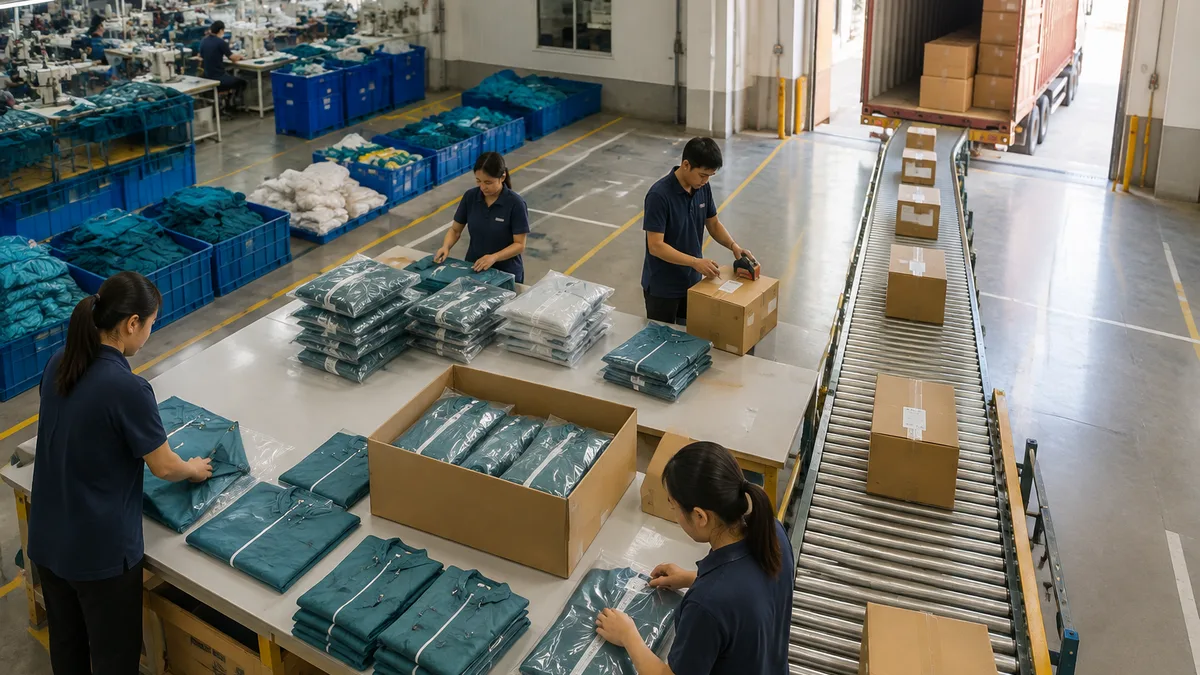
The first factory is optimized for speed and volume on a single product type, which makes it well-suited for emergency tenders and large institutional orders but less flexible when a buyer needs a mixed container of raincoats, ponchos, and suits. Tiancigear's three-line structure and product mix fall into the second category, which means the facility can fill a 40-foot container with a combination of PVC raincoats for the construction trade, EVA ponchos for festival distribution, and PE ponchos for corporate emergency kits, all produced in parallel and packed to ship on the same date.
Scalability in OEM production is not only about whether a factory can handle a single large order. It is also about whether the factory can handle multiple concurrent orders without forcing buyers into long queues or quality compromises.
A buyer placing a 5,000-piece custom raincoat order wants to know how many other orders are already in the production schedule, how much of the factory's capacity is committed to long-term contracts, and whether their order will be delayed if a larger customer places an urgent reorder. Tiancigear's three-line layout and order-management system address this concern by allowing the facility to allocate one line to high-priority custom orders while keeping the other two lines running on scheduled production. That buffer protects lead times and prevents the all-too-common scenario where a factory that promises 20-day lead times in January delivers 45 days in March because it underestimated its capacity.
What Material-Specific MOQs Reveal About Production Economics and How Tiancigear's Lines Handle Them
As of 2024, Tiancigear's MOQ structure reflects the economics of each production line, and buyers should read those minimums as signals about batch efficiency rather than arbitrary thresholds. For disposable PE ponchos, the facility typically sets a 5,000-piece minimum per custom design, because a masterbatch bag (concentrated pigment used to tint plastic film) tints a full film roll.
A custom-color order below 5,000 pieces leaves unused film that cannot be economically held for a future reorder, since another buyer is unlikely to request the same Pantone shade in the same film thickness. Stock-color PE ponchos, by contrast, can often be quoted at a lower MOQ in the 3,000-piece range, because Tiancigear runs those configurations regularly and carries the film in standing inventory.
For EVA ponchos, the MOQ sits at 1,000 to 2,000 pieces, depending on the level of customization. A semi-custom order—standard cut, stock color, printed logo—can start at 1,000 pieces because the EVA film is purchased in smaller rolls and each order can draw from inventory if the buyer selects a color already in stock. A fully custom order—Pantone-matched color, contoured pattern, snap-button closures, and embossed branding—requires 2,000 pieces to justify the cost of new cutting dies and the setup time for the embossing station.
For PVC raincoats and suits, the MOQ ranges from 500 to 1,000 pieces, because these garments involve more labor per unit and the material cost is higher. A 500-piece order is economical when the buyer accepts a standard pattern and color; a 1,000-piece order is required for fully custom designs that include reflective tape, storm flaps, or multi-color paneling.
Contact Tiancigear directly to confirm MOQs and lead times for your specific order, as these may vary by season and material availability. These MOQ figures are not negotiation starting points. They are the order sizes at which production cost per unit drops below the price floor that makes the order profitable after accounting for material waste, setup labor, and the opportunity cost of line time.
A buyer who asks for 2,000 custom PE ponchos instead of 5,000 is not asking for a small concession; they are asking the factory to produce at a loss or to hold unusable film inventory that may never be consumed. Accepting orders below MOQ without price adjustment typically results in either negative margins or quality trade-offs, as the factory must absorb setup costs or use leftover materials from unrelated batches.
How Tiancigear's Lead Time Breaks Down by Production Stage and Where Delays Actually Occur
Current lead times range from 15 to 25 days, depending on customization level and material availability. This timeframe includes four distinct stages: material preparation, cutting, sealing and assembly, and inspection and packing.
Material preparation takes 2 to 5 days and includes confirming that the required PVC fabric, EVA film, or PE film is in stock, pulling the correct color batch, and pre-cutting large rolls into manageable widths that fit the cutting tables. If a buyer has requested a custom Pantone color, this stage extends to 7 or 10 days, because the film supplier must mix a new masterbatch, extrude a test roll, submit a color sample for approval, and then produce the full order quantity once the sample is confirmed. This is the single longest variable in lead time, and it is also the stage over which Tiancigear has the least control, because it depends on the film supplier's schedule.
Cutting takes 1 to 3 days, depending on the complexity of the pattern and the order quantity. A 5,000-piece order of simple rectangular PE ponchos can be die-cut in a single shift, because the cutting die nests dozens of pieces per meter of film and the operation is fast. A 2,000-piece order of contoured EVA rider ponchos with extended back panels takes longer, because the pattern is less efficient and each cut piece must be inspected for alignment.
Cutting
References
Argus Apparel. Apparel Manufacturing Quality Control Checklist.
Thai Son S.P. How to Control Lead Time in Garment Production - Thai Son S.P.
Capital World Group. Apparel Manufacturing Lead Times: A US Brand's Guide.
Frequently Asked Questions
Practical answers related to this article.
How many production lines does Tiancigear operate, and where is the facility located?
As of Q1 2024, Tiancigear operates three dedicated production lines in its 2,000-square-meter facility in Yuwu.
What material types are processed on each of Tiancigear's three production lines?
Line 1 handles PVC-coated fabric raincoats and industrial suits; Line 2 processes EVA film products like rain ponchos and cycling capes; Line 3 produces disposable PE ponchos.
Why does Tiancigear use separate production lines instead of a single shared line?
Separate lines eliminate cross-contamination and downtime during changeovers. Each line maintains consistent calibration for its specific material, reducing lead time and improving yield—e.g., switching between PVC (180–200°C), EVA (120–150°C), and PE (100–130°C) sealing temperatures would require hours of recalibration on a shared line.
What quality checkpoints does Tiancigear integrate into its production process?
Tiancigear integrates four quality checkpoints: 1) Material receipt and testing, 2) Post-cutting inspection, 3) Sealing and assembly verification, and 4) Final audit with AQL sampling before shipment.
What is Tiancigear’s standard lead time for OEM orders, and what factors affect it?
Tiancigear offers a standard lead time of 15 to 25 days from deposit confirmation to ready-for-shipment status. The 15-day end applies to orders using stock materials in standard colors with minimal customization; more complex or custom orders may take longer.
How many workers does Tiancigear employ, and how are they distributed across the production lines?
Tiancigear employs 50+ skilled workers. Typically, 20–22 workers are assigned to the PVC line, 15–18 to the EVA line, and 12–15 to the PE line, reflecting the varying labor intensity per product type.