Can a PVC Raincoat Be Customized with Reflective Strips and Logo Printing? What Are the Limitations?
Yes—a PVC raincoat can be customized with reflective strips, logo printing, and custom colorways, but there are process-related limitations such as reflective tape placement, extra drying time for high-contrast logos, and a 500-piece MOQ for custom branding.
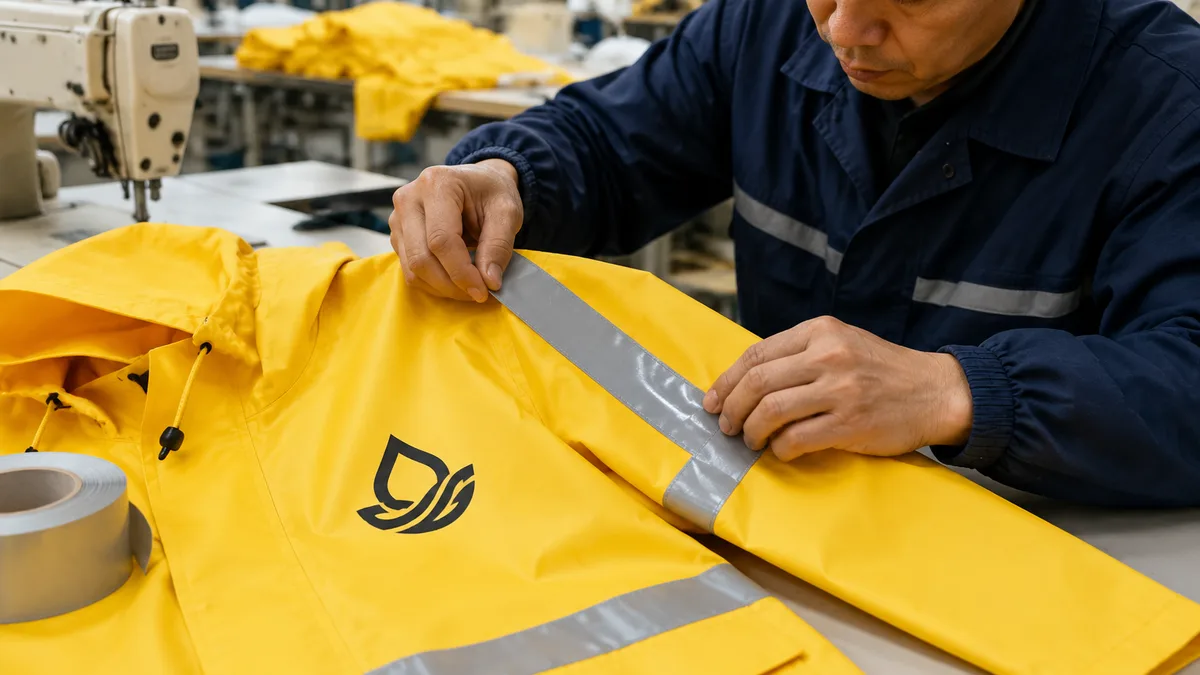
Yes—a PVC raincoat can be customized with reflective strips, logo printing, and custom colorways, and for TianCiGear, you treat each one as a distinct production stage. You apply reflective tape after the raincoat is sewn, print logos with screen printing or heat transfer, and introduce custom colors at the masterbatch stage. The practical limits are process-related, not capability-related: reflective tape must be positioned outside weld zones, high-contrast logos need extra drying time, and the MOQ for custom branding starts at 500 pieces for standard PVC raincoats.
Buyers ask this question for two reasons. An e-commerce seller wants a branded product that stands out. A procurement manager wants a safety garment that meets a tender specification. Both goals are achievable, but they require different decisions at the sampling stage.
What TianCiGear Can Customize on a PVC Raincoat
For a PVC raincoat, the branding surface and the visibility surface are different materials with different rules. You support three main customization routes:
• Screen printing is the most economical choice for logos on film materials like PVC and EVA. The ink bonds to the polymer surface without needle penetration, so the waterproofing stays intact.
• Heat transfer works well when artwork contains fine detail, multiple colors, or gradients that screen printing cannot register cleanly on a curved panel.
• Reflective tape is applied as a separate step. For EN 20471-compliant garments, you use certified reflective material and position it according to the standard's minimum area requirements.
Custom colorways follow a different logic. You color PVC film at the masterbatch stage, which means the dye lot sets the practical minimum quantity. A custom color therefore costs more than a standard one: it requires a dedicated batch rather than a draw from existing stock.
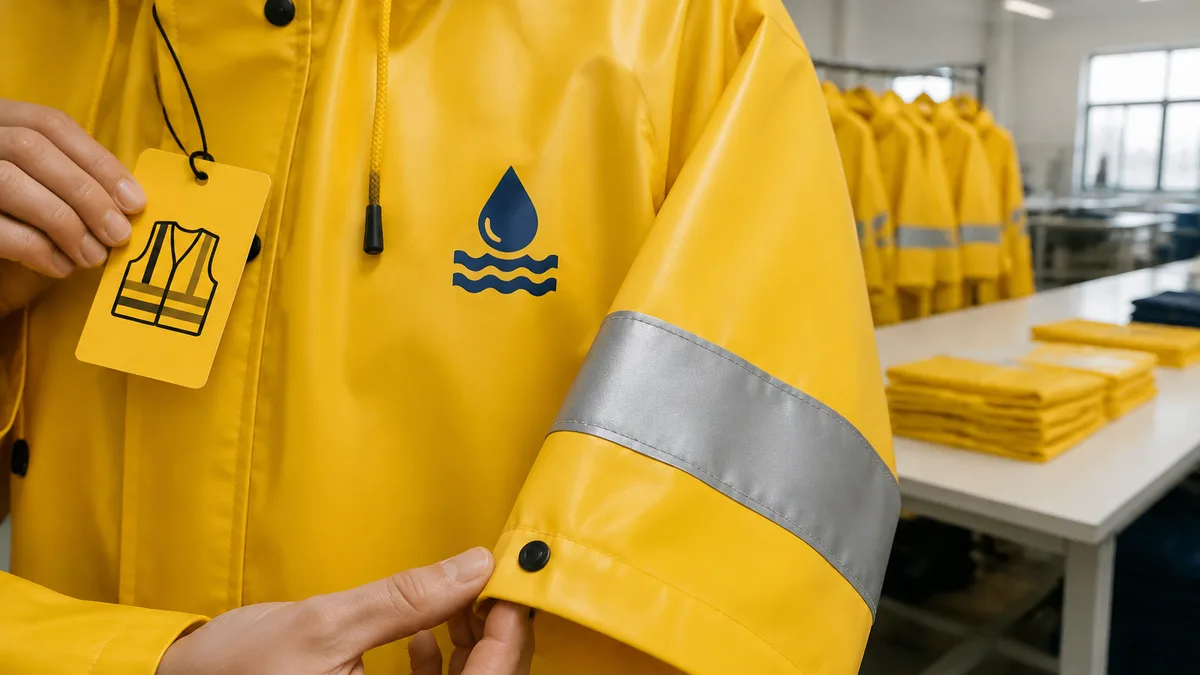
One combination deserves attention during design. Logo placement and reflective tape should not compete for the same panel. If a chest logo sits too close to a reflective stripe, the ink can be partially hidden in low light, and the print can reduce the certified reflective area. On your line, you position the two on separate panels or keep a clear gap between them.
The Limitations You Need to Plan Around
Reflective strips must be applied after sewing
If reflective tape is sewn or welded before the panels are joined, the seam allowance can pull the tape, cause wrinkles, or expose a raw edge that traps water. That is why you apply reflective strips after the main garment assembly. The practical consequence is simple: reflective tape adds a production step, and that step appears in the lead time.
There is also a thermal consideration. High-frequency welding, which you use to seal PVC seams, generates heat and pressure. If reflective tape falls inside the weld zone, the heat can degrade the glass-bead or microprismatic layer and reduce retroreflective performance. Keeping the tape outside the weld zone protects both the seam and the certified visibility property.
High-contrast logos may require additional drying time
Light ink on dark PVC, or white ink on a high-vis yellow shell, needs more cure time than dark ink on a light shell. The ink will bond, but if the garment is folded and packed before the print has fully flashed, the logo can block against itself or the poly bag. On your line, you add drying time for these jobs and adjust the stacking pattern so printed panels do not face each other in the carton.
Common misconceptions about decorating PVC
Embroidery is the first. Embroidery requires needle penetration, and on PVC every needle hole is a potential leak path. Unless each hole is sealed, water can migrate through the pattern, and the film distorts under thread tension. On a lightweight raincoat, you steer buyers toward woven neck labels or heat-transfer labels instead.
Machine washing is the second. Most PVC garments should be hand washed in cold water; machine washing risks seam separation and can degrade the reflective layer. Titanium-coated reflective tape, in particular, should be cleaned with a damp microfiber cloth and mild soap, because strong solvents can break down the coating.
Certified area is the third. A thin decorative strip looks similar to a certified reflective band but does not meet EN ISO 20471's minimum area for the garment class. If the buyer advertises a Class 2 hi-vis raincoat, the tape width and placement must match the tested configuration.
MOQ, Sampling, and Lead Time for Branded PVC Raincoats
The commercial thresholds are straightforward. As a PVC raincoat manufacturer, your MOQ for custom branding on standard PVC raincoats is 500 pieces. If a buyer requests a custom color, that number can move upward because the masterbatch run is sized by the dye lot. Lower volumes are possible only with premium pricing that absorbs the setup costs.
| Milestone | Timeline |
|---|---|
| Concept-to-sample | Under two weeks |
| Sample approval and revisions | 3–7 days |
| Full OEM order lead time | 25–35 days |
| Custom color masterbatch run | Adds 5–10 days |
The practical sequence: launch with two standard factory colors, then introduce a signature color in the second season. The first order stays close to the 500-piece floor, and the second purchase order absorbs the masterbatch cost once sales data justifies it.
The sample round is where these limits become visible. On your line, the sample confirms three things in one pass: whether the ink adheres to the film, whether the reflective tape lays flat around the collar and cuffs, and whether the custom color matches the buyer's reference. That is why concept-to-sample takes under two weeks rather than a single day—each element needs its own verification. Lead times also depend on the decoration load. A five-color logo with reflective tape and a custom color is a different job from a one-color printed logo on a stock raincoat. The 25–35 day window assumes the specification is frozen after sample approval.
Case Data: What the Standards Actually Require
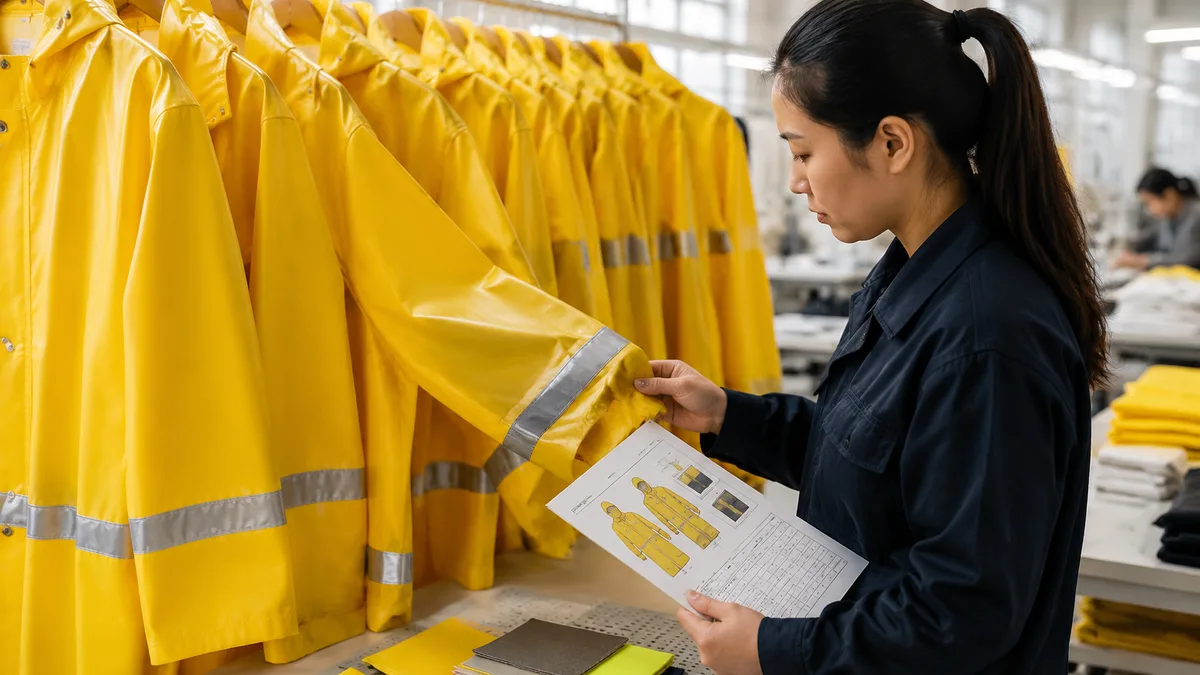
For e-commerce sellers, logo durability and waterproofing sit at the top of the checklist. For safety teams, the standard is the floor. If you supply hi-vis rainwear into the European market, the relevant framework is EN ISO 20471 for visibility and EN 343 for rain protection.
Under the European PPE Regulation (EU) 2016/425, high-visibility clothing is classified as Category II PPE. That classification requires an EU-type examination by a notified body before the CE mark can be applied. The contracting consequence is direct: when a distributor places its own label on the garment, it steps into the role of manufacturer for regulatory purposes. Your factory supplies the production and the test reports, but the distributor owns the compliance file in the EU.
A Declaration of Conformity is not sufficient if the reflective configuration deviates from the tested sample. Procurement officers rarely test garments themselves; they check the label marking, the standard references on the order, and the technical file. The safest route is to lock the reflective tape specification—width, placement, certified supplier—at the sample stage and refuse to change it during bulk production.
Conclusion and Action Points
Order a pre-production sample before bulk production. Even a repeat design can behave differently on a new material lot, so your factory verifies zipper spec, seam-tape width, and reflective tape adhesion against the prior batch.
Confirm the certified reflective area. EN ISO 20471 sets minimum retroreflective area per garment class; if the logo overlaps the tape or the tape is decorative, the garment may not meet the advertised class.
Align on drying and packaging. High-contrast prints must be fully cured before folding and packing, and individual poly bags protect printed panels during long transit.
Plan around the timeline. Standard 500-piece orders fit a 25–35 day lead time; custom colors and certified hi-vis programs add time at the front end, so include the sample round in the buying calendar.
Key Takeaways
| Takeaway | What it means for your order |
|---|---|
| Customization is possible | Logo printing, EN 20471-compliant reflective tape, and custom colorways are available on PVC raincoats |
| Process limits exist | Reflective tape is applied after sewing and outside weld zones; high-contrast prints need extra drying time |
| MOQ | 500 pieces for standard PVC raincoats; custom colors may raise it; lower volumes carry premium pricing |
| Timeline | Concept-to-sample under two weeks; full OEM order 25–35 days |
| Compliance | Hi-vis garments under EU 2016/425 are Category II PPE; the buyer owns the compliance file |
References
Cnygm. Reflective Tape For Clothing Manufacturer - YGM Reflective.
Chinareflective. What Is Reflective Tape And Where To Buy Reflective Tape for Clothing | Chinastars.
Xwreflective. TC Reflective Tape Manufacturer, China Supplier - XW Reflective.
Made In China. Reflective PVC Raincoat Durable PVC Rain Coat ....
Bp Online. EN ISO 20471: What you need to know about high-visibility protection..