
PVC, EVA, and Nylon Waders Compared — Material Technology and Seam Types
Compare solid PVC, PVC-coated nylon, and breathable waders: material construction, seam methods, comfort, and how to choose based on working conditions.
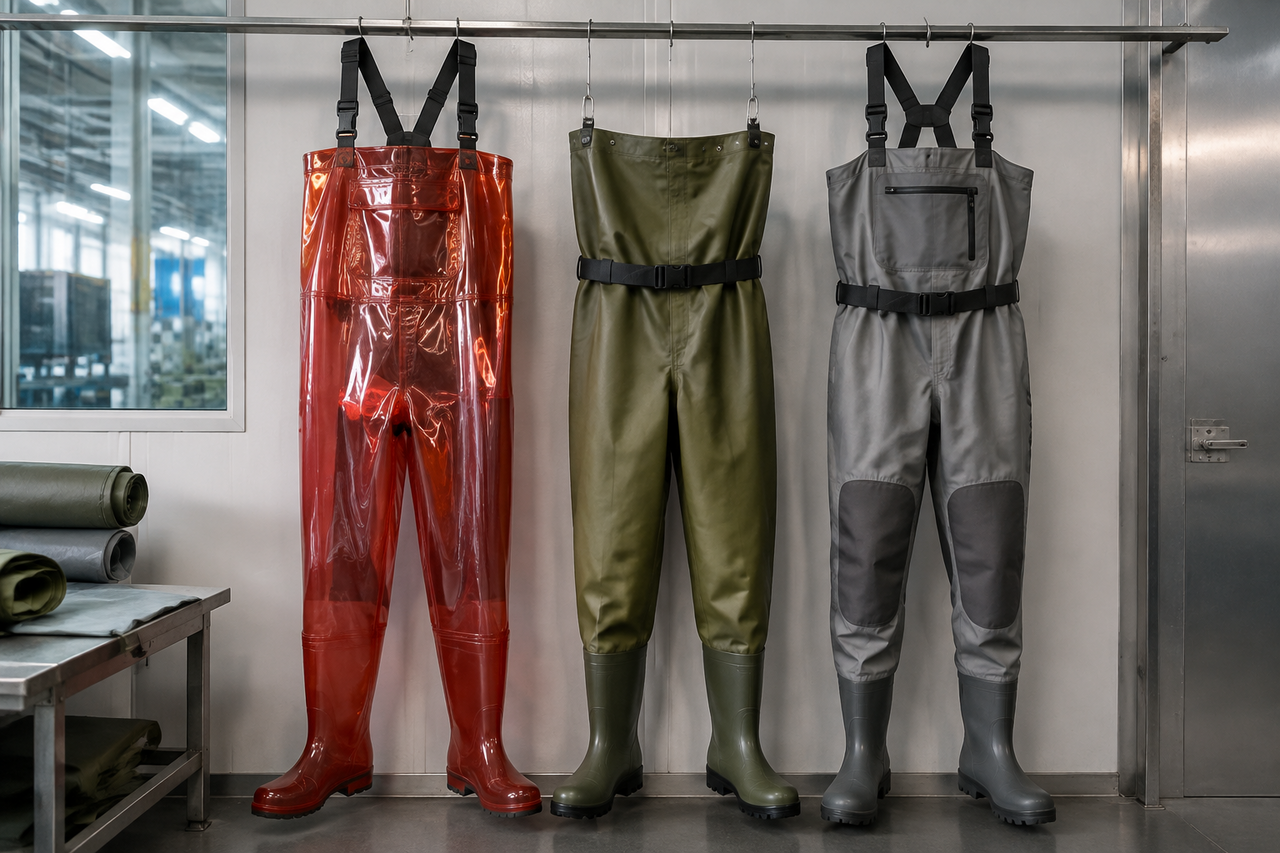
When a buyer compares PVC, nylon, and breathable waders side by side, the important differences are not in the color or the buckles but in how each construction behaves under cold, under physical stress, and over a long working day. Solid PVC waders are thick film garments joined by dielectric welding and chosen for cold water and chemical exposure; PVC-coated nylon waders combine a fabric substrate with a waterproof coating and depend on stitched-and-taped seams; breathable waders use a laminated membrane that releases sweat vapor while keeping water out. Working duration and water temperature should drive the decision, with chemical exposure and budget as the secondary filters.
The three wader constructions at a glance
Tiancigear produces three wader constructions — solid PVC chest waders, PVC-coated nylon waist waders, and breathable chest waders — and each one carries the waterproof function in a different material. Solid PVC is a self-supporting film, coated nylon is a fabric with a waterproof layer bonded to it, and breathable waders are a laminated membrane assembly.
The table below is a starting point, not a substitute for test reports. Every figure in it is a typical range; the values on a specific quotation should be confirmed against the factory's material data sheet and a pre-production sample.
PropertySolid PVC chest waderPVC-coated nylon waist waderBreathable chest waderWaterproof layerContinuous PVC film, typically 0.3–0.6 mmPVC coating on a woven nylon base, often 210D–300DLaminated membrane, microporous PU or ePTFEHydrostatic headNot the limiting factor; the film has no pores3,000–8,000 mm depending on coating weight5,000–20,000 mm depending on membrane gradeMoisture vapor transmissionNegligibleNegligible5,000–15,000 g/m²/24h typicalSeam methodDielectric (high-frequency) weldingStitched, then sealed with hot-melt tapeStitched, then sealed with membrane-compatible tapeFlexibility in coldStiffens below about 10°C; grade-dependent below 0°CModerate; coating stiffens as temperature dropsMaintains flexibility in most working rangesChemical resistanceGood against many acids, alkalis, and oilsModerate; solvent exposure can damage the coatingLow; intended for clean water and mild conditionsTypical full-garment weightHeaviest of the threeMediumLightest of the threeBest-fit working patternShort-duration, cold water, chemical risk, limited movementShallow-water work, frequent donning and doffing, warm or cool conditionsLong-duration active work in mild to warm conditions
Read the hydrostatic-head column with one caution: for a continuous film like solid PVC, water cannot pass through the material at all, so the meaningful test is not the film but the seam weld. For coated fabrics and membranes, ISO 811 hydrostatic-head testing is the standard way to compare waterproofness, and a respectable work wader should carry a documented minimum value rather than a marketing phrase.
What each wader construction is made of
The material that carries the waterproof function determines almost everything else about a wader, including its seam method, its weight, its working temperature range, and its failure modes. A buyer who can read a material specification — resin type, film thickness, base-fabric denier, coating weight, membrane construction — can evaluate two quotations against each other instead of comparing claims.
Solid PVC and EVA film waders
Solid PVC waders start as PVC resin mixed with plasticizers, heat stabilizers, and often UV stabilizers, calendered into a continuous film of controlled thickness. The plasticizer content is the single most important formulation detail: too little makes the film stiff and prone to cracking in cold weather; too much makes it soft, more easily punctured, and prone to plasticizer migration over time. A film between roughly 0.3 mm and 0.6 mm is typical for wader bodies, with heavier material in the lower legs and boots. Because the film has no pores, waterproofness is a given; what you are really buying is thickness, flexibility, and chemical resistance.
EVA (ethylene-vinyl acetate) appears in some wader ranges as a lighter relative of PVC. EVA film stays flexible at lower temperatures and weighs less, which is why it shows up in budget and mid-price waders and in molded boot constructions. The trade-offs matter for industrial buyers: EVA is less abrasion resistant than PVC, tears more easily on sharp edges, and has a different chemical profile, so it should not be substituted for PVC where acids, alkalis, or oils are part of the working environment. If a supplier offers EVA where you specified PVC, ask for the chemical-resistance data before approving the change.
PVC-coated nylon waders
In a coated-nylon wader, the waterproof function comes from a PVC layer applied to a woven nylon base fabric, typically in the 210D to 600D range for the body and heavier in the boot areas. The nylon carries the tear and puncture strength; the coating provides the impermeability. That division of labor is the key to understanding the construction: if the coating is scratched, the fabric still holds, but if the coating delaminates from the fabric, the wader is finished even though the nylon looks intact. Bond strength between coating and fabric should therefore appear on the spec sheet alongside base-fabric weight and coating weight.
PVC-coated nylon is heavier and stiffer than bare woven nylon but far more supple than solid PVC film, which makes it the natural choice for waist waders that get donned and doffed repeatedly through the day. A lower-leg reinforcement of heavier denier or an extra coating pass is a common factory option where the wader rubs against boots or tank edges. One caution from our production experience: PU-coated nylon, a cheaper alternative, is more vulnerable to hydrolysis than PVC-coated nylon when stored wet, which is one reason work-wader programs with damp storage conditions favor PVC coatings.
For further reading, see A Public Lands buying guide compares PVC and nylon wader materials and breathability..
Breathable laminated-fabric waders
Breathable wader fabric is a laminate, not a coating. A microporous membrane — typically polyurethane or ePTFE — is bonded between an outer nylon face fabric and, in three-layer construction, an inner knit liner. The membrane pores are large enough to let water-vapor molecules pass through when the wearer sweats, but small enough to block liquid water under pressure. Two-layer and 2.5-layer constructions drop the inner liner to save weight, at the cost of a printed or mesh inner surface that touches the leg directly.
The two numbers that matter on a breathable wader spec sheet are hydrostatic head, measured in millimeters under ISO 811 or an equivalent method, and moisture vapor transmission rate (MVTR), measured in grams per square meter per 24 hours. A practical work wader typically sits in the 5,000–20,000 mm range for hydrostatic head and 5,000–15,000 g/m²/24h for MVTR, depending on membrane grade. The adhesive bonds that hold the laminate together are the vulnerable point: they degrade with heat, with repeated flexing, and most of all with wet storage. In accelerated aging tests at our factory, wet-hung laminated samples delaminate roughly 30–40% faster than identical samples dried properly, so storage instructions are not a minor detail — they are part of the product's expected life.
Seam technology: where waders actually leak
The seam is where most waterproof failures begin, because every needle hole is a potential leak path and every weld depends on machine settings that can drift during a production run. In practice, the majority of wader waterproofing complaints trace back to seam integrity, not to the material itself.
For a buyer, the question is not "is it welded or sewn?" but "exactly how is this specific seam made, and how does the factory verify it?" The answer should appear in writing on the spec sheet. One distributor we work with requires the factory to state the seam method, the tape width, and the sealing temperature range for every SKU, and has rejected quotations that omit seam details entirely. That is a good habit to copy.
Welded seams on PVC and EVA
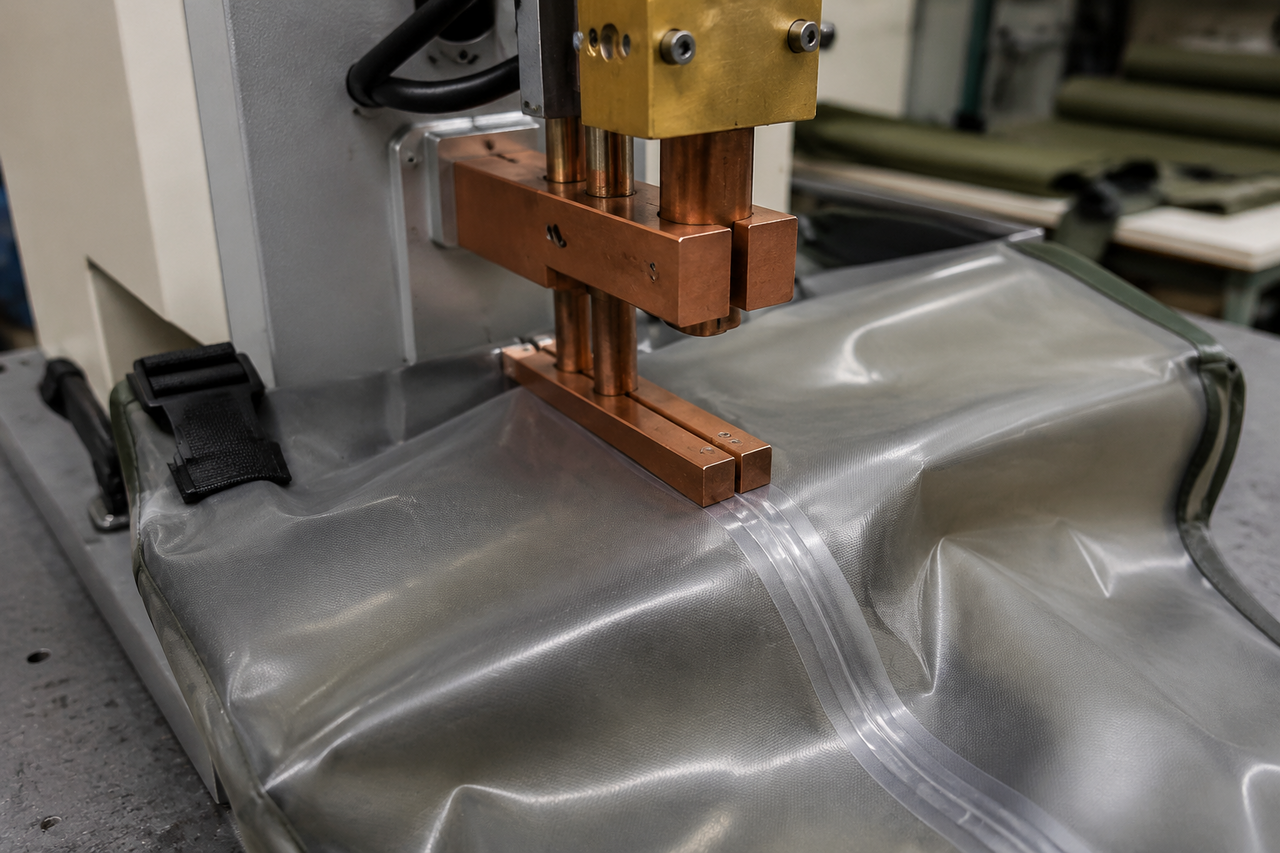
Dielectric welding, also called high-frequency or radio-frequency welding, is the standard seam method for solid PVC and EVA waders. The panels are placed between copper electrodes, and a high-frequency electromagnetic field excites the polymer molecules so the two layers fuse into one. The result is a joint without thread or adhesive, and on a correct weld the seam is as strong as, or stronger than, the surrounding film.
The failure modes are what a buyer should probe. A cold weld from insufficient power or pressure looks fused but separates under stress. Overheating degrades the polymer and creates a brittle line that cracks later. Contamination on the film surface — dust, release agents, moisture, or greasy fingerprints — prevents molecular fusion over part of the weld width. A serious factory logs welding parameters per batch and tests welds destructively on samples, pulling them until they tear. ISO 811 hydrostatic-head testing on seam-sealed panels is the reference method; in our experience even a gap of 0.5 mm in a seam seal creates a measurable leak path before the base film itself would fail.
Stitched-and-taped seams on coated nylon and breathable waders
Fabric-based waders cannot be welded panel-to-panel in the same way, so they are stitched, and every needle hole becomes a micro leak path. The waterproofing work is done by the seam tape: after stitching, a hot-melt adhesive tape is pressed over the seam from the inside, covering the needle holes and bonding to the coating or membrane. A stitched-and-taped seam is only as good as three things — the stitch quality, the tape's bond to the material, and the sealing machine's temperature, pressure, and speed.
Leaks occur where the tape bond is incomplete: at tape ends, at the start and stop of each tape run, at compound curves like the crotch and the boot attachment, and where a folded hem creates a bump the tape has to bridge. Tape width is a spec-sheet item for a reason: wider tape covers more risk area, but it must follow curves without wrinkling. For breathable waders, the tape must be compatible with the membrane, and the taped area becomes a non-breathable patch. That is normal, but the pattern should minimize total taped area so the garment keeps as much breathable surface as possible.
How a factory validates seam integrity
A complete seam-validation sequence looks like this in production:
- Panel preparation — cut panels are inspected and the seam zones are cleaned of dust and release residue before assembly.
- Joining — panels are welded or stitched, with machine parameters logged per batch so a problem can be traced to a specific run.
- Sealing — stitched seams are taped on a hot-air or hot-melt machine at the documented temperature, pressure, and speed, with tape width recorded per SKU.
- Verification — seam samples are pulled to destruction and seam-sealed panels are hydrostatic-head tested per ISO 811, while finished garments pass an air-inflation or full-water leak check.
Comfort and heat stress: how long can a worker actually wear them?
Breathable construction exists for one practical reason: it extends the number of hours a person can stay in a wader before heat and sweat force them out. A solid PVC wader seals water out, but it seals sweat vapor in, and in warm conditions the inside of the garment becomes a saturated microclimate very quickly.
The body cools itself by evaporating sweat. When vapor cannot escape the garment, evaporation stops, cooling stops, and the wearer is effectively working inside a plastic bag. Anyone who has worn solid PVC waders on a warm day knows the sensation: the garment is wringing wet inside within a short time, quite independently of any leak. The practical limit depends on temperature and effort, but the pattern is consistent — short, static work is fine; active walking, lifting, or stream-crossing work is not.
This is where the waist wader earns its place in a range. A coated-nylon waist wader covers less body surface, so the heat load is dramatically lower even though the material itself is non-breathable. For shallow-water tasks, a waist wader is often better comfort engineering than a breathable chest wader: it keeps the legs dry without wrapping the torso in a sealed layer.
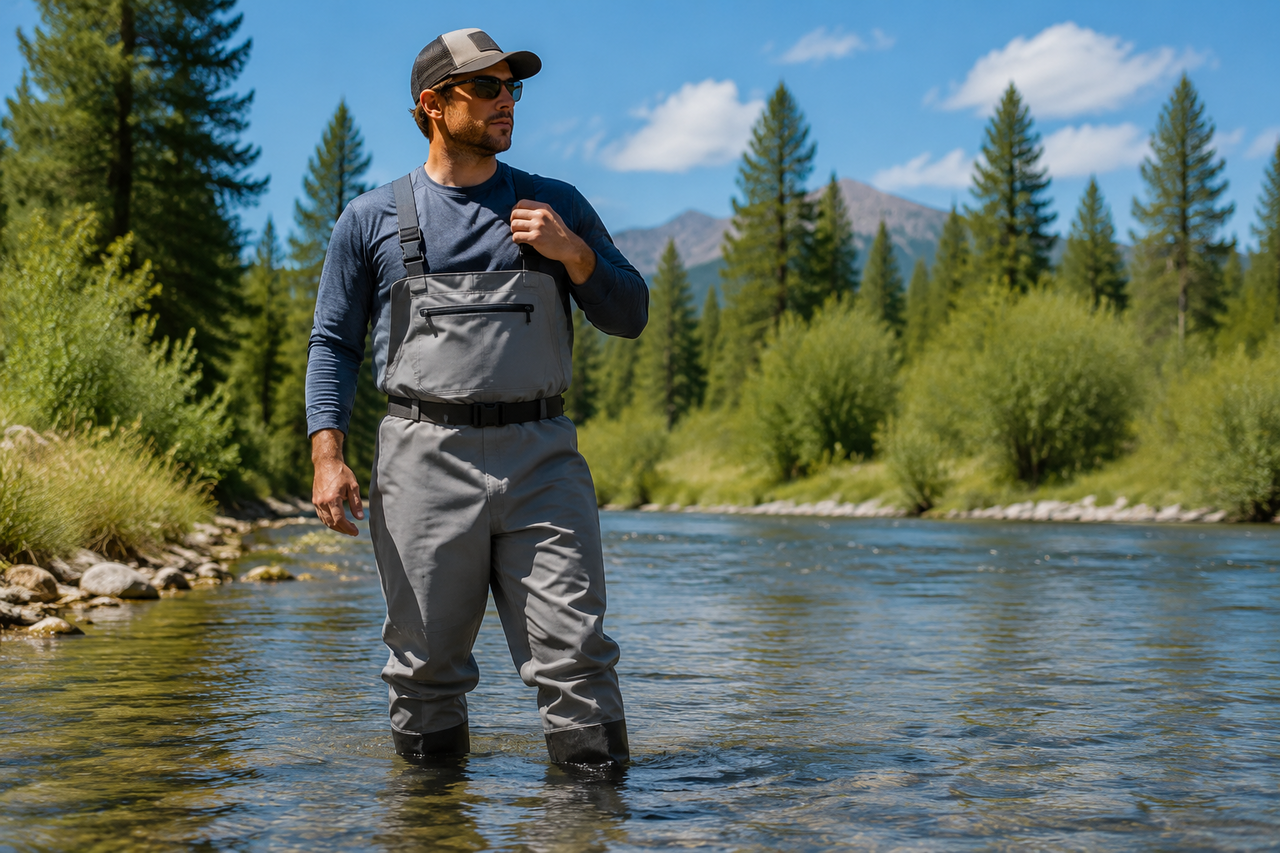
A breathable chest wader solves a different problem. It allows full-shift wearing in mild to warm conditions because sweat vapor escapes steadily. In our experience, buyers who switch from solid PVC to breathable for active, long-duration work consistently report the same outcome — the wader stops being the limiting factor in how long a worker can stay on the job. The trade-off is price, membrane fragility, and a stricter care regime.
Cold weather changes the calculation. In cold water, the insulating effect of a non-breathable wader is a genuine advantage; the sealed layer keeps body heat in, and the thicker PVC film adds insulation. The same property that is a liability in July is a benefit in January. The real winter problem with PVC is mechanical: standard formulations stiffen as temperature drops, and near freezing a board-like wader becomes a mobility and safety issue. A cold-flex PVC formulation, or a fabric-reinforced model, is the buyer's tool for that condition.
Matching wader construction to working conditions
Choose a wader construction by four criteria in order of importance: wading depth, water temperature, working duration and activity level, and chemical exposure. Each of the three constructions wins on at least one criterion; none wins on all four.
Start with depth. Chest waders belong where water comes above the knee; waist waders suit depths that stay below mid-thigh, where waterproofing is needed without the heat load of a chest garment. Past the knee, a breathable chest wader is the workable option for long tasks, because the alternative is extended time inside a non-breathable shell.
Then temperature. When the workday is warm, roughly above 20°C air temperature, breathable construction should be the priority for anyone who will be moving. In cold conditions, PVC's heat retention is an asset, and its stiffness is the constraint to manage. Coated nylon sits between the two: moderate flexibility, moderate heat retention, and a waist-height form factor that keeps the heat question manageable. The PVC-versus-breathable decision, in other words, is really a duration-and-activity decision dressed up as a material debate.
Finally, exposure. Solid PVC has the strongest chemical resistance of the three, which is why it remains the standard for sewage work, agricultural chemical handling, abattoirs, and industrial cleaning. Breathable membranes belong in clean-water applications. If the specification includes acids, alkalis, oils, or disinfectants, the construction decision is made for you: PVC, with the chemical-resistance data sheet requested in writing.
Structuring a wader range for different buyer segments
A distributor does not have to choose one construction; the strongest wader ranges mix waist and chest models and pair non-breathable with breathable versions, because different end users have different work cycles. A coherent range lets one buyer cover farms, fisheries, utilities, and technical users from a single supplier.
The entry volume driver in most programs is the solid PVC chest wader — welded seams, one material, no tape, low unit cost, and the largest MOQ. The mid-range volume comes from coated-nylon waist waders for agriculture, aquaculture, and facility maintenance, where the end user is in and out of shallow water all day. The high-margin, lower-volume tier is the breathable chest wader for angling guides, field technicians, and long-duration river and wetland work. Typical lead times and MOQ tiers differ between the three constructions because welding and taping are different production lines; ask the factory to quote each model separately rather than accepting a blended price.
Range design questions to settle before sampling: how many boot or stocking-foot options each model carries, how the male and female sizing curves overlap, whether the waist and chest waders share a grade rule, and which accessories — gravel guards, neoprene socks, suspender systems, utility pockets — are standard versus optional. Matching upper-body sizes to boot sizes is one of the most common fit complaints in waders; a range that offers two upper sizes per boot size cuts return rates.
For further reading, see Wired2Fish's 2026 wader roundup highlights breathable models for varied conditions..
For private label, the spec sheet is the contract. For every SKU it should state the material composition and gauge — film thickness for PVC, base-fabric denier and coating weight for coated nylon, membrane construction and layer count for breathable — plus the seam method, tape width, sealing temperature range, minimum hydrostatic head per ISO 811, MVTR where breathability is claimed, and the hardware specification: buckles, straps, and boot attachment method. Add batch traceability, compliance documentation such as REACH where applicable, and the factory's storage and care instructions, because wet storage measurably shortens the life of coated and laminated constructions.
Conclusion: verify before you commit
The three constructions are not competing versions of the same product; they are different tools. Solid PVC waders win on chemical resistance, cost, and cold-water heat retention. Coated-nylon waist waders win on shallow-water versatility and low heat load. Breathable waders win on full-shift comfort in active work. The buying mistake is choosing by price alone, because the difference between a solid PVC chest wader and a breathable chest wader is the price of a different working-day length.
The next step is concrete: write down the working conditions for each end-user group — wading depth, water and air temperature, hours in the garment, activity level, and any chemical exposure — then ask the factory for three documents before sampling: the material spec sheet, the seam parameter sheet, and the hydrostatic-head test report from the most recent production batch. A supplier that produces all three without hesitation is a supplier that controls its seams. A supplier that cannot is asking you to trust the marketing sheet instead of the product.
References
• Neoprene vs. Breathable Waders
• Best Fishing Waders For 2026 - Wired2Fish
Frequently Asked Questions
Practical answers related to this article.
What are the three wader constructions compared in the article?
Solid PVC chest waders, PVC-coated nylon waist waders, and breathable chest waders. Solid PVC uses a continuous film, PVC-coated nylon combines a fabric substrate with a waterproof coating, and breathable waders use a laminated membrane that releases sweat vapor while keeping water out.
What are the typical seam methods for each wader type?
Solid PVC waders use dielectric (high-frequency) welding; PVC-coated nylon and breathable waders use stitched-and-taped seams with hot-melt tape.
What are the typical hydrostatic head and MVTR ranges for breathable waders?
Hydrostatic head ranges from 5,000 to 20,000 mm, and moisture vapor transmission rate ranges from 5,000 to 15,000 g/m²/24h, depending on membrane grade.
Why is plasticizer content important in solid PVC waders?
Too little plasticizer makes the film stiff and prone to cracking in cold weather; too much makes it soft, more easily punctured, and prone to plasticizer migration over time.
What happens to breathable wader laminates when stored wet?
In accelerated aging tests, wet-hung laminated samples delaminate roughly 30–40% faster than identical samples dried properly.
What is the best-fit working pattern for each wader type?
Solid PVC: short-duration, cold water, chemical risk, limited movement; PVC-coated nylon: shallow-water work, frequent donning and doffing, warm or cool conditions; breathable: long-duration active work in mild to warm conditions.