
Building a Compliant Hi-Vis Rain Suit Program for European Road Teams
A compliant hi-vis rain suit for European road teams must pass two separate fitness tests. EN ISO 20471 measures visibility in low light; EN 343 measures rain protection. A distributor that wins a municipal contract buys a chain of verified specifications, from fabric certificates to batch-level traceability.
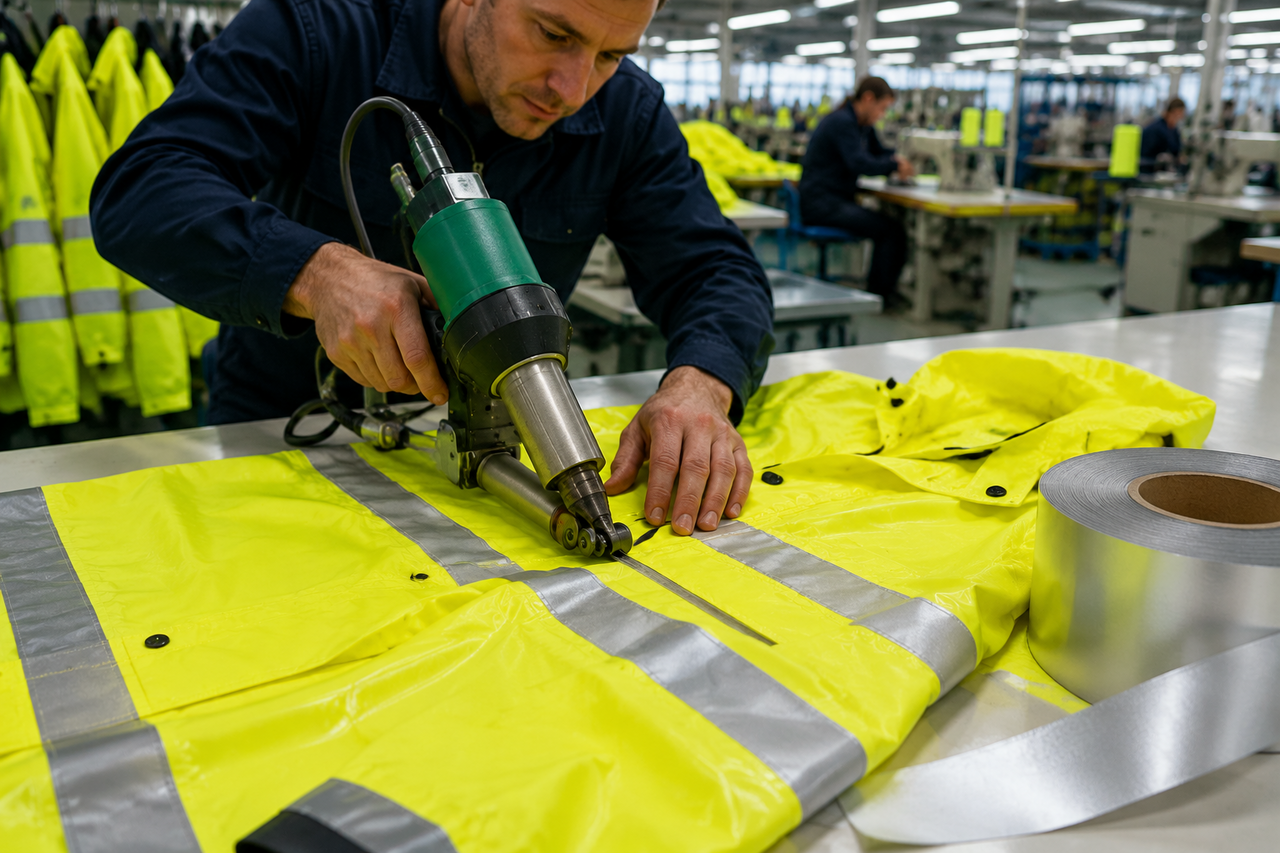
A compliant hi-vis rain suit for European road teams must pass two separate fitness tests. EN ISO 20471 measures how well motorists can see the wearer in low light; EN 343 measures how well the suit keeps rain out. A distributor that wins a municipal road maintenance contract does not buy these suits from a catalog — it buys a chain of verified specifications, from fabric and tape certificates to seam-sealing records and batch-level traceability.
The path from a tender clause to a delivered pallet runs through five checkpoints: reading the compliance requirements correctly, translating them into measurable specs, selecting materials and reflective tape, revising samples, and releasing production only after an independent inspection. Each step can be checked against a document, which is exactly what makes the process repeatable for reorders and defensible in an audit.
The procurement challenge: what a municipal tender actually asks for
A municipal road maintenance tender usually starts with one binding sentence: the garments must be CE-marked hi-vis rain suits tested to EN ISO 20471 for visibility and EN 343 for rain protection. For the distributor, that sentence becomes a legal obligation the moment the contract is signed.
Procurement officers rarely test garments themselves. They request a Declaration of Conformity, check the marking on the label, and note the standard references on the order. What they are verifying is that the distributor holds the technical file for the product. Under the European PPE Regulation (EU) 2016/425, high-visibility clothing is classified as Category II PPE, which requires an EU-type examination by a notified body before the CE mark can be applied. When the distributor places its own label on the garment, it steps into the role of manufacturer for regulatory purposes and carries that responsibility.
This is where the real work begins. The factory in Asia supplies the production and the test reports, but the distributor owns the compliance file in the EU. That means the tender's clause must be converted into a product specification the factory can measure on a cutting table, then verified at every stage from material purchase to packed carton.
Turning EN ISO 20471 and EN 343 clauses into measurable specifications
EN ISO 20471 organizes visibility into three classes with minimum areas of fluorescent background and retroreflective material, while EN 343 rates waterproofness and breathability with two numbers. Each clause in the tender converts into a dimension the factory can measure on the garment and a test report the buyer can hold.
The visibility classes are purely arithmetic. Class 1 requires at least 0.14 m² of background material and 0.10 m² of retroreflective material. Class 2 requires 0.50 m² of background and 0.13 m² of retroreflective material. Class 3, the level usually expected for work on motorways and high-speed roads, requires 0.80 m² of background and 0.20 m² of retroreflective material. When a jacket and trousers are certified separately and worn together, their areas combine; that is how most rain suits reach Class 3 on the road.
The background material must keep its fluorescent color within the standard's luminance and chromaticity tolerances after accelerated weathering, abrasion, and a declared number of cleaning cycles. The retroreflective tape must return a minimum coefficient of retroreflection measured in candelas per lux per square metre at the test angles specified in the standard, both before and after flexing, rain, washing, and temperature exposure. The standard's marking requirement matters too: every garment must carry the pictogram and class number permanently, plus care instructions that state the maximum cleaning cycles the certification covers.
EN 343 works differently. Its marking uses two digits, for example 3/1 or 4/2. The first digit rates water penetration resistance from 1 to 4 based on a hydrostatic-head test. Hydrostatic-head testing measures the water pressure a fabric can withstand before leakage begins, expressed in pascals; Class 3 requires at least 13,000 Pa, and Class 4 requires at least 20,000 Pa. The second digit rates water vapor resistance from 1 to 4, where a higher class number means lower evaporative resistance and greater breathability for the wearer. Because EN 343 also tests seams, the seam construction is a compliance point, not just a comfort feature — a fabric that passes on its own will fail if the sealing tape is wrong.
Fabric selection: fluorescent background that survives rain and UV
The background fabric carries two jobs at once: it must keep its fluorescent color within EN ISO 20471 tolerances after years of outdoor exposure, and it must hold back water to the EN 343 rating the tender demands. In practice, that means a coated or laminated woven polyester, with PVC reserved for heavy industrial rainwear rather than road-team garments.
Fluorescent yellow is the dominant color for European roadwork, although orange-red is common in some railway specifications. The fluorescent pigment is typically applied to the fabric surface and then protected by the coating or laminate on the reverse side, which is why the coating is not just about waterproofness — it also shields the pigment from UV degradation. Cheap fabric that fades after a season fails the EN ISO 20471 weathering test, so the material's dye and coating chemistry matters as much as its weight.
MaterialTypical weightHow it is made waterproofTrade-off in a hi-vis rain suitPU-coated polyester190–210 gsmA polyurethane layer applied to the reverse side, with sealed seamsThe most common shell for road-worker suits; a good balance of weight, flexibility, and costPVC-coated or laminated300 gsm and upA thick PVC film or laminate that blocks water without seam tapingVery durable but heavy and clammy, and it stiffens in cold weather; used more for general heavy industrial rainwearBreathable PU/TPU laminate150–190 gsmA microporous membrane laminated to the face fabric and taped at seamsLets body moisture escape during long shifts; costs more and requires more careful seam sealing
A distributor should treat the safety data sheet as a sourcing document, not an afterthought. The SDS for the coating and the seam-sealing adhesive tells a buyer what solvents and plasticizers are in the product, whether the factory's chemical handling is documented, and whether the material will be accepted under the buyer's own restricted-substance policy. A factory that cannot produce an SDS for its coating has no business supplying CE-marked PPE.
Reflective tape: construction, placement, and the ways it fails
At night, a fluorescent jacket without tape is nearly invisible, which is why EN ISO 20471 places most of its performance demands on the retroreflective material: minimum width, minimum return of light at defined angles, and survival through washing, flexing, and abrasion. Glass-bead and microprismatic constructions can both pass the standard when engineered to it, but they perform differently in service.
Retroreflective tape returns light to its source — in this case, the headlights of an approaching vehicle. Microprismatic tape uses small corner-cube prisms and generally returns more light at the wide angles a driver sees when the wearer's torso is turned. Glass-bead tape is an older construction, heavier on the fabric, and still used widely; it is acceptable under the standard but often gives lower readings at wide observation angles. The safest decision is to request the tape supplier's own test certificate before bulk production and check that the tape is certified to EN ISO 20471 as a component.
Placement is where many rain suits lose points. The standard requires retroreflective bands at least 50 mm wide, and the practical rule for roadwork suits is two horizontal bands around the torso, placed so a driver sees them without the wearer's arm or a seam allowance breaking the reflective circuit. Pockets, vents, adjuster tabs, and hood attachments will all interrupt a band. Every interruption reduces the reflective area that counts toward the class calculation, so the spec sheet must show exactly where each band runs — measured from the shoulder seam and sleeve hem — before a sample is cut.
The most common field failures follow the same pattern: tape peeling after a few washes, cracking after flexing in cold weather, or losing brightness because the garment was washed beyond the cycle count printed on its certification label. These are not factory mysteries — they are predictable results of tape construction, adhesive quality, and sewing tension. A pre-production sample checked against the placement drawing catches most of them before the first bulk carton is filled.
Sample revisions: from tech pack to pre-production approval
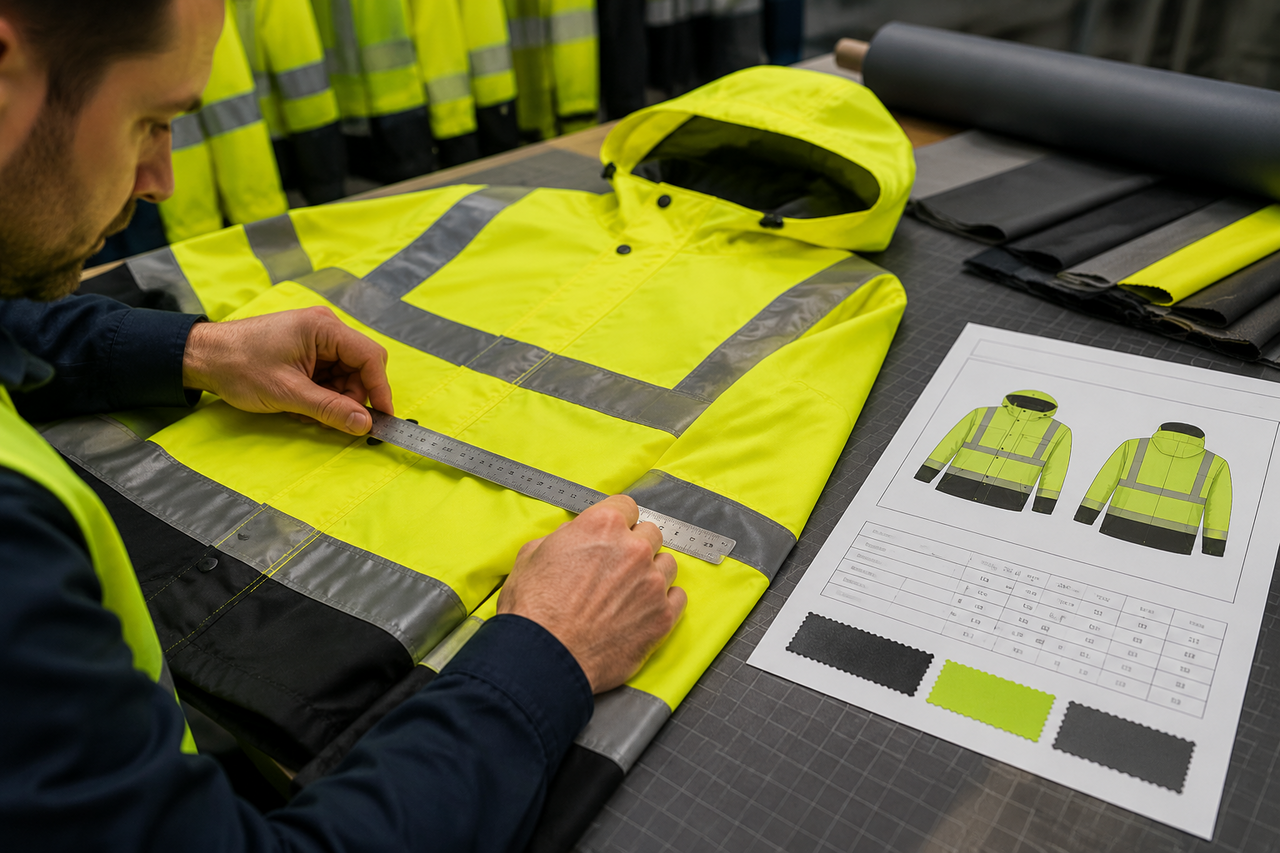
Sample approval converts the spec sheet into a wearable product. The pre-production sample is the critical gate: it should be made from production materials on the factory's real line, and it must pass four checks — seams, zippers, grade rules, and packaging — before the production clock starts.
A technical pack for a hi-vis rain suit is more detailed than the same document for a fashion raincoat, because the class certification depends on measurable areas. The buyer measures the reflective tape width and the total reflective area on the actual sample and compares them to the EN ISO 20471 class calculation. Discrepancies here are common in first samples — a factory will place a shoulder yoke seam through the middle of a reflective band, or shorten a band to avoid a pocket, and quietly lose 15 percent of the certified reflective area. The marking on the paper spec sheet and the marking on the garment must agree.
The four checks are best run in a fixed order:
- Seams — confirm the sealing tape is applied to every critical seam, including the hood, shoulders, armholes, and leg hems, and that the tape has no blisters, folds, or unsealed overlaps.
- Zippers — check that the storm flap fully covers the zipper track and that the garment is water-resistant at the zip line, because an untaped zipper seam is a guaranteed leak point.
- Grade rules — measure chest, back length, sleeve length, and leg length across every size in the range to confirm the factory followed the grading table rather than adjusting each pattern by eye.
- Packaging — verify the poly bag, size label, barcode, and carton markings against the packing spec so the goods can pass straight through the distributor's own warehouse process.
Revisions then happen on a marked garment and a corrected spec sheet, not on a phone call. Each round of changes adds a week or two, which is why the sample phase is where lead times genuinely slip. A factory with experience in certified PPE will ask for the class calculation up front and build the placement drawing around it; that is a much better signal than a factory that produces a beautiful first sample and lets the buyer find the compliance errors.
Third-party inspection: SGS, TÜV, and BV before bulk release
Third-party inspection separates conformity from shipment quality: the notified body certificate makes the garment legal to sell, while an SGS, TÜV, or BV final inspection makes sure the thousands of pieces in the shipment match the one approved sample. These are different jobs and a distributor needs both.
The CE marking is the outcome of a conformity assessment — a product design verified against EN ISO 20471 and EN 343, documented in a technical file, and covered by an EU-type examination certificate. But a certificate covers a design, not a specific production batch. AQL inspection covers the batch. AQL, or acceptable quality limit, is a sampling method that defines how many defects are tolerable in a lot; AQL 2.5 is the common industry standard for this product category and the level most European buyers write into their contracts.
For further reading, see SATRA outlines how manufacturers can verify and document CE-marked PPE compliance..
The inspector's checklist on a hi-vis rain suit is specific. It includes the permanent label with pictogram and class number, the width and placement of the reflective tape, the quality of seam sealing, zipper function, measurement conformity across sizes, and the packing and carton marking. Inline inspection during production catches systemic faults while they can still be corrected; final random inspection before shipment is the release gate. A factory that objects to independent inspection is a risk signal, as is a factory that cannot explain its own defect rate.
Batch-level traceability is what makes inspection meaningful. Each production lot should carry a number that connects the film batch, the seam-sealing machine, the production date, and the packer. When a defect appears in the field — a batch of tape that delaminates, a coating that blisters — that number is what allows the factory to isolate the problem and the distributor to recall only the affected lot instead of the entire program.

Production lead time, QC release, and the reorder cycle
A standard production run takes 30 to 60 days after sample approval, but capacity disappears quickly in seasonal peaks, so a distributor with a fixed road-contract start date must reserve production slots before the first order ships. Winter maintenance contracts do not wait for a factory's availability.
In rainwear, the seasonal rhythms are consistent: the monsoon season and the fourth quarter fill factory capacity weeks in advance. A distributor that commits to a second-season forecast before the first order ships does two things: it secures production slots, and it improves pricing, because the factory can schedule material purchases instead of expediting them. The forecast is not a favor to the factory — it is the mechanism that makes a 30-to-60-day lead time reliable instead of optimistic.
The QC release process is the final gate. Once the final random inspection passes, the factory packs to the agreed carton specification, assigns the batch numbers, and releases the shipment. The distributor holds the inspection report, the batch records, and the conformity file together, because the next tender will ask for the same documents and the next reorder will use the same specifications. The first order is only half the project; the supply chain that supports reorders is the other half.
Lessons from a compliance-first sourcing process
The pattern that works across every step is verification, not persuasion: test reports, spec sheets, inspection clauses, and batch records decide trust. A distributor should ask a shortlisted factory for three documents before discussing price — a hydrostatic-head test report for the proposed material, an SDS for the coating and adhesive, and a sample sales contract with the inspection clause written in.
Those three documents tell a buyer more about a factory than any presentation. The test report shows whether the material actually reaches the EN 343 rating the tender requires. The SDS shows whether the chemistry behind the waterproofness is documented and acceptable. The contract with an inspection clause shows whether the factory expects to be held accountable. If any of the three is missing or vague, the risk belongs to the distributor, not to the factory.
The same discipline applies to the pre-production sample: run the four checks — seams, zippers, grade rules, and packaging — and check the reflective area against the class calculation. Then let an independent inspector confirm the bulk shipment at AQL 2.5 before release. When the first batch lands in the warehouse, the distributor should have a file that answers any audit question: the EU-type examination certificate, the Declaration of Conformity, the material test reports, the inspection reports, and the batch traceability numbers connecting each production lot to its film batch, seam-sealing machine, and packer. That file is the product.
The road from municipal tender to delivered pallets is a chain of verifiable documents, and the distributor who wins the contract is the one who treats compliance as a specification system rather than a certificate to be collected at the end. Start with a shortlist, request the three documents, and run the four checks on a pre-production sample before committing to bulk. The standards do the persuading; the factory either meets them on paper and in the product, or it does not.
References
• ISO 20471:2013\(en\), High visibility clothing — Test methods and ...
• Understanding EN ISO 20471 High Visibility Safety Standards – SKANWEAR®
• Ensuring compliance of CE-marked products
Frequently Asked Questions
Practical answers related to this article.
What standards must a hi-vis rain suit for European road teams comply with?
A compliant hi-vis rain suit must pass EN ISO 20471 for visibility and EN 343 for rain protection. It must also be CE-marked under the European PPE Regulation (EU) 2016/425 as Category II PPE.
What are the minimum material areas for EN ISO 20471 Class 3?
Class 3 requires at least 0.80 m² of fluorescent background material and 0.20 m² of retroreflective material. When a jacket and trousers are certified separately and worn together, their areas combine.
What does the two-digit EN 343 marking indicate?
The first digit rates water penetration resistance from 1 to 4 (Class 3 requires at least 13,000 Pa, Class 4 at least 20,000 Pa). The second digit rates water vapor resistance from 1 to 4, where a higher class number means lower evaporative resistance and greater breathability.
Why is the safety data sheet (SDS) important when sourcing materials?
The SDS for the coating and seam-sealing adhesive tells the buyer what solvents and plasticizers are in the product, whether the factory's chemical handling is documented, and whether the material will be accepted under the buyer's restricted-substance policy. A factory that cannot produce an SDS for its coating has no business supplying CE-marked PPE.
What are the four checks in pre-production sample approval?
The four checks are seams, zippers, grade rules, and packaging. Seams confirm sealing tape is applied to critical seams; zippers check that the storm flap covers the zipper track; grade rules verify measurements across every size; packaging verifies poly bag, size label, barcode, and carton markings.
What is the difference between a notified body certificate and an AQL inspection?
A notified body certificate covers the product design and makes the garment legal to sell, while an AQL inspection covers a specific production batch. AQL 2.5 is the common industry standard for this product category.