
Comparing PVC and EVA Materials for Camouflage Raincoat Printing
PVC and EVA are both printable polymer films, but their molecular structures create distinct outcomes for camouflage decoration, flexibility, and durability under outdoor conditions. Understanding how each material affects print adhesion, flexibility, and field performance helps you source raincoats that match your buyers' performance requirements and end-use applications.
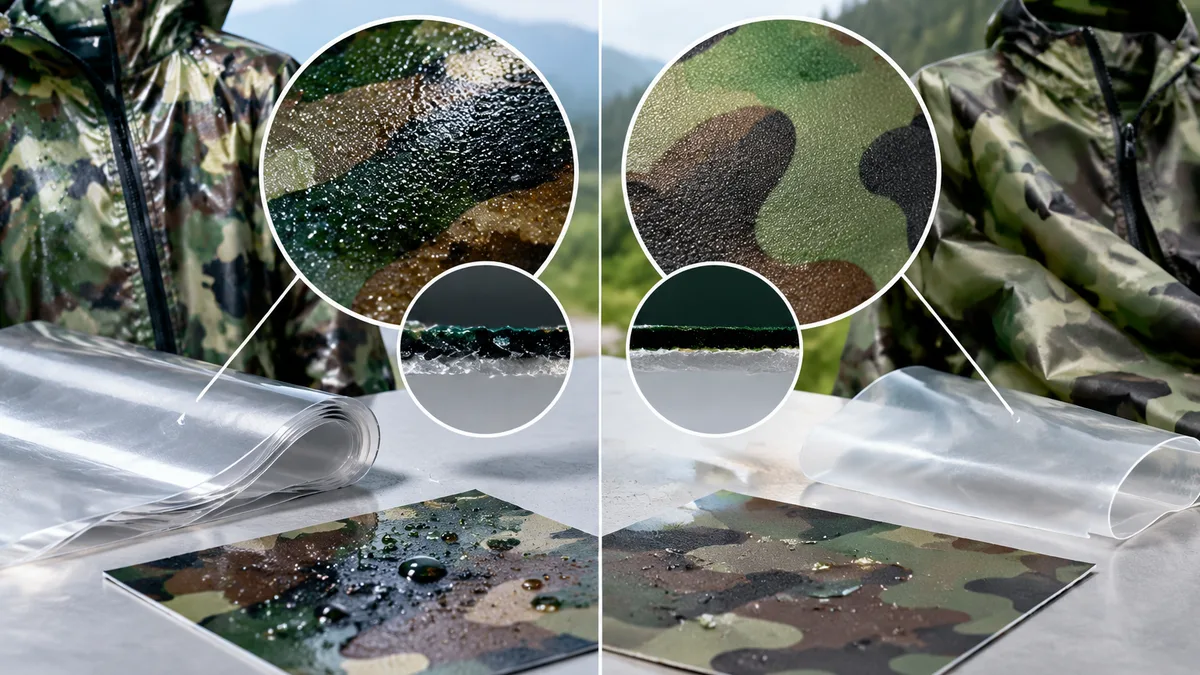
When you source camouflage raincoats for hunting, wildlife observation, or tactical applications, the base material determines how well the pattern prints, how long it lasts in the field, and whether the garment remains comfortable during extended wear. PVC and EVA are both printable polymer films, but their molecular structures create distinct outcomes for camouflage decoration, flexibility, and durability under outdoor conditions.
Material Structure: How PVC and EVA Composition Affects Print Adhesion
PVC is a thermoplastic polymer with a rigid molecular backbone that becomes more flexible when plasticizers are added during film production. The surface of PVC film is relatively smooth and dense, which influences how ink bonds to the material. When you print camouflage patterns onto PVC, the ink sits on top of the polymer surface rather than penetrating it. Adhesion depends on the chemistry of the ink system and the surface energy of the film. PVC formulations used in raincoat manufacturing typically include stabilizers and processing aids that can affect how well printing inks wet the surface and form a durable bond.
EVA is a copolymer of ethylene and vinyl acetate, and the ratio between these two components determines the material's flexibility and surface characteristics. Higher vinyl acetate content produces a softer, more elastic film. EVA surfaces tend to have slightly different polarity compared to PVC, which changes the interaction with printing inks. The copolymer structure also influences how the material responds to heat during heat-transfer printing processes.
Because no standardized test data comparing ink adhesion strength on PVC versus EVA films is publicly available, you should request adhesion test results from your printing supplier. Ask specifically about tape-peel tests or wash-fastness results for the camouflage ink system they plan to use on your chosen substrate. The ink formulation, surface preparation, and curing process matter as much as the base polymer.
Printing Method Compatibility: Screen Printing vs Heat Transfer on Each Material
You support two main decoration routes for camouflage patterns on polymer raincoats: screen printing and heat transfer. Screen printing deposits ink directly onto the film surface through a mesh stencil. This method works well on both PVC and EVA, and it is the most economical choice when you need repeating camouflage patterns in two to four colors. The ink bonds to the polymer surface without puncturing the waterproof barrier, so the garment's protection stays intact. Screen printing on PVC typically requires solvent-based or plastisol inks that cure under heat. EVA accepts similar ink systems, though the curing temperature and dwell time may need adjustment based on the material's softening point.
Heat transfer applies a pre-printed design from carrier film onto the raincoat under heat and pressure. This method handles fine detail, color gradients, and multi-color artwork that screen printing cannot register cleanly on a curved panel. Both PVC and EVA respond to heat-transfer decoration, but the process parameters differ. PVC requires higher pressure and longer dwell time to ensure the transfer adhesive bonds fully. EVA softens at a lower temperature, so you can often achieve good adhesion with less heat exposure, which reduces the risk of distorting the material or affecting its flexibility.
One practical consideration: EVA ponchos processed on your dedicated EVA line can complete decoration and assembly in shorter cycle times compared to PVC raincoats. When a buyer places a rush order for camouflage ponchos, the faster processing of EVA allows you to meet tighter delivery windows. However, the choice between screen printing and heat transfer should be guided by pattern complexity, color count, and order volume rather than material alone.
Color Vibrancy and Pattern Detail Retention on PVC vs EVA
Camouflage effectiveness depends on accurate color matching and sharp pattern edges. PVC's smooth, dense surface can hold fine detail well when the ink system is formulated correctly. The material does not absorb ink, so colors remain on the surface where they appear vivid immediately after printing. However, the same surface smoothness that aids detail can also present adhesion challenges if the ink does not fully cure or if the garment is exposed to abrasion during use.
EVA's slightly softer surface may allow for better mechanical interlocking between cured ink and the polymer, but this depends heavily on the vinyl acetate content and the specific ink chemistry. Color vibrancy on EVA can match or exceed PVC when the right ink and curing process are used, but without controlled testing data, you cannot assume uniform results across all EVA grades and camouflage ink systems.
Pattern detail retention over time is influenced by UV exposure, flexing, and surface abrasion. Both materials can experience fading or ink cracking if the ink formulation is not matched to the substrate and end-use environment. When sourcing camouflage raincoats for outdoor applications, request wash-fastness and UV-resistance test results specific to the ink-substrate combination your supplier will use. Ask whether the inks meet colorfastness standards relevant to your target market, and whether the supplier has field-tested the printed garments under conditions similar to your buyers' intended use.
Flexibility and Comfort Factors for Extended Outdoor Wear
Flexibility affects how comfortably a camouflage raincoat moves with the wearer during extended periods of field activity. EVA is inherently more flexible than rigid PVC, especially in cold conditions. The copolymer structure of EVA maintains elasticity across a wider temperature range, which means the garment bends and stretches more easily when a hunter crouches, kneels, or reaches. This flexibility also reduces noise during movement, an important factor for applications where stealth is critical.
PVC raincoats rely on plasticizers to achieve flexibility. The amount and type of plasticizer determine how soft the film feels and how it performs in cold weather. Over time, plasticizers can migrate out of the material, especially during washing or prolonged storage, which makes the garment stiffer and more prone to cracking. When you produce PVC raincoats for buyers who expect long storage periods or repeated laundering, you need to specify stabilized PVC formulations that retain flexibility over the product's intended service life.
Weight is another comfort factor. PVC films are generally denser than EVA films of equivalent thickness, so a PVC raincoat may feel heavier during extended wear. For applications where weight matters—such as backpacking or long-distance trekking—EVA offers an advantage. However, for stationary or short-duration use, the weight difference may not be significant enough to outweigh other performance or cost considerations.
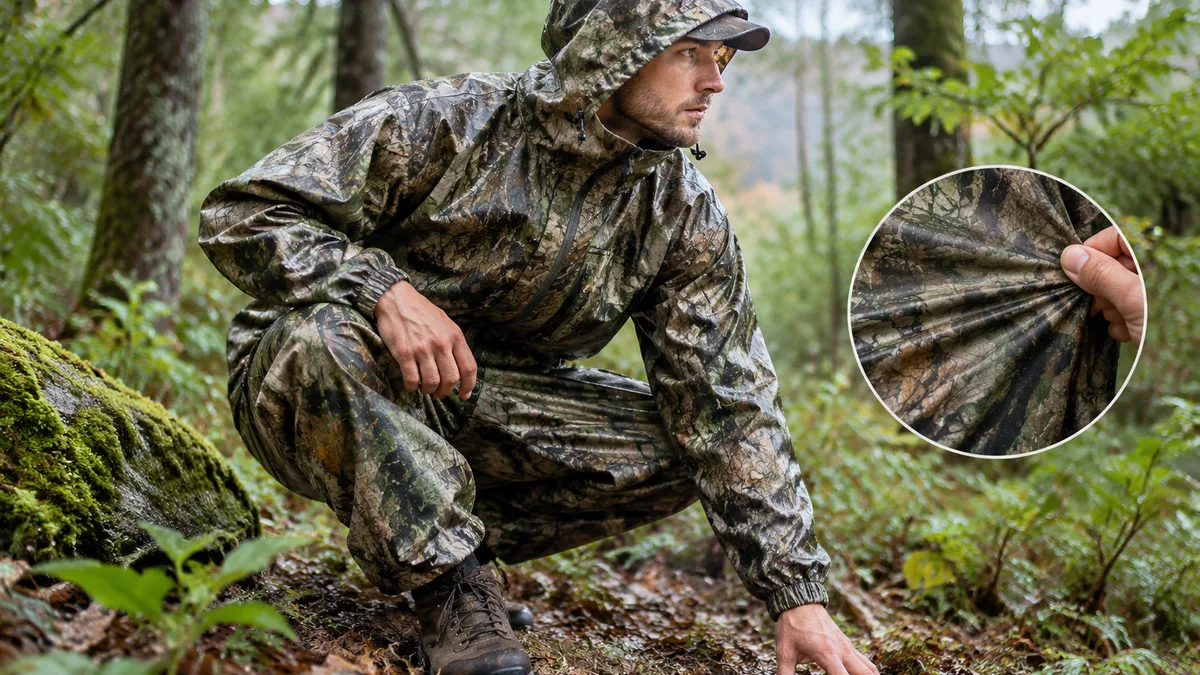
When a buyer asks you to recommend a material for camouflage raincoats intended for all-day wear in variable weather, you can explain these flexibility differences clearly and offer samples of both materials so the buyer can assess the tactile and movement characteristics directly.
Water Resistance and Hydrostatic Head Performance Comparison
Both PVC and EVA films are inherently waterproof when processed correctly, but the practical water resistance of a finished raincoat depends on seam construction, zipper quality, and closure design as much as the base material. Reliable public data on hydrostatic head values for commercial PVC and EVA raincoat films is limited, and performance varies by film thickness, plasticizer content in PVC, and vinyl acetate ratio in EVA.
Hydrostatic head testing measures the water column height a material can withstand before leakage occurs. In raincoat manufacturing, values above a certain threshold indicate sufficient waterproofing for typical rain exposure. However, the test result for the film itself does not guarantee the assembled garment will perform equivalently, because seams are the most common failure point. You weld PVC seams using high-frequency or heat-sealing equipment, which fuses the material into a continuous waterproof barrier. EVA seams are similarly welded, though the process parameters differ due to the material's different melting characteristics.
When a buyer evaluates camouflage raincoats for water resistance, you should provide hydrostatic head test reports for both the film material and the finished garment after seam welding. This dual reporting gives the buyer confidence that the camouflage pattern, which is applied before or after seam welding depending on your production sequence, does not compromise the waterproof integrity. If testing data is not available for a specific film-ink combination, recommend that the buyer request pre-production samples and arrange third-party water-penetration testing before committing to a bulk order.
Durability in Field Conditions: Abrasion Resistance and Tear Strength
Field durability determines how long a camouflage raincoat remains functional under real-world conditions such as brush contact, snagging on branches, repeated folding, and pack storage. Abrasion resistance and tear strength are the two primary mechanical properties that predict durability, but standardized test data comparing PVC and EVA films used in raincoat production is not widely published.
References
SKYSWALLOW. PVC vs EVA Fabrics for Rainwear - SKYSWALLOW.
Triple Crown Products. Screen Printing vs. Heat Transfer: Which Is Best? | Blog | TCP.
McLogan Supply. Choosing Compatible Screen Printing Inks – McLogan Supply.
Frequently Asked Questions
Practical answers related to this article.
What is the main difference between PVC and EVA for camouflage raincoat printing?
PVC is a thermoplastic polymer with a smooth, dense surface where ink sits on top rather than penetrating. EVA is a copolymer of ethylene and vinyl acetate with a slightly softer surface that may allow better mechanical interlocking with ink. The molecular structures affect print adhesion, flexibility, and how each material responds to heat during printing processes.
Which printing methods work for camouflage patterns on PVC and EVA raincoats?
Both screen printing and heat transfer work on PVC and EVA. Screen printing deposits ink directly through a mesh stencil and is economical for repeating patterns in two to four colors. Heat transfer handles fine detail and color gradients. PVC requires higher pressure and longer dwell time for heat transfer, while EVA softens at lower temperatures and processes faster.
Which material is more flexible for extended outdoor wear?
EVA is inherently more flexible than PVC, especially in cold conditions. EVA maintains elasticity across a wider temperature range and reduces noise during movement. PVC relies on plasticizers for flexibility, which can migrate out over time during washing or storage, making the garment stiffer and more prone to cracking.
How does color vibrancy compare between PVC and EVA for camouflage patterns?
PVC's smooth, dense surface can hold fine detail well and colors appear vivid immediately after printing, but adhesion challenges can occur with abrasion. EVA's softer surface may allow better ink interlocking depending on vinyl acetate content and ink chemistry. Color vibrancy on EVA can match or exceed PVC when the right ink and curing process are used.
Are PVC and EVA raincoats equally waterproof?
Both PVC and EVA films are inherently waterproof when processed correctly. Practical water resistance depends on seam construction, zipper quality, and closure design as much as the base material. PVC and EVA seams are both welded using heat-sealing equipment, though process parameters differ due to different melting characteristics.
What testing should buyers request when sourcing camouflage raincoats?
Buyers should request adhesion test results including tape-peel tests and wash-fastness results for the specific ink-substrate combination. Also request wash-fastness and UV-resistance test results, hydrostatic head test reports for both film material and finished garment after seam welding, and confirmation that inks meet colorfastness standards relevant to the target market.