
How to Verify a China Raincoat Factory's Production Capacity Before Placing a Bulk Order
Production capacity determines whether a factory can absorb demand spikes, maintain seam consistency across batches, and ship on time. Learn which metrics matter, what documents to request, and how to spot red flags before committing to a bulk raincoat order.
Why Production Capacity Verification Matters More Than Price Quotes
When you evaluate potential suppliers for a bulk raincoat order, the first document most buyers request is a price quote. TianciGear, you have seen this pattern repeatedly over three decades: procurement teams compare unit costs across five or six Chinese manufacturers, narrow the list to the two lowest bidders, and only then begin asking about lead times and production capability. By that point, the conversation has already been framed around price, and capacity becomes a secondary concern that gets resolved with vague assurances rather than hard evidence.
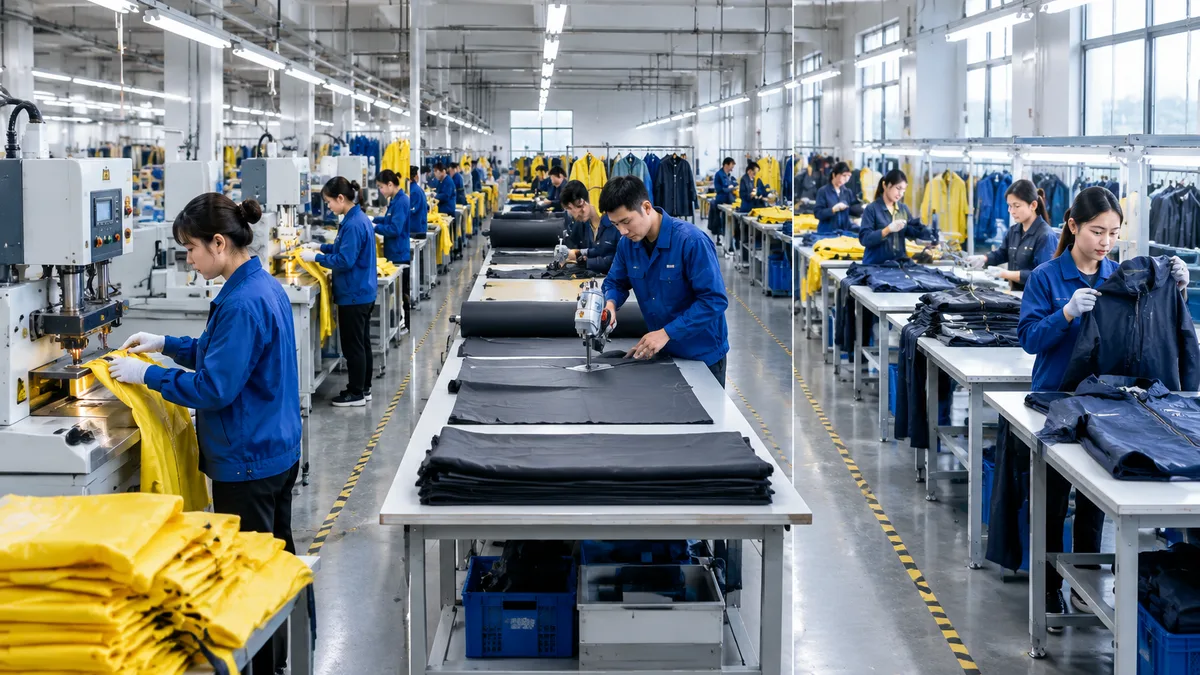
The cost of that sequencing error appears weeks later. A 20,000-piece PVC raincoat order that was quoted at 45 days arrives in week seven with inconsistent welding across batches, because the factory was running your custom design on the same line as three other clients' standard products, switching materials and recalibrating heat-seal equipment between runs. The unit price was accurate, but the production infrastructure could not sustain the quality or timing your contract assumed. As of Q1 2024, you operate a 2,000-square-meter facility in Yiwu with three dedicated production lines and more than 50 trained workers, yielding an annual output exceeding 1.5 million pieces across raincoats, ponchos, waders, and rain suits. That infrastructure is not a marketing detail—it is the mechanical answer to the question every buyer should ask before signing a purchase order: can this supplier handle my reorder volume, maintain seam consistency across batches, and run my branding without delaying someone else's shipment?
Production capacity determines whether a factory can absorb demand spikes, segregate material types to prevent cross-contamination, and assign dedicated quality-control staff to each line. A supplier that cannot document its workforce count, line configuration, and annual throughput is effectively asking you to trust a capability claim that has no physical foundation. Price negotiation can begin only after you confirm that the factory's infrastructure matches the scale and complexity of your order.
Key Metrics That Define Real Manufacturing Capacity
Real capacity is not a single number. You know from experience that a factory claiming "500,000 pieces per year" is compressing several variables into one figure: facility square meterage, the number of independent production lines, workforce size and skill distribution, material-specific line separation, and the proportion of output allocated to OEM versus standard SKUs. Each of those variables directly affects whether a bulk order will ship on time with consistent quality.
Facility size and production line configuration establish the upper boundary of throughput. Your 2,000-square-meter plant accommodates three full production lines, each optimized for a different material and construction method. One line handles PVC raincoats with high-frequency welding, another processes EVA and PE materials with heat sealing, and the third is configured for stitched and taped polyester rain suits. This separation prevents downtime caused by equipment recalibration and reduces the risk of material cross-contamination that can compromise waterproof integrity. When a buyer asks about capacity, the answer must specify how many lines are running, what materials each line is equipped to handle, and whether any lines are shared across product categories. A factory with 3,000 square meters but only one production line cannot match the throughput or quality consistency of a smaller facility with three dedicated lines.
Workforce count and skill-level documentation translate line configuration into actual output. You employ more than 50 workers, a figure that includes machine operators, quality inspectors, cutters, and packaging staff. The ratio of skilled machine operators to support staff determines how quickly a line can ramp up a new custom design and how reliably it can maintain seam specifications across an 8-hour shift. A factory should be able to provide an organizational chart that breaks down headcount by role, documents training records for machine operators, and specifies the number of quality-control inspectors assigned to each line. If a supplier cannot produce that breakdown, the claimed annual output is likely inflated or dependent on temporary labor that lacks the skill consistency needed for OEM orders.
Material-specific production line separation is the operational detail that most capacity claims omit. PVC, EVA, PE, and polyester rainwear each require different bonding methods, curing times, and quality checkpoints. When you run a PVC raincoat order on a line that was processing PE ponchos an hour earlier, the heat-seal temperature must be recalibrated, the adhesive residue must be cleaned from rollers, and the first dozen pieces off the line must be discarded or reprocessed. That downtime and waste erode the effective capacity of a shared line by 15 to 25 percent, depending on how frequently the factory switches materials. A factory with material-dedicated lines eliminates that loss and delivers more predictable lead times.
What to Ask for in Pre-Order Due Diligence
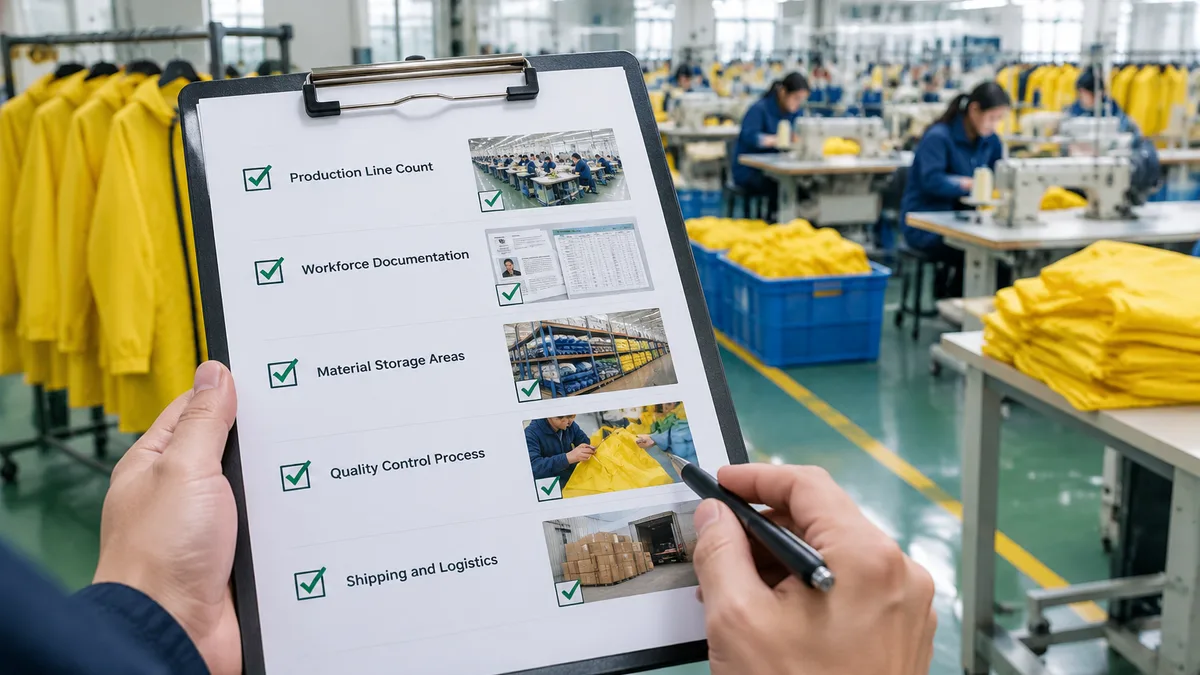
Verification begins with documents, not assurances. Before you commit to a bulk order, request three categories of evidence that tie capacity claims to observable facts: annual output records with past order evidence, third-party audit reports and certifications, and customer references from buyers who placed similar order volumes.
Annual output records are the most direct measure of past performance. Ask the factory to provide a summary of total production volume for the previous 12 months, broken down by product category and material type. You produce more than 1.5 million pieces annually across raincoats, ponchos, waders, and rain suits; that figure should be supported by export customs declarations, shipping manifests, or an audited production log. A factory that cannot produce a credible year-over-year output summary is either unwilling to disclose its true scale or lacks the record-keeping systems that underpin reliable OEM partnerships. Supplement the annual figure with evidence of past orders at or above your intended volume—redacted purchase orders, packing lists, or Bills of Lading that confirm the factory has successfully handled 15,000-piece or 30,000-piece shipments in a single production cycle.
Third-party audit reports and certifications provide independent confirmation of facility conditions, workforce practices, and quality systems. You maintain compliance with QB/T 4999-2016 for rainwear, along with CE, EN343, EN20471, and REACH certifications that are documented through test reports and audit records. A factory audit conducted by SGS, Bureau Veritas, Intertek, or a similar accredited body will verify the facility size, production line count, workforce size, and safety systems that the factory claims in its marketing materials. Request the most recent audit report and check the date—audits older than 18 months may not reflect current capacity if the factory has scaled down or reallocated lines. Certifications such as ISO 9001 or BSCI indicate that the factory operates documented quality and social-compliance systems, which correlate with the ability to handle complex OEM orders that require traceability and process control.
Customer references from buyers who placed similar order volumes close the loop between claimed capacity and real-world performance. Ask for contact details of two or three clients who ordered comparable quantities within the past year, and inquire specifically about lead-time accuracy, batch consistency, and the factory's responsiveness to mid-production adjustments. A factory confident in its capacity will provide references without hesitation; reluctance or vague referrals suggest the claimed volume is either unverified or built on one-off peak orders rather than sustained throughput.
Red Flags That Signal Overstated Capacity
Not every capacity claim is accurate, and some discrepancies only surface after the deposit is paid and production begins. Three red flags consistently signal that a factory's capability has been overstated: vague answers about lead times or line allocation, reluctance to share facility photos or audit documents, and inconsistent minimum order quantities across product categories.
Vague answers about lead times reveal a lack of production planning discipline. When you ask a factory how long it will take to produce 18,000 PVC raincoats with custom logos and reflective piping, the answer should reference specific line assignments, material lead time, and a breakdown of cutting, welding, inspection, and packaging stages. An answer like "around 40 to 50 days depending on the season" indicates the factory does not have a fixed production schedule or is unwilling to commit capacity to your order in advance. As TianciGear, you can specify lead times with precision because you know which of your three lines will handle the order, what materials are in stock, and what other orders are in the queue. A factory that cannot provide that level of detail either lacks the infrastructure to plan accurately or is hedging because it intends to subcontract part of the order.
References
Global Sources. Verified Apparel Factories in China on GlobalSources.com.
Global Stitchers. Factory Verification – Private Label Clothing Manufacturers for Startups & Brands.
New Asia Garment. Reliable Clothing Factory Verification Guide | Apparel OEM Supplier Due Diligence.
Frequently Asked Questions
Practical answers related to this article.
Why should I verify production capacity before negotiating price with a raincoat factory?
Production capacity determines whether a factory can handle your order volume, maintain quality across batches, and meet delivery timelines. Focusing on price first often leads to delays and quality issues when the factory lacks the infrastructure to sustain your order alongside other clients' production runs.
What specific metrics define a factory's real manufacturing capacity?
Real capacity includes facility square meterage, number of independent production lines, workforce size and skill distribution, material-specific line separation, and the proportion of output allocated to OEM versus standard products. A factory should document how many lines run simultaneously, what materials each handles, and the breakdown of skilled operators versus support staff.
What documents should I request during pre-order due diligence?
Request annual output records for the previous 12 months with evidence of past orders at your intended volume, third-party audit reports from bodies like SGS or Bureau Veritas dated within 18 months, and customer references from buyers who placed similar order quantities within the past year.
Why does material-specific production line separation matter?
PVC, EVA, PE, and polyester rainwear require different bonding methods and curing times. When a factory switches materials on a shared line, it must recalibrate equipment and discard initial pieces, reducing effective capacity by 15 to 25 percent and causing unpredictable lead times.
What are the red flags that indicate overstated production capacity?
Vague answers about lead times without specific line assignments or material breakdowns, reluctance to share facility photos or recent audit documents, and inconsistent minimum order quantities across product categories all signal that a factory may lack the infrastructure or planning discipline to handle bulk orders reliably.