
Is It Possible to Customize a Raincoat with Both Breathable Fabric and Reflective Strips?
Yes—as TianCiGear, you can customize a breathable raincoat with reflective strips, but the outcome depends on how you sequence the production stages and where you position the tape. The compatibility question is not binary.
Understanding Material Compatibility Constraints
TianCiGear can customize breathable raincoats with reflective strips, but the outcome depends on production sequencing and tape positioning. The compatibility question is not binary.
Breathable fabrics such as polyester with micro-porous coatings operate by allowing vapor molecules to escape through microscopic channels while blocking liquid water. Reflective tape, by contrast, is a laminated product: a glass-bead or micro-prismatic retroreflective layer bonded to a fabric carrier with heat-activated adhesive. When reflective tape is applied over a breathable zone, vapor transmission is blocked in that specific area. The challenge is not whether the two features can coexist, but whether the design preserves the functional zones each feature requires.
Target Market Segments
This raincoat customization question arrives most often from three buyer segments. Municipal procurement teams need high-visibility rainwear meeting EN ISO 20471 for road crews working in low-light conditions, while also requiring moisture management for workers wearing garments over insulated layers during extended shifts. Outdoor recreation distributors want branded rain jackets that perform on multi-day hikes, where breathability prevents interior condensation and reflective details improve trail safety at dawn or dusk. Industrial workwear buyers need garments satisfying both ANSI/ISEA 107 visibility standards and jobsite comfort requirements. All three scenarios require integrating two features that impose competing design constraints on the same garment surface.
Zoned Functionality Approach
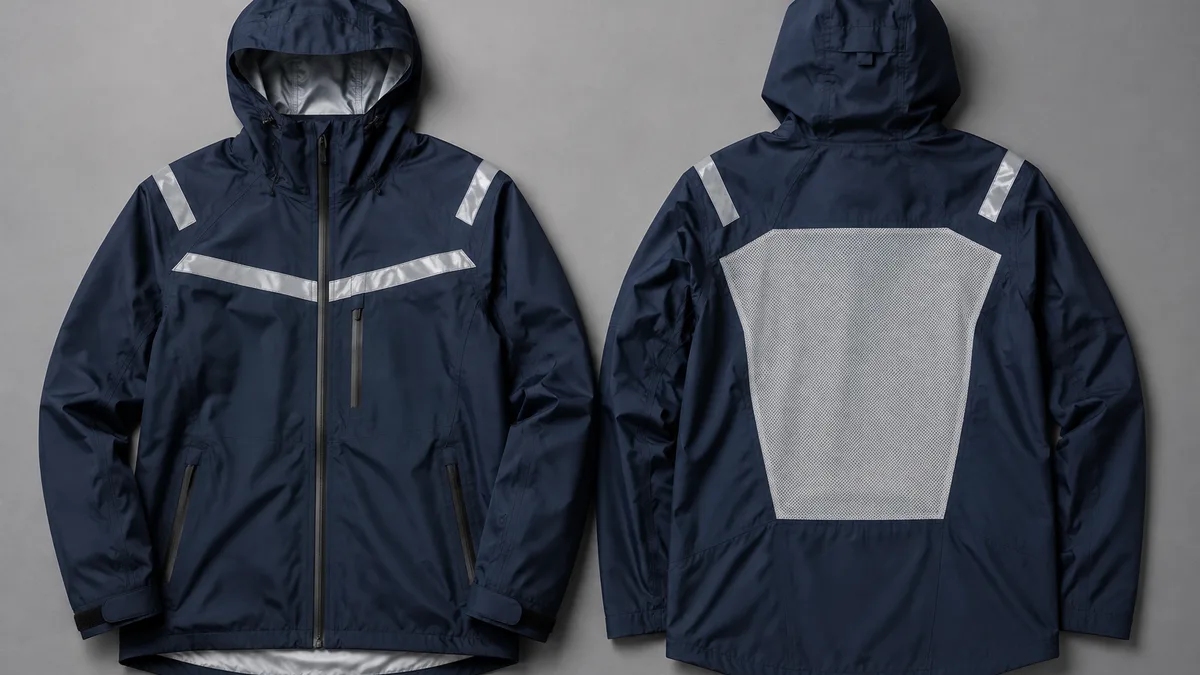
The technical solution is straightforward. Both features are achieved by treating breathability and visibility as zoned functions rather than whole-garment properties. The polyester raincoat maintains MVTR (moisture vapor transmission rate, measuring breathability) performance across the back panel, underarm gussets, and ventilation zones, while reflective tape occupies the chest, shoulders, and lower hem—areas where vapor transmission is less critical and where retroreflective performance delivers the greatest angular visibility to oncoming vehicles or search teams. The placement decision is not aesthetic but rather a mechanical trade-off between surface area available for vapor escape and surface area required to meet photometric performance standards under EN ISO 20471 or ANSI/ISEA 107.
Production Process: How Breathable Fabrics and Reflective Tape Come Together
Fabric Selection and Coating Verification
The production sequence for breathable raincoats with reflective strips involves four distinct stages, and the order is not negotiable. The process starts with fabric selection and coating verification, moves to pattern cutting and seam construction, applies reflective tape post-assembly, and finishes with quality testing for both breathability and retroreflectivity.
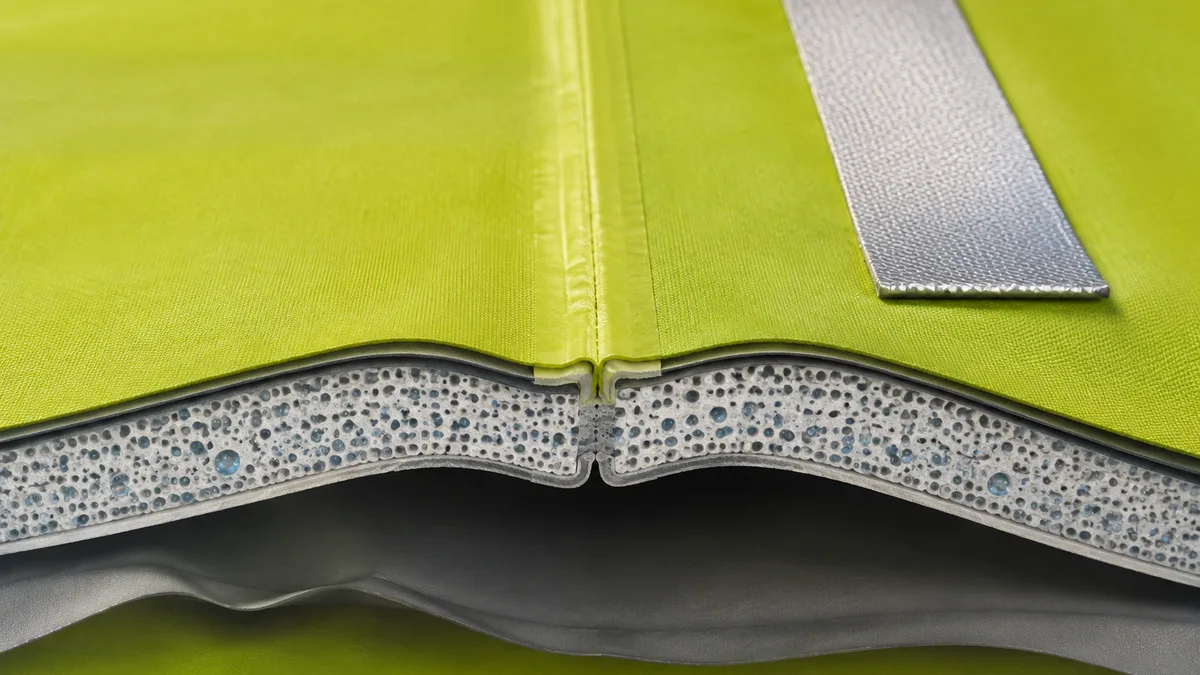
Breathable polyester raincoats typically use a two-layer or three-layer construction. The face fabric is 190T to 210T polyester taffeta, treated with a durable water repellent finish that causes water to bead on the surface. The breathable layer is either a micro-porous polyurethane coating applied to the fabric reverse, or a separate hydrophilic membrane laminated between the face fabric and an inner lining. Both systems achieve MVTR values between 3,000 and 8,000 g/m²/24hr under ASTM E96 or ISO 11092 test conditions, which is sufficient for moderate-exertion activities such as walking, light construction work, or event staff duties. TianCiGear specializes in workwear-grade breathable raincoats rather than technical mountaineering shells requiring ePTFE (expanded polytetrafluoroethylene, a high-performance membrane) with MVTR above 15,000 g/m²/24hr.
Seam Construction Methods
Seam construction for breathable raincoats requires ultrasonic welding (a heat-free joining method) or taped seams rather than traditional lock-stitch sewing. A standard sewn seam creates 200 to 300 needle perforations per meter, and each perforation is a potential pathway for liquid water ingress and a disruption of the vapor transmission gradient.
Industrial ultrasonic welding systems for breathable polyester typically operate at 20 kHz to 40 kHz and apply localized heat and pressure for 0.2 to 0.5 seconds per weld point. The process melts and fuses the fabric and coating layers without puncturing them, preserving both waterproofness and MVTR. The weld zone is 3 to 5 mm wide, and that zone becomes a non-breathable strip along every seam. For this reason, seam placement avoids the center back panel and underarm areas, where vapor transmission is most critical during exertion.
Reflective Tape Application Techniques
Reflective tape application occurs after seam welding and garment assembly. Heat-activated adhesive tape is used rather than sew-on reflective trim because stitching through reflective tape damages the retroreflective layer and creates the same needle perforation problem avoided during seam construction. The tape application process uses a hot-air tacker or a heated press set to 150°C to 170°C for 8 to 12 seconds, depending on the tape manufacturer's specification. The adhesive must bond to the polyester face fabric, not to the micro-porous coating on the reverse, which means tape placement is limited to the garment exterior. Reflective tape cannot be applied to the garment interior or sandwiched between fabric layers without blocking breathability in that zone.
Technical Requirements for Preserving Breathability
Surface Area and MVTR Performance
The MVTR performance of a breathable polyester raincoat is a system-level property, not a material property alone. A micro-porous polyurethane coating may achieve 5,000 g/m²/24hr when tested as a flat swatch in a laboratory, but the finished raincoat will deliver lower effective breathability because seam welds, reflective tape, and any printed logos occupy surface area that no longer transmits vapor. The manufacturing challenge is preserving enough open surface area that the garment still performs within the buyer's expected range.
For a typical long raincoat (110 cm back length, 120 cm chest), the exterior surface area is approximately 1.8 to 2.0 m², depending on sleeve length and hood design. A standard two-stripe reflective tape configuration—one 5 cm stripe around the chest at mid-torso height and one 5 cm stripe around the lower hem—would cover roughly 0.10 to 0.12 m², or about 5-6% of the garment surface. A more complex high-visibility design that adds shoulder stripes, sleeve cuffs, and a front chest logo may cover 0.25 m², or 12% to 14% of the surface.
In field experience, tape coverage below 8-10% generally maintains adequate breathability for moderate activity, while coverage above 12-15% may increase condensation in high-exertion scenarios. Actual thresholds vary by coating type and activity level.
Coating Type Selection
The coating type also determines how much MVTR loss can be tolerated. A hydrophilic polyurethane coating works by absorbing moisture vapor on the interior side, transporting it through the polymer matrix, and releasing it on the exterior side. This process is bidirectional and relies on a vapor pressure gradient. If the exterior environment is highly humid—such as during rain—the gradient weakens, and the coating's effective MVTR drops.
A micro-porous coating, by contrast, allows vapor to pass through physical pores without relying on absorption, so it maintains higher MVTR in wet conditions. For buyers who need consistent breathability during rain, micro-porous coatings are recommended with reflective tape coverage limited to 8% or less of the garment surface.
Seam Impact on Breathability
Ultrasonic welding of seams introduces a second MVTR constraint. Each welded seam blocks vapor transmission along a 3 to 5 mm strip. A typical raincoat has 8 to 12 meters of total seam length, which translates to 0.024 to 0.06 m² of non-breathable surface, or 1.2% to 3% of the garment area. When reflective tape coverage and seam blockage are combined, a heavily customized design may reduce effective breathable area by 15% to 17%. For this reason, industry design guidelines require that the center back panel, which accounts for roughly 0.35 m² or 18% of the garment surface, remain free of both reflective tape and complex seam intersections. That panel becomes the primary vapor transmission zone.
Placement Strategy and Design Restrictions
Meeting Visibility Standards
Reflective tape placement must satisfy a visibility requirement—usually EN ISO 20471 Class 2 or Class 3, or ANSI/ISEA 107 Type R Class 2—which translates into minimum retroreflective area and specific placement zones. EN ISO 20471 Class 2 requires 0.13 m² of retroreflective material arranged in a closed loop around the torso or as horizontal and vertical stripes ensuring 360-degree visibility. ANSI/ISEA 107 Type R Class 2 requires 0.0929 m² (one square foot) of retroreflective material, with at least one horizontal stripe around the torso and additional material on the shoulders or sleeves.
These requirements are typically met by positioning 5 cm wide retroreflective tape in a horizontal stripe around the chest at 15 cm below the armpit, a second horizontal stripe around the lower hem at 25 cm above the bottom edge, and two vertical stripes running from the shoulders down the front chest, forming an "H" pattern. This configuration delivers 0.14 m² of retroreflective area, satisfying Class 2 requirements under both EN ISO 20471 and ANSI/ISEA 107, while keeping all tape placement outside the back panel breathability zone. The chest and shoulder stripes occupy the front and side panels, where fabric movement during walking naturally pumps air through the garment, reducing the need for high MVTR in those specific areas.
Thermal and Mechanical Clearance Rules
Industry best practice recommends maintaining clearance of 5-8 cm between reflective tape and ultrasonic seams to prevent coating delamination. When reflective tape is applied using a hot-air tacker, the 150°C to 170°C heat can delaminate a micro-porous coating or shrink a hydrophilic membrane if applied too close to a seam edge where the coating is already under mechanical stress from welding. A delaminated edge allows liquid water to wick between the fabric and coating layers, creating a failure point that spreads over time. This clearance requirement is communicated during the sampling stage, because moving a reflective stripe by 3 cm to avoid a seam may require the buyer to resubmit artwork or adjust logo placement.
Logo and Print Considerations
Logos and custom prints introduce a third design constraint. A screen-printed or heat-transfer logo occupies a defined area and blocks vapor transmission in that zone just as reflective tape does. A 15 cm x 10 cm logo on the upper back covers 0.015 m², or less than 1% of the garment surface, and has minimal MVTR impact. But if a buyer requests a large 40 cm x 30 cm print spanning the entire back panel, that print blocks 0.12 m², or 6% of the garment, and eliminates the primary vapor transmission zone. This request is accommodated by relocating breathability to the underarm gussets and side panels, but this requires a custom pattern and raises the MOQ from 500 to 1,000 pieces due to new pattern templates and reconfigured tape application stations.
Segment-Specific Design Configurations
Different buyer segments have distinct priorities that drive raincoat customization decisions.
For municipal road crews: Prioritize Class 3 visibility with 12% tape coverage and micro-porous coatings. This configuration ensures compliance with stringent visibility regulations while maintaining breathability during extended outdoor shifts. Select high-durability tape rated for 50+ industrial wash cycles.
For outdoor recreation distributors: Focus on Class 2 visibility with 6-8% tape coverage to preserve maximum breathability for multi-day hiking and trail use. Hydrophilic membranes offer adequate performance for moderate-exertion recreational activities while keeping weight lower than micro-porous alternatives.
For industrial workwear buyers: Balance ANSI/ISEA 107 Type R Class 2 compliance with jobsite comfort by using strategic tape placement on front and shoulder panels while preserving the entire back panel for vapor transmission. Specify abrasion-resistant tape and reinforced seam construction for high-wear environments.
Cost-Benefit Considerations for Buyers
Price Premium and Durability Trade-offs
Breathable raincoats with reflective strips typically carry a 25-35% price premium over standard non-breathable PVC raincoats with basic reflective trim. The premium reflects three cost drivers: specialized breathable coating materials, ultrasonic welding equipment and process time, and heat-activated reflective tape with adhesive systems compatible with coated fabrics.
However, the long-term value proposition often justifies the initial investment. Breathable garments reduce interior condensation, which extends the effective comfort range and increases wearer compliance—workers are more likely to keep protective rainwear on throughout a shift when interior moisture is managed. This improves safety outcomes in high-visibility applications. Additionally, garments using ultrasonic seams and heat-bonded tape typically withstand 30-50 industrial wash cycles compared to 15-25 cycles for sewn alternatives, reducing replacement frequency and total cost of ownership over a three-to-five-year procurement cycle.
References
CNYGM. Reflective Material A To Z: Types, How It's Made, & Uses.
RushOrderTees. A Guide To High-Visibility Workwear.
Frequently Asked Questions
Practical answers related to this article.
Can breathable raincoats be customized with reflective strips while maintaining vapor transmission?
Yes, but it depends on production sequencing and tape positioning. Breathable fabrics allow vapor to escape through microscopic channels, while reflective tape blocks vapor transmission in the areas where it is applied. The key is using a zoned functionality approach—keeping breathability in critical zones like the back panel and underarms, and placing reflective strips on less critical areas such as the chest, shoulders, and lower hem.
What are the main technical constraints when combining breathable fabric and reflective strips?
The main constraints include: (1) reflective tape blocks vapor transmission in the areas where it is applied; (2) ultrasonic welding seams create non-breathable strips 3–5 mm wide; (3) tape must be applied to the garment exterior only, not between layers; (4) placement must maintain clearance (5–8 cm) from seams to prevent coating delamination; and (5) total tape coverage above 12–15% may increase condensation during high-exertion activity.
What production sequence is required to integrate reflective strips into breathable raincoats?
The production sequence involves four stages: (1) fabric selection and coating verification, (2) pattern cutting and seam construction (using ultrasonic welding or taped seams), (3) reflective tape application after garment assembly, and (4) quality testing for both breathability and retroreflectivity. Tape must be applied post-assembly using heat-activated adhesive at 150°C–170°C, and stitching through tape is avoided to prevent damage.
How does reflective tape coverage affect MVTR performance in a breathable raincoat?
Reflective tape coverage reduces effective breathable area. A standard two-stripe configuration covers ~5–6% of the garment surface, while more complex designs can reach 12–14%. For moderate activity, coverage below 8–10% generally maintains adequate breathability; above 12–15%, condensation risk increases. Combined with seam blockage (1.2–3%), heavily customized designs may reduce breathable area by 15–17%.
Which visibility standards do reflective strips need to meet, and how are they placed?
Reflective strips must meet EN ISO 20471 Class 2 or Class 3, or ANSI/ISEA 107 Type R Class 2. These require minimum retroreflective areas (0.13 m² for EN ISO 20471 Class 2, 0.0929 m² for ANSI/ISEA 107 Type R Class 2). Typical placement includes a horizontal chest stripe (15 cm below armpit), a horizontal lower hem stripe (25 cm above bottom edge), and vertical stripes from shoulders down front chest, forming an 'H' pattern—totaling 0.14 m² to satisfy Class 2 requirements while avoiding the back panel.
What factors determine whether micro-porous or hydrophilic coatings are recommended for breathable raincoats with reflective strips?
Micro-porous coatings are recommended for consistent breathability during rain because they rely on physical pores rather than vapor pressure gradients, making them less affected by high external humidity. Hydrophilic coatings absorb and transport moisture bidirectionally, which weakens in humid conditions. For buyers needing reliable performance in wet weather, micro-porous coatings with reflective tape coverage limited to ≤8% of the garment surface are advised.