How Tiancigear's Three Production Lines Enable Batch-to-Batch Consistency for OEM Orders
Tiancigear's dedicated production lines for PVC, EVA, and PE eliminate cross-contamination, ensuring batch-to-batch consistency and reliable OEM/ODM rain gear production.
Why Three Production Lines Matter More Than Three Price Tiers
You manage a 2,000-square-meter factory floor in Yiwu, and every week brings a familiar pattern: a European distributor needs 15,000 navy-blue PVC raincoats with reflective piping by mid-March, a U.S. promotional buyer wants 8,000 translucent PE ponchos in assorted colors by late February, and a construction supplier in the Middle East has just confirmed a reorder for 5,000 high-visibility EVA rain suits in fluorescent yellow. All three orders overlap. All three specify strict color matching to previous shipments. All three carry penalty clauses for late delivery. This is not a scheduling exercise. It is a test of whether your physical infrastructure can maintain material separation, seam quality, and color fidelity when three chemically distinct thermoplastics move through your facility at the same time.
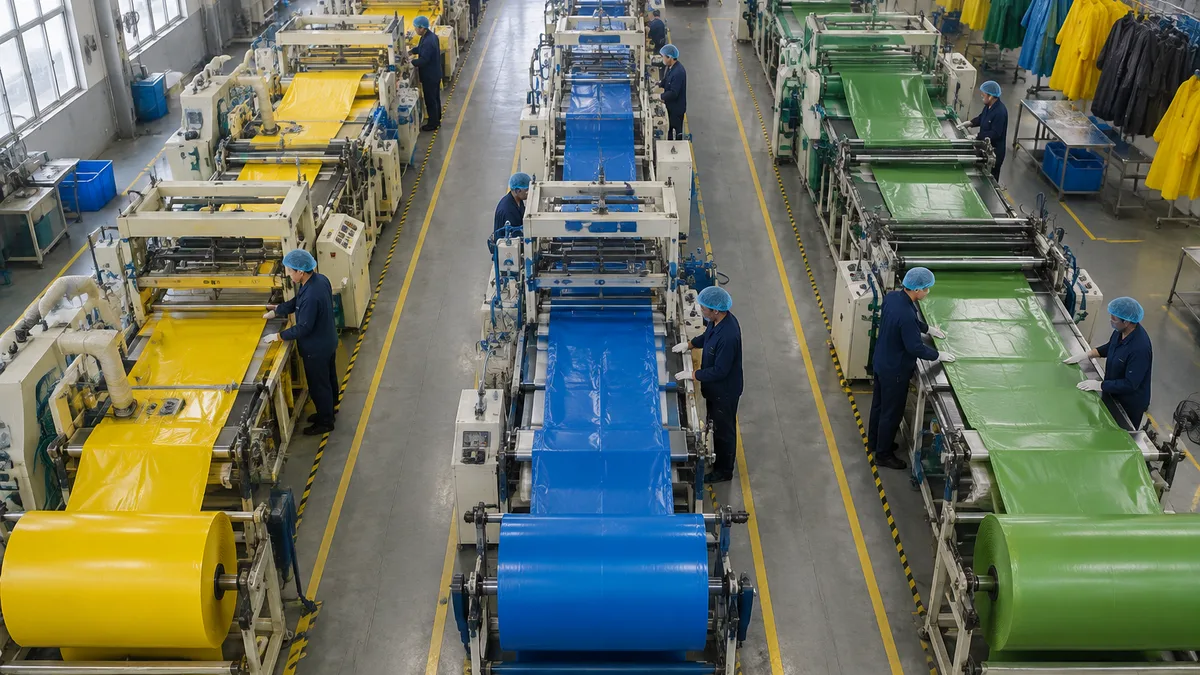
As Tiancigear, you have answered that question by dedicating one production line to PVC products, one to EVA goods, and one to PE disposables. That decision was not made to impress factory tour visitors. It was made because polyvinyl chloride, ethylene-vinyl acetate, and polyethylene each demand incompatible welding parameters, release different plasticizer residues during heat sealing, and produce color shifts when traces of one material contaminate the tooling or work surface of another. A shared production line that switches between materials requires complete equipment teardown, surface cleaning, and parameter recalibration between every changeover. Even with rigorous cleaning protocols, residual pigment from a previous batch can migrate into the next run, turning a buyer's specified Pantone 295C navy into an off-tone blue-gray that fails visual inspection at the receiving warehouse.
The three-line structure you operate is not about capacity alone. It is about eliminating the mechanical preconditions for batch inconsistency. When your PVC line runs navy raincoats on Monday and switches to black raincoats on Wednesday, both products use the same base polymer, the same high-frequency welding head, and the same plasticizer chemistry. The risk of cross-contamination drops to near zero because no foreign resin enters the workspace. When your PE line produces translucent ponchos in continuous runs, the low-density polyethylene film never contacts EVA elastomer or PVC plasticizer residue, so optical clarity remains stable across cartons. When your EVA line handles high-visibility rain suits, the fluorescent yellow pigment dispersed in the ethylene-vinyl acetate matrix stays within a closed material loop, preventing the pigment bleed that occurs when EVA and PVC share the same heat-sealing platen.
This separation is invisible to buyers who evaluate suppliers by comparing price spreadsheets and lead-time promises. It becomes visible only when a 20,000-piece order arrives at the buyer's distribution center and the quality control team discovers that cartons from the first half of the production run match the approved sample, while cartons from the second half show a two-shade color shift and inconsistent seam width. That failure almost always traces back to a single root cause: the factory ran the order on a shared line, inserted a different material run in the middle to meet another customer's deadline, and failed to eliminate all tooling residue before resuming the original order. The result is not a defect that quality inspection can catch and rework. It is systemic variability baked into the production process.
How Material Chemistry Dictates Line Separation
Polyvinyl chloride, ethylene-vinyl acetate, and polyethylene are all thermoplastics, but they behave as different substances when subjected to the heat, pressure, and electromagnetic fields used in rainwear seam sealing. PVC is a polar polymer that responds to high-frequency electromagnetic energy by generating internal heat through molecular friction. This property makes PVC ideal for radio-frequency welding, where a high-frequency electric field oscillates the polar molecules within the material, raising the temperature at the seam interface without applying external heat to the entire surface. The process is fast, localized, and produces hermetically sealed seams that can withstand hydrostatic pressure above 5,000 mm. But it requires specialized RF welding equipment, precise electrode alignment, and tight control over power output and dwell time. If the same RF welder is used to bond EVA or PE—materials with lower polarity—the electromagnetic field generates insufficient internal heat, resulting in weak fusion that delaminates under stress.
Ethylene-vinyl acetate occupies a middle zone. EVA contains vinyl acetate copolymer chains that give the material greater flexibility and elasticity than rigid PVC, but less polarity. Standard RF welding works for EVA, though at different frequency and pressure settings than PVC. Many factories use hot-air welding or impulse heat sealing for EVA products instead, applying external heat through a heated platen or hot-air nozzle to soften the material surface, then consolidating the joint with pressure rollers as the material cools. This method is more forgiving of material thickness variation and can handle EVA formulations with high vinyl acetate content, but it introduces a new variable: the heated platen or air nozzle must reach the correct temperature for EVA's melting range (approximately 70–90°C depending on formulation), which is significantly lower than the contact temperature needed for PE heat sealing (approximately 110–130°C). If the same heat-sealing line is used for both EVA and PE without recalibration, either the EVA seam overheats and degrades, or the PE seam underheats and fails to fuse.
Polyethylene is non-polar and does not respond to RF welding at all. PE rainwear is sealed using impulse heat sealing or continuous heat sealing, where heated jaws or rollers apply direct contact heat to the film surface, melting the polyethylene just enough to create a fusion bond when the surfaces are pressed together. The process is fast and economical, making it the standard method for disposable PE ponchos and rain covers. But PE's lower melting point and tendency to stick to hot tooling surfaces create contamination risk when the same sealing equipment is used for PVC or EVA. Residual PE film on a heat-sealing jaw transfers to the next product, creating visible blemishes and weak spots in the seam. Removing that residue requires mechanical scraping or solvent cleaning, both of which consume production time and carry the risk of incomplete removal.
You run three lines because running one line means choosing between two unacceptable outcomes: either you halt production for a full equipment cleaning and recalibration after every material changeover, stretching lead times by days or weeks, or you accept a baseline level of cross-contamination and seam inconsistency that shows up as field failures and customer complaints. The three-line model eliminates that trade-off. Each line is permanently configured for the sealing method, temperature range, and tooling surface treatment that suits its assigned material. The PVC line keeps its RF welding heads tuned to the frequency and power settings that produce consistent fusion without scorching. The EVA line maintains its hot-air nozzles and pressure rollers at the temperature and speed that prevent both under-sealing and over-melting. The PE line runs its impulse sealers at the jaw temperature and dwell time that fuse low-density polyethylene film without creating peel-back or film perforation.
Workflow Separation and Quality Checkpoints Per Line
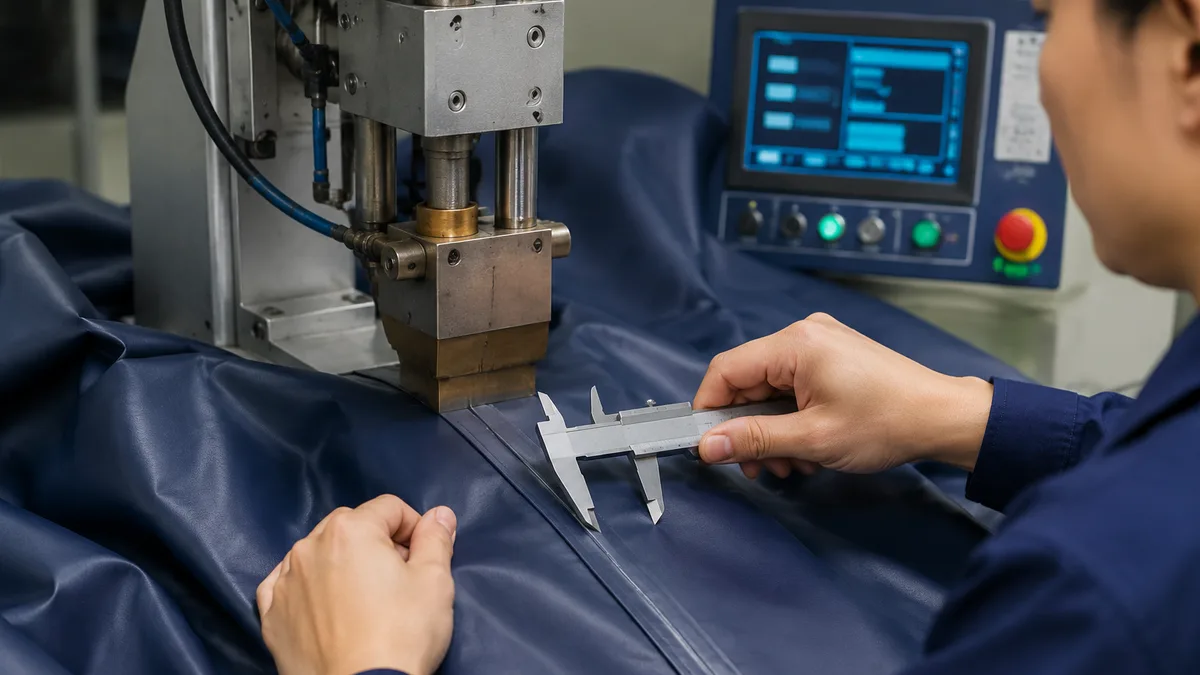
Material separation alone does not guarantee batch consistency. Each of your three production lines operates as a self-contained workflow, from raw material intake through cutting, sealing, inspection, and packaging. On the PVC line, rolls of plasticized PVC film arrive in specific colors and thicknesses, stored in a dedicated staging area to prevent mixing with EVA or PE stock. Cutting operators use pneumatic presses and steel-rule dies to stamp out raincoat panels—front, back, sleeves, and hood pieces—according to the pattern files for each SKU. The cut panels move to the RF welding station, where operators align the panel edges under the welding electrode, activate the high-frequency field for a calibrated dwell time (typically 3–6 seconds depending on film thickness), and release the weld. The welded seam is immediately inspected for width consistency, surface smoothness, and the absence of wrinkles or air pockets. Any seam that shows incomplete fusion or scorching is flagged and reworked before the garment proceeds to the next station.
This inspection happens on the line, not in a separate quality control room at the end of the shift. The reason is mechanical: a defective RF weld that passes through three more assembly stations becomes embedded in a finished raincoat that must be fully disassembled to repair. Catching the defect at the welding station means the operator adjusts the electrode pressure or dwell time immediately, re-welds the seam, and continues. The correction takes thirty seconds. Catching the same defect after final assembly takes thirty minutes and produces a garment with visible rework marks. Your PVC line embeds three inspection checkpoints: one after cutting to verify panel dimensions and edge quality, one after RF welding to verify seam integrity, and one after final assembly to verify waterproofness through a spray test or low-pressure water immersion. Each checkpoint is staffed by a dedicated QC operator who records defect type, frequency, and corrective action in a batch log. That log travels with the production batch, so if a buyer reports a seam failure in a specific carton, you can trace the failure back to a specific welding station, a specific operator, and a specific machine setting on a specific date.
The EVA line follows a parallel structure but uses different equipment and different checkpoints. EVA raincoats and rain suits are typically more flexible and thicker than PVC products, so cutting requires rotary knives or laser cutters instead of steel-rule dies. The cut EVA panels move to the hot-air welding station, where a heated nozzle softens the seam edge and pressure rollers consolidate the joint. Because hot-air welding applies heat over a broader area than RF welding, the risk of warping or buckling is higher, especially on thin EVA film. Your EVA line includes a flatness check immediately after welding: the operator places the welded seam on a flat inspection table and visually checks for ripples, puckers, or edge distortion. Any deviation is corrected by adjusting the air temperature or roller pressure before the next panel is welded. The second checkpoint on the EVA line is a peel test: the QC operator takes a sample seam from every fiftieth garment, clamps it in a tensile tester, and applies a perpendicular pulling force to measure seam strength. If the seam delaminates below the target threshold (typically 15–25 Newtons per centimeter for EVA rainwear), the line stops and the welding parameters are recalibrated.
The PE line operates at higher speed but with tighter tolerances on film thickness and seam placement. Disposable PE ponchos are made from low-density polyethylene film between 0.02 mm and 0.05 mm thick, and even a 0.01 mm variation in film thickness can cause seam failure during impulse sealing. Your PE line includes a film thickness gauge at the material intake station: every roll of PE film is spot-checked with a digital micrometer before it enters production. If the thickness falls outside the specified range, the roll is rejected and returned to the supplier. This upstream checkpoint prevents a common failure mode: weak seams caused by under-thickness film that melts through during heat sealing, creating pinholes instead of fusion bonds. The second checkpoint on the PE line is a visual seam inspection under magnification. Because PE film is translucent, defects such as incomplete fusion, edge misalignment, or contamination particles are visible when the seam is backlit. Your QC operator uses a lightbox and a 5× magnifier to inspect the shoulder seam and side seam of every twentieth poncho, flagging any seam that shows gaps, wrinkles, or foreign matter. The third checkpoint is a water-spray test: finished ponchos are draped over a mannequin and sprayed with water at 200 kPa pressure for sixty seconds. Any seam that leaks is removed from the batch, and the sealing station is recalibrated.
These per-line checkpoints are not duplicated across lines. The PVC line does not run peel tests because RF-welded PVC seams rarely delaminate; they either fuse completely or fail to fuse at all, and the failure is visible during the post-weld inspection. The PE line does not run flatness checks because thin PE film does not buckle under impulse sealing; it either fuses or perforates. Each checkpoint is calibrated to the failure mode that the material and sealing method are most likely to produce. This specificity is only possible when each line handles one material family exclusively. A shared line that switches between PVC, EVA, and PE would require all checkpoints for all materials, tripling inspection time and creating bottlenecks that delay every batch.
Color Matching and Pigment Control Across Batches
Color consistency is the most frequent complaint in OEM rainwear production, and it is also the hardest to prevent on a shared production line. Thermoplastic rainwear is colored by dispersing pigment into the polymer resin during extrusion or calendering, producing a film or sheet with uniform color throughout its thickness. But pigment dispersion is never perfectly uniform. Even within a single production batch from the same film supplier, you will find slight color variation between the leading edge and trailing edge of a 100-meter roll. When you order a custom color—Pantone 295C navy, for example—the film supplier mixes titanium white, carbon black, and phthalocyanine blue pigments into the PVC resin, extrudes the film, and ships it to your factory. The color of that film is determined by the pigment loading, the extrusion temperature, the cooling rate, and the ambient humidity on the day the film was produced. If you reorder the same Pantone 295C navy six months later, the film supplier will remix the pigments using the same formula, but the resulting color will not match the original batch exactly. The difference may be imperceptible to the human eye under indoor lighting, but it becomes visible when garments from the two batches are placed side by side under daylight or when a buyer compares the new shipment to a retained sample from the previous order.
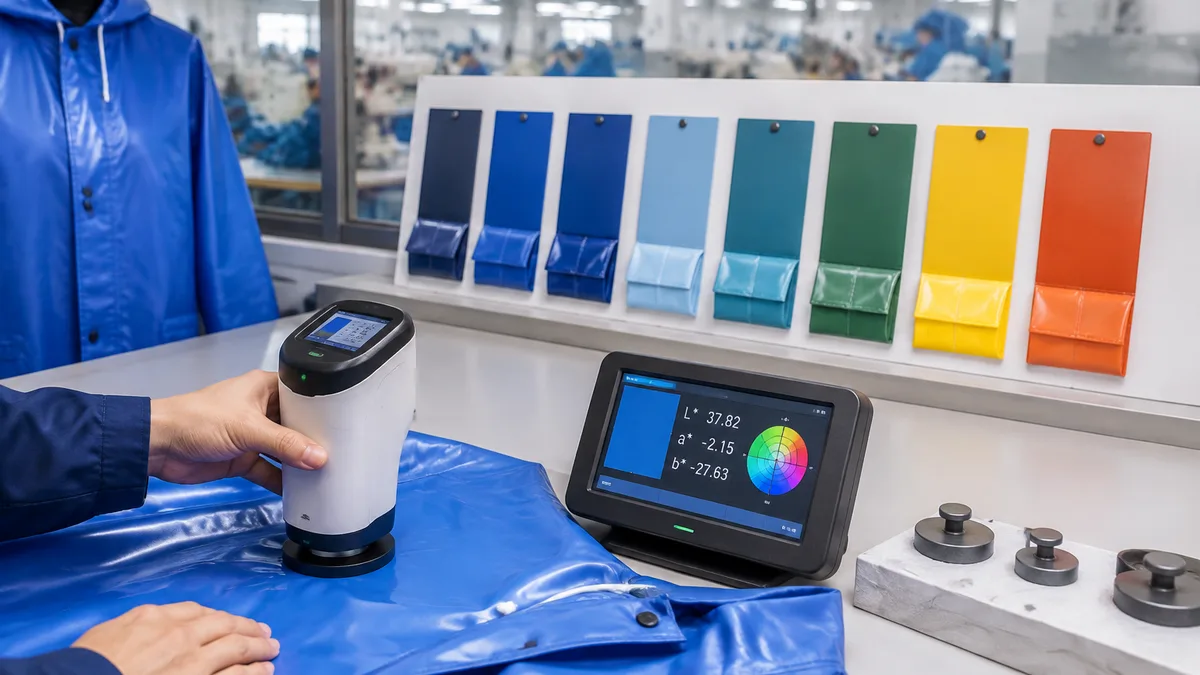
You address this variability through batch control and spectrophotometric color verification. When a custom-color film order arrives at your factory, the quality control team takes a sample from each roll, measures its color using a spectrophotometer, and records the Lab color values in your production database. L represents lightness (0 = black, 100 = white), a represents the red-green axis, and b represents the yellow-blue axis. A Pantone 295C navy target might have L = 25, a = 5, b = -30, with a tolerance of ΔE ≤ 2.0 (where ΔE is the Euclidean distance in Lab space, and values below 2.0 are generally imperceptible to the human eye). If the measured color of the incoming film falls within that tolerance, the roll is approved for production. If it falls outside, the roll is either returned to the supplier or segregated for use in a different product where the color shift is acceptable.
Once the film is approved, your three-line structure prevents the most common source of color contamination: pigment carryover from a previous batch. On a shared production line, residual pigment from a bright yellow EVA rain suit can transfer to the RF welding electrode, the cutting table, or the operator's gloves, then migrate into the navy PVC raincoat that runs immediately afterward. The contamination is often invisible until the finished garment is inspected under bright light, at which point the buyer sees faint yellow streaks or mottling in the navy fabric. Reworking that defect is impossible; the contaminated garment must be scrapped. Your PVC line eliminates that risk by handling only PVC products, and within the PVC line, you run dark colors before light colors in any given production day. Navy and black raincoats are produced in the morning shift, and light blue or white raincoats are produced in the afternoon shift after a mid-shift cleaning of all contact surfaces. This sequencing minimizes the chance that dark pigment contaminates light colors, and because all products on the line use the same PVC base polymer, any residual material that does transfer is chemically identical to the current batch, producing no color shift.
The EVA line and PE line follow the same dark-to-light sequencing rule, and each line maintains its own set of cutting dies, welding tools, and work gloves to prevent cross-line contamination. When your EVA line produces fluorescent yellow rain suits, the operators wear yellow-designated gloves and use yellow-designated cutting mats. When the line switches to clear EVA ponchos the next day, the gloves and mats are replaced with clear-designated equivalents. This level of procedural control sounds excessive until you calculate the cost of a single color-contamination failure: a 10,000-piece order with a 5% contamination rate means 500 defective garments, each worth $3 to $8 in materials and labor, totaling $1,500 to $4,000 in scrap cost plus the reputational cost of a delayed or incomplete shipment. Preventing that failure through dedicated tooling and strict sequencing costs approximately $200 in additional gloves, mats, and cleaning supplies per month. The return on investment is immediate and measurable.
 ab* values, and a row of approved color samples mounted on a reference board in the background">
Lead Time Predictability and MOQ Flexibility
For buyers managing multi-SKU rain gear programs, the three-line structure you operate delivers two advantages that do not appear on a price list: lead time predictability and the ability to run small custom orders without disrupting large standard orders. Lead time predictability comes from the fact that each line operates independently. When a new custom order arrives, your production planner evaluates which line will handle it based on material type, then schedules it into that line's queue without affecting the timelines of orders running on the other two lines. If your PVC line is fully booked for the next three weeks with a large distributor order, a new PVC custom order must wait, but a new EVA custom order can start immediately on the EVA line. A factory with a single shared line cannot offer that flexibility; every new order pushes every existing order backward in the queue, and buyers receive revised lead times that extend by days or weeks with each new inquiry.
MOQ flexibility is equally important for buyers who need small trial runs or seasonal restocks. Many rain gear buyers order 1,000 to 3,000 pieces as a market test before committing to a 10,000-piece bulk order. On a shared production line, a 1,000-piece order is often uneconomical because the setup time and material changeover time consume the same resources as a 10,000-piece order. Factories either refuse small orders entirely or quote a per-unit price that includes a setup surcharge, making the trial order prohibitively expensive. Your three-line structure reduces setup time because each line remains configured for its assigned material. Running 1,000 navy PVC raincoats on Monday and 1,000 black PVC raincoats on Tuesday requires only a material swap and a quick electrode cleaning, not a full equipment reconfiguration. That reduction in setup friction allows you to accept smaller orders at economically viable pricing, and it allows buyers to test multiple SKUs simultaneously by splitting a 3,000-piece trial order into 1,000 PVC raincoats on Line 1, 1,000 EVA ponchos on Line 2, and 1,000 PE disposables on Line 3, all running in parallel and shipping together.
This capability becomes strategically important during peak procurement seasons. Buyers in Europe and North America typically place rain gear orders in February and March for summer stock, and again in August and September for autumn and winter stock. During those windows, every rain gear factory operates at or near full capacity, and lead times stretch from four weeks to eight weeks or longer. A factory with a single
References
HunterLab. How Do Companies Ensure Consistent Color Across Different Production Lines?.
GMP SOP. Basic Overview of Contamination Control in GMP Facility.
Frequently Asked Questions
Practical answers related to this article.
Why does Tiancigear operate three separate production lines instead of using one shared line for PVC, EVA, and PE products?
Tiangcigear operates three separate production lines because polyvinyl chloride (PVC), ethylene-vinyl acetate (EVA), and polyethylene (PE) require incompatible welding parameters, release different plasticizer residues, and cause color shifts when mixed during heat sealing. A shared line would necessitate full equipment teardown, surface cleaning, and parameter recalibration between material changeovers, which still risks cross-contamination and batch inconsistency.
What specific welding methods are used on each of Tiancigear's three production lines?
The PVC line uses radio-frequency (RF) welding with high-frequency electromagnetic energy to generate internal heat in the polar polymer. The EVA line uses hot-air welding or impulse heat sealing with heated nozzles and pressure rollers. The PE line uses impulse heat sealing with heated jaws or rollers, as PE is non-polar and does not respond to RF welding.
How does material separation on dedicated lines prevent color shifts and seam inconsistencies?
Material separation prevents color shifts and seam inconsistencies by ensuring that each line handles only one type of thermoplastic. For example, fluorescent yellow pigment in EVA stays within a closed loop, preventing bleed when EVA and PVC share tooling; PVC’s plasticizers do not contaminate PE film; and PE residue does not stick to EVA or PVC sealing tools, avoiding blemishes and weak seams.
What quality checkpoints are implemented on the PVC production line, and where are they performed?
The PVC line has three inspection checkpoints: one after cutting to verify panel dimensions and edge quality, one after RF welding to verify seam integrity (width, smoothness, absence of wrinkles), and one after final assembly to verify waterproofness via spray test or low-pressure water immersion. All inspections occur on the line, not at the end of the shift, to allow immediate correction.
What unique quality control measures are used on the EVA and PE lines compared to the PVC line?
On the EVA line, a flatness check is performed immediately after welding to detect ripples or puckers, and a peel test is conducted every fiftieth garment to measure seam strength (target: 15–25 Newtons per centimeter). On the PE line, a film thickness gauge checks every roll of PE film at intake with a digital micrometer to reject under-thickness rolls before production begins.
What happens if a defect is discovered after final assembly versus during the welding process on the PVC line?
If a defect like incomplete fusion or scorching is found after final assembly, the garment must be fully disassembled for repair, taking about thirty minutes and leaving visible rework marks. If caught during welding, the operator adjusts electrode pressure or dwell time and re-welds the seam in about thirty seconds, minimizing downtime and preserving product appearance.