
What Is the Minimum Order Quantity for Custom PVC Raincoats with Reflective Strips?
The minimum order quantity for custom PVC raincoats with reflective strips at Tiancigear is 500 pieces for standard designs and 1,000 pieces for fully custom designs. This MOQ is determined by the setup costs of masterbatch preparation, logo printing, and reflective tape application stages.
The Direct Answer: 500 Pieces for Standard Custom Branding, More for Complex Designs
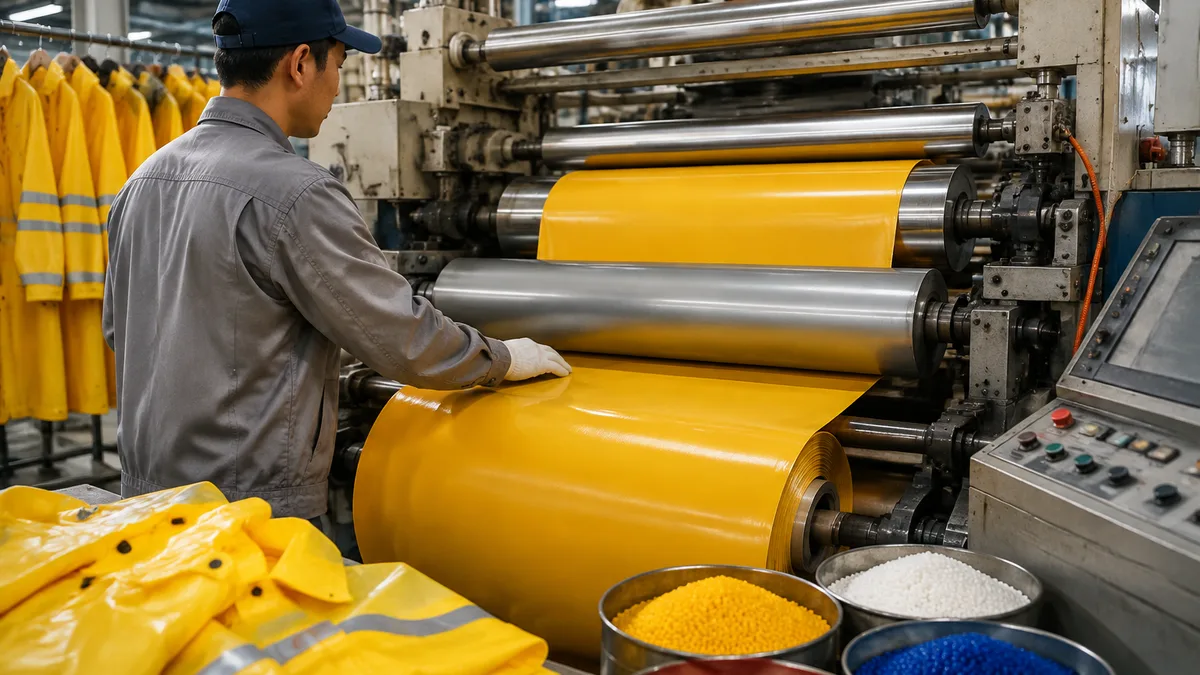
The minimum order quantity for custom PVC raincoats with reflective strips at Tiancigear is 500 pieces when you accept a standard raincoat pattern with one or two reflective tape placements and screen-printed logos in up to two colors. This MOQ is not a negotiation starting point or a volume discount threshold. It represents the order size at which the three production stages—masterbatch preparation for custom colors, logo printing setup and drying, and reflective tape application—become economically viable after accounting for material waste, setup labor, and the opportunity cost of production line time.
For more complex designs, the MOQ rises to 1,000 pieces. A fully custom design includes multi-color paneling, storm flaps, additional reflective tape configurations, or high-contrast logos that require extended drying cycles. At 1,000 pieces, you absorb the cost of custom cutting dies, additional tape application stations, and the longer changeover time between production runs. If your order involves safety-critical applications such as municipal road crews or construction site wear, compliance with EN ISO 20471 may require batch-level traceability documentation that effectively raises the practical MOQ beyond the standard threshold, because each batch must be tracked separately through masterbatch mixing, tape application, and final inspection.
Understanding why these numbers exist, rather than treating them as arbitrary limits, helps you make better sourcing decisions. A buyer who asks for 400 pieces is not requesting a small concession. They are asking you to produce at a loss or to hold unusable PVC film and reflective tape inventory that may never be consumed in another order. A buyer who specifies five reflective tape placements without understanding weld-zone constraints is setting up a sampling delay, not a capability challenge.
Why MOQ Exists: The Economics of Masterbatch, Printing, and Tape Application
Tiancigear, you produce custom PVC raincoats in three distinct stages, and each stage has a setup cost that must be spread across the final order quantity. The 500-piece MOQ is the point at which the per-unit cost of setup drops below the price floor that makes the order profitable.
Masterbatch preparation is the first stage. When a buyer requests a custom color—corporate blue, safety orange, forest green—you introduce a pigment concentrate into the PVC resin before the film is calendered. The minimum batch size for a stable color match is approximately 200 kilograms of PVC compound, which yields enough film for roughly 500 raincoats depending on the pattern size. Smaller batches result in color inconsistency because the pigment dispersion becomes uneven, and the cost of cleaning the mixing equipment and calender rollers between batches is the same whether you produce 100 pieces or 500 pieces. At 500 pieces, the setup cost per unit is absorbed. Below that threshold, the setup cost per unit exceeds the margin on a standard wholesale price.
Logo printing is the second stage. Screen printing and heat transfer both require artwork separation, screen preparation or transfer film cutting, ink mixing, and a test run on scrap material to confirm color accuracy and adhesion. For a two-color logo, you prepare two screens and run the fabric through two stations. Setup takes between 90 and 120 minutes, and the first 20 to 30 prints are typically discarded because ink coverage and registration are inconsistent. High-contrast logos—white on dark blue, reflective silver on black—require an additional drying cycle between the base layer and the top layer to prevent smudging. This extends the throughput time but does not make the design infeasible. At 500 pieces, the setup cost and the discarded test prints represent roughly 6% of the total production cost. At 200 pieces, that figure rises to 15%, which pushes the unit price above the buyer's budget threshold in most cases.
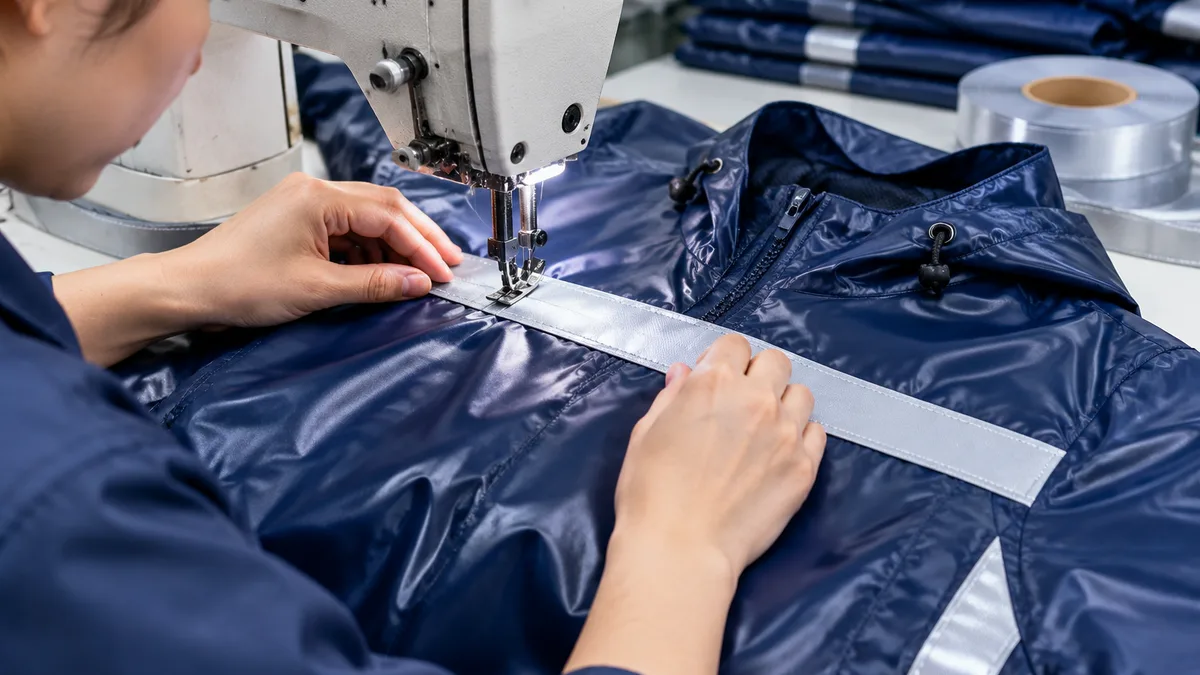
Reflective tape application is the third stage. Reflective strips are sewn or heat-sealed onto the finished raincoat after the garment is assembled. Each placement requires a separate sewing pass or a separate heat-seal station setup. Standard placements—two horizontal chest stripes and two vertical back stripes—are already programmed into your sewing machines, so setup time is minimal. Non-standard placements require new machine settings, new tape cutting lengths, and a test run to confirm that the tape does not overlap with high-frequency weld zones, which would compromise both the weld integrity and the tape adhesion. Tape application adds roughly 15 to 30 seconds per raincoat depending on the number of placements. At 500 pieces, this labor cost is predictable. At lower volumes, the setup cost per unit rises and the risk of tape waste increases because operators must adjust machine tension and feed rates manually.
Process Constraints That Affect Design Feasibility, Not Capability
Tiancigear, you treat process constraints as design rules, not capability limits. A constraint tells the buyer where to position a reflective strip or how to structure a logo file. A capability limit would mean you cannot apply reflective tape at all, which is not the case. Understanding the distinction helps buyers avoid sampling delays and revision cycles.
Reflective strip placement must avoid weld zones. PVC raincoats use high-frequency welding to join seams, pockets, and hoods. The weld zone is typically 12 to 15 millimeters wide, and it requires direct contact between two layers of PVC film under heat and pressure. If a reflective strip overlaps with a weld zone, one of two failures occurs. Either the tape prevents the PVC layers from bonding, which results in a seam failure during wear, or the heat and pressure degrade the retroreflective layer on the tape, which reduces its visibility performance below the EN ISO 20471 threshold of 330 cd/lx/m². You apply reflective tape after welding, and you position it at least 20 millimeters away from any seam or pocket edge. This is a process constraint. The buyer's artwork must account for it at the sampling stage, or you will flag the conflict during the pre-production review and request a revised placement diagram.
High-contrast logos require extended drying time, which affects throughput but not feasibility. A white logo on a dark blue raincoat requires a white base layer, a drying cycle, and then a top layer of white ink to achieve opacity. Without the intermediate drying cycle, the base layer smudges when the top layer is applied. The drying cycle adds roughly 40 minutes to the production timeline for each batch of 50 raincoats. At 500 pieces, this adds one additional production day. At 1,000 pieces, it adds two days. The design is feasible, but the lead time increases from 18 days to 20 days for a 500-piece order. Buyers who specify high-contrast logos without understanding this timeline sometimes assume the delay indicates a production problem, when in fact it indicates proper process control.
Custom color matching requires a physical sample or a Pantone reference, not an RGB value from a website screenshot. PVC film is produced using pigment concentrates, not digital color profiles. An RGB value of (0, 102, 204) can appear as three different shades of blue depending on the monitor calibration, the lighting conditions when the buyer views the sample, and the finish of the PVC film (matte, semi-gloss, or gloss). You require either a physical fabric swatch or a Pantone TPG or TCX reference to mix the masterbatch. If the buyer provides only an RGB value, you produce a sample based on the closest Pantone match, but the buyer must approve it before bulk production begins. This approval step adds roughly five days to the sampling timeline.
When the MOQ Rises: Fully Custom Designs and Safety-Critical Applications
The 500-piece MOQ applies to custom branding on a standard raincoat pattern with one or two reflective tape placements. When the design complexity increases, the MOQ rises to 1,000 pieces because the setup cost and the risk of material waste both increase.
Multi-color paneling requires separate cutting dies for each panel and separate calendering runs for each color. A raincoat with a navy body, reflective yellow sleeves, and a reflective orange hood requires three separate PVC film rolls, three sets of cutting dies, and three separate sewing passes to join the panels. The setup cost for the cutting dies alone is approximately $600 to $800 depending on the pattern complexity. At 1,000 pieces, this cost is $0.60 to $0.80 per unit. At 500 pieces, it is $1.20 to $1.60 per unit, which often exceeds the buyer's target unit price. You absorb some of this cost on the first order if the buyer commits to repeat orders, but a one-time 500-piece order with multi-color paneling is typically not economical.
Additional reflective tape placements beyond the standard four stripes require additional sewing machine setups and additional tape waste during the test runs. A design with six reflective placements—chest, back, sleeves, and hem—requires six separate sewing passes. The setup time increases from 20 minutes to 60 minutes, and the tape waste increases from roughly 2 meters per setup to 6 meters per setup. At 1,000 pieces, this waste is negligible. At 500 pieces, it represents roughly 3% of the total tape cost, which is absorbed in the unit price. Below 500 pieces, the waste percentage rises above 5%, which makes the order unprofitable unless the buyer accepts a higher unit price.
Safety-critical applications such as municipal road crews, railway maintenance teams, or airport ground staff require compliance with EN ISO 20471, which specifies minimum areas of retroreflective material and background material for Class 2 and Class 3 garments. For Class 2 compliance, the retroreflective area must be at least 0.13 m² and the background fluorescent area must be at least 0.50 m². For Class 3 compliance, those figures rise to 0.20 m² and 0.80 m². You produce compliant garments regularly, but buyers in safety-critical sectors often require batch-level traceability documentation that links each finished raincoat to the specific roll of reflective tape, the specific batch of PVC film, and the specific production date. This traceability requires additional record-keeping at each production stage, which raises the administrative cost per unit. At 1,000 pieces, this cost is manageable. Below 1,000 pieces, the administrative burden per unit often exceeds the margin on the order unless the buyer accepts a higher unit price or a longer lead time.
How to Structure Your Order to Meet the MOQ Without Overbuying
Many buyers hesitate at a 500-piece MOQ because they are uncertain about demand, storage capacity, or the risk of design changes between orders. Tiancigear, you help buyers structure orders in ways that meet the MOQ without forcing them to hold excess inventory or commit to a single design.
Split the order across two or three colorways using the same pattern and the same reflective tape placement. A 500-piece order can be divided into 250 pieces in navy blue and 250 pieces in black, both with the same logo and the same reflective tape configuration. The masterbatch cost increases because you mix two separate color batches, but the printing screens, the cutting dies, and the tape application settings remain the same. The incremental cost of the second color is roughly $0.15 to $0.25 per unit, which is far lower than the cost of producing two separate 250-piece orders at different times. This approach works well for retail buyers who want to test two colorways without committing to 500 pieces of each.
Combine two related products into a single order to reach the MOQ. A buyer who needs 300 custom PVC raincoats and 200 custom PVC rain pants can combine both products into a 500-piece order if the logo, the color, and the reflective tape specifications are identical. The cutting dies and the sewing patterns are different, but the printing setup and the masterbatch preparation are shared. This approach reduces the effective MOQ per product while maintaining the overall order profitability.
References
OSS Apparel. Minimum Order Quantities Explained: Why They Matter in Custom Apparel – OSS Apparel.
Delta Tecnic. Masterbatch: Advantage and Sustainability in the Plastics Industry.
Global Textile Times. Understanding Minimum Order Quantities In Apparel Production.
Frequently Asked Questions
Practical answers related to this article.
What is the minimum order quantity for custom PVC raincoats with reflective strips at Tiancigear?
The minimum order quantity is 500 pieces for standard custom branding, which includes one or two reflective tape placements and screen-printed logos in up to two colors. For more complex designs, the MOQ rises to 1,000 pieces.
Why does Tiancigear set a 500-piece MOQ for standard custom PVC raincoats?
The 500-piece MOQ ensures economic viability across three production stages—masterbatch preparation, logo printing, and reflective tape application—by spreading setup costs, material waste, and labor over enough units to avoid losses.
What factors increase the MOQ beyond 500 pieces?
A higher MOQ of 1,000 pieces applies to fully custom designs such as multi-color paneling, additional reflective tape configurations, high-contrast logos requiring extended drying, or safety-critical applications needing EN ISO 20471 compliance and batch-level traceability.
Can reflective tape be placed anywhere on a PVC raincoat?
No—reflective strips must be positioned at least 20 millimeters away from any seam or pocket edge to avoid overlapping weld zones, which could compromise seam integrity or degrade the retroreflective performance below EN ISO 20471 standards.
Does specifying five reflective tape placements cause a capability issue?
No—it creates a sampling delay due to non-standard placement requirements, not a capability problem. Non-standard placements require new machine settings, tape cutting lengths, and test runs to confirm no overlap with weld zones.
How can buyers meet the 500-piece MOQ without overbuying?
Buyers can split orders across multiple colorways using the same pattern and tape placement, or combine related products (e.g., raincoats and rain pants) into a single order, as long as the logo, color, and other specifications remain consistent.