
How Tiancigear's Dedicated Production Lines Prevent Cross-Contamination in OEM Orders
How Tiancigear's dedicated PVC, EVA, and PE production lines prevent cross-contamination and ensure consistent quality for OEM rain gear orders.
Why Cross-Contamination Remains the Hidden Risk in Multi-Material Rain Gear Production
Consider a common scenario in multi-material manufacturing: three overlapping orders arrive—15,000 PVC raincoats in navy blue with reflective trim for a March shipment, 8,000 translucent PE ponchos in mixed colors needed by late February, and 5,000 fluorescent yellow EVA rain suits for a Middle Eastern construction supplier. All three orders specify strict color matching to previous batches. All three include penalty clauses for delivery delays or quality deviations. This scenario illustrates why multi-material rain gear production on shared lines creates cross-contamination risks that compromise color consistency and delay shipments.
Tiancigear operates a 2,000-square-meter factory floor in Yiwu, and this scenario does not test scheduling software or workforce size. It tests whether the physical manufacturing infrastructure can maintain material separation, seam integrity, and color fidelity when three chemically distinct thermoplastics move through the facility simultaneously. Tiancigear solved that challenge by dedicating one production line exclusively to PVC-coated fabric products, a second to EVA film goods, and a third to disposable PE items. Tiancigear's decision to establish dedicated lines was driven by the incompatible processing requirements of PVC, EVA, and PE, rather than marketing considerations. Polyvinyl chloride, ethylene-vinyl acetate (a copolymer combining two monomers for flexibility), and polyethylene each demand incompatible heat-sealing parameters, release different plasticizer residues (additives that increase flexibility) during thermal bonding, carry different colorant systems, and leave measurable surface contaminants on shared tooling that degrade the next batch if not removed through a multi-hour cleaning protocol.
How Shared Production Lines Introduce Material Cross-Contamination and Batch Inconsistency
A shared production line in rain gear manufacturing typically includes a roll-fed material station, a cutting table equipped with pneumatic or hydraulic dies, a heat-sealing station with adjustable temperature and dwell time, optional stitching machines for reinforced seams, and a final inspection and folding area. When a factory runs multiple material types on a single line, every product changeover follows a predictable sequence: operators must swap cutting dies to match the new garment pattern, recalibrate the sealing temperature and pressure to suit the new polymer, clean residual film or fabric dust from feed rollers and sealing jaws, and run a test batch to confirm that seam strength meets the specification before releasing the line for full production.
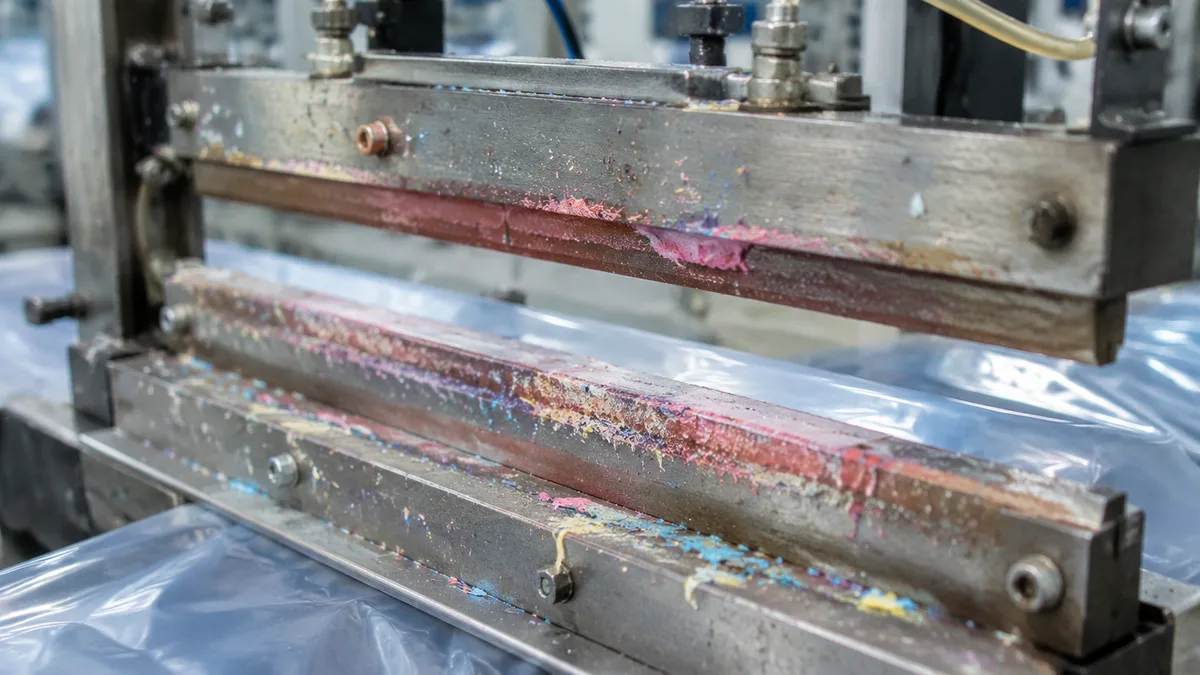
The problem is not the time cost, though a typical PVC-to-EVA changeover consumes two to three hours of production capacity. The problem is the invisible residue. PVC-coated fabric used in industrial raincoats contains plasticizers—most commonly dioctyl phthalate or diisononyl phthalate—that migrate to the surface during heat sealing at 180–200°C. When the same sealing jaw is used minutes later on an EVA poncho that bonds at 120–150°C, trace amounts of plasticizer transfer to the EVA film surface. That plasticizer residue does two things. First, it reduces the bond strength of the EVA seam because the plasticizer acts as a release agent, preventing full molecular entanglement (the interlocking of polymer chains that creates a strong bond) between the two film layers. Second, it creates a tacky surface finish that attracts dust during packaging and causes the ponchos to stick together in cartons during summer shipping, leading to customer complaints about product appearance and handling.
PE film ponchos present a different contamination vector. Polyethylene film in the 0.02 to 0.03 mm thickness range used for disposable rain ponchos is sealed at approximately 110–130°C in a single heat-press cycle with no stitching. Because PE is chemically inert and carries no plasticizers, it does not leave oily residues on tooling. However, PE film is often printed with water-based or solvent-based inks for branding or pattern decoration, and those inks contain pigments that adhere to the heated sealing jaws. If the same line is switched to PVC production without a solvent cleaning step, microscopic ink particles transfer to the PVC fabric and appear as random color specks on the finished raincoat—a defect that procurement buyers classify as a "contamination reject" and that triggers a batch rework or credit claim.
Color consistency suffers as well. PVC raincoats are typically dyed using pigment-loaded plastisols applied to polyester fabric before lamination, while EVA ponchos use masterbatch colorants blended directly into the EVA resin during extrusion. When both materials pass through the same cutting station, polyester fiber dust from PVC fabric accumulates on the cutting die and is pressed into the surface of the next EVA poncho batch, creating visible texture defects and color shifts. A fluorescent yellow EVA poncho contaminated with navy-blue fiber dust from a previous PVC run will appear greenish under daylight, failing the buyer's color-matching requirement and delaying shipment until a replacement batch is produced.
Tiancigear's Three Independent Production Lines for PVC, EVA, and PE Material Families
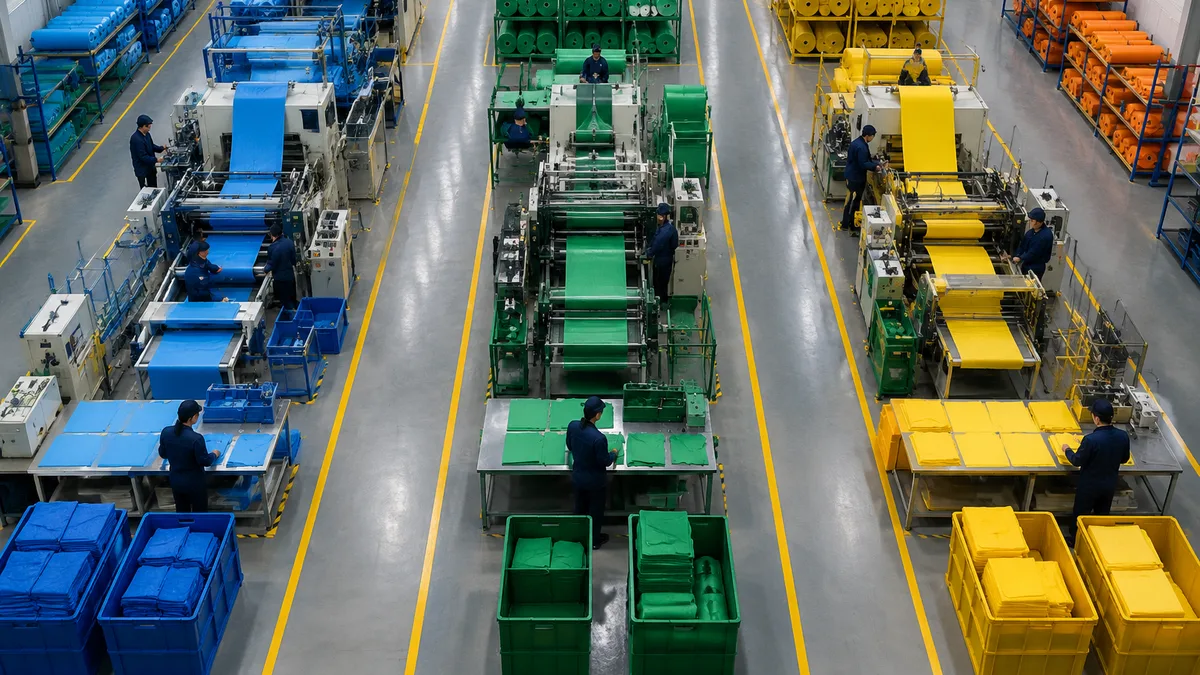
Tiancigear established dedicated production zones for each material family early in its operational history, recognizing that polyvinyl chloride, ethylene-vinyl acetate, and polyethylene require fundamentally different processing conditions. The company divided its 2,000-square-meter facility into three parallel production zones. Each zone was built around a single material system, with dedicated equipment, trained operators, and isolated material storage to eliminate the changeover penalties and contamination risks described above.
Line One: PVC-Coated Fabric Raincoats and Industrial Suits
Tiancigear's first line handles all PVC-coated fabric products, including long raincoats, reflective safety raincoats, industrial rain suits, and custom-branded workwear for construction and agricultural buyers. PVC-coated polyester fabric arrives in rolls ranging from 150 to 280 grams per square meter, with the PVC layer providing waterproofing and the polyester substrate providing tear strength.
Key specifications for Line One:
• Welding technology: High-frequency welding at 27.12 MHz, generating localized heat through electromagnetic induction
• Operating temperature: 180–200°C sustained to achieve full molecular bonding
• Cutting force: 15 to 20 metric tons (pneumatic press with hardened steel dies)
• Target seam strength: Minimum 40 Newtons per 25 mm width, aligned with QB/T 4999-2016 Chinese national standard
• Typical cycle time: 90 to 120 seconds per garment
High-frequency welding is necessary for PVC because the material's thickness and plasticizer content require sustained temperatures of 180–200°C to achieve full molecular bonding along the seam. Conductive heat sealing alone would scorch the fabric surface before the inner layers fused properly. The cutting dies on this line are designed for garment patterns that include long sleeves, hoods with drawstring channels, and reinforced shoulder panels. Because PVC fabric is stiffer than EVA or PE film, higher tonnage is required to ensure clean edges without fraying.
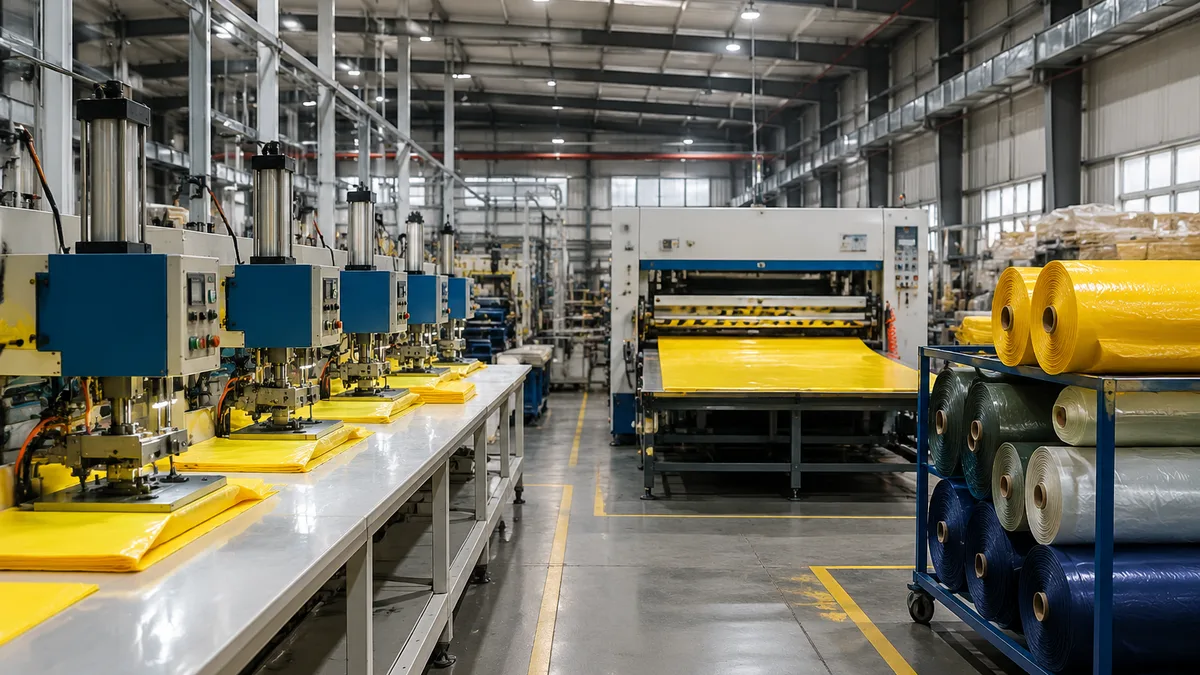
Operators on this line are trained to inspect seam width and peel strength using a manual tensile tester. Material storage for this line includes a dedicated rack system positioned within five meters of the cutting station, reducing the need to transport rolls across the factory floor and preventing cross-contact with EVA or PE film inventory. Finished PVC raincoats are folded, poly-bagged, and transferred directly to a separate packing zone to avoid commingling with other product types during quality inspection or carton loading.
Line Two: EVA Film Ponchos, Cycling Capes, and Translucent Fashion Rainwear
Tiancigear's second line is dedicated to ethylene-vinyl acetate copolymer products, which include disposable rain ponchos, cycling rain capes, and translucent fashion raincoats popular in the European and North American retail markets. EVA film is a thermoplastic copolymer with a vinyl acetate content typically between 18 and 28 percent, giving it flexibility, clarity, and a lower melting point than PVC. This material is supplied in rolls of 0.08 to 0.15 mm thickness and can be extruded in a wide range of colors—solid, translucent, or printed with decorative patterns.
Key specifications for Line Two:
• Sealing technology: Thermal impulse sealers or continuous band sealers
• Operating temperature: 120–150°C with controlled dwell time of 1.5 to 3 seconds
• Cutting force: 8 to 12 metric tons (reduced for thinner film)
• Typical cycle time: 45 to 60 seconds per garment
• Surface treatment: PTFE-coated sealer bars to prevent film adhesion
Because EVA softens at a lower temperature than PVC and does not contain migrating plasticizers, the sealing jaws remain cleaner between production runs, and seam quality is more predictable. The cutting dies on this line are lighter and designed for poncho patterns with minimal seams—typically a hood, a body panel, and sleeve openings.
One of the key advantages of dedicating a line to EVA is cycle time consistency. Because the material does not require the extended dwell time or high pressure needed for PVC, operators can process an EVA poncho in approximately 45 to 60 seconds from roll feed to final fold, compared to 90 to 120 seconds for a PVC raincoat. That speed advantage translates directly into delivery flexibility. When a buyer places a rush order for 10,000 EVA ponchos with a two-week lead time, Tiancigear can allocate full-time production on Line Two without delaying the PVC or PE orders running concurrently on the other lines.
Color quality control on this line includes a visual color-matching step under standardized D65 daylight-equivalent lighting, which allows inspectors to detect even minor color shifts caused by raw material batch changes or extruder temperature drift. Because EVA masterbatch colorants are supplied by the same resin vendor across multiple production runs, color consistency from order to order is high, and buyers report fewer reorder rejections due to color mismatch.
Line Three: Disposable PE Ponchos for Promotional and Emergency Use
Tiancigear's third line processes low-density polyethylene film in the 0.02 to 0.03 mm range, which is used almost exclusively for single-use or short-term rain ponchos distributed at outdoor events, theme parks, sporting events, and emergency relief programs. PE film is the lightest and least expensive of the three material families Tiancigear manufactures, and it is also the fastest to produce.
Key specifications for Line Three:
• Sealing technology: Impulse sealers or ultrasonic welding at 20–40 kHz
• Operating temperature: 110–130°C with dwell time under one second
• Quality monitoring: Continuous infrared temperature sensors to prevent overheating
• Construction: Single rectangular film panel with hood cutout and minimal sealing
• Static control: Ionizing air blowers at roll-feed stations
A disposable PE poncho typically consists of a single rectangular film panel with a hood cutout and minimal sealing—often just the hood perimeter and the side seams, or in some cases a simple fold-and-seal construction with no side seams at all. Because PE film is thin and has a narrow processing window, operators monitor sealing temperature continuously using infrared sensors to prevent overheating, which would cause the film to wrinkle or perforate.
The cutting process on this line is simplified: PE ponchos are often die-cut from pre-folded film sheets, which eliminates the need for separate hood and body panels and reduces labor time per unit. PE film rolls are lighter and bulkier than PVC or EVA rolls, and static electricity can cause film sheets to cling together during handling. Finished PE ponchos are typically packed in polybag bundles of 50 or 100 units, then loaded into export cartons without individual folding, which keeps per-unit handling cost low and supports the high-volume, low-margin business model that most promotional buyers require.
Material-Specific Tooling, Workflow Separation, and Color Consistency
Dedicating a production line to a single material family allows Tiancigear to optimize tooling, training, and workflow in ways that a shared line cannot match. On the PVC line, the high-frequency welding electrodes are sized and shaped specifically for raincoat seam geometries—long straight seams for sleeves, curved seams for hoods, and double-folded seams for pocket flaps. Those electrodes are made from brass or copper alloys that withstand sustained temperatures above 180°C without warping. On the EVA line, the thermal impulse sealer bars are coated with a PTFE release layer to prevent film adhesion, and they are narrower to reduce heat spread into the surrounding film area. On the PE line, the ultrasonic welding horns are tuned to 20 kHz or 40 kHz to match the acoustic impedance (a material property affecting ultrasonic energy transfer) of polyethylene, ensuring efficient energy transfer and consistent weld strength across the thin film.
Production Line Comparison
| Material | Sealing Temp (°C) | Dwell Time (sec) | Thickness Range (mm) | Typical Products | Cycle Time (sec) |
|---|---|---|---|---|---|
| PVC-coated fabric | 180–200 | Continuous HF welding | 0.3–0.6 | Raincoats, industrial suits, workwear | 90–120 |
| EVA film | 120–150 | 1.5–3.0 | 0.08–0.15 | Ponchos, cycling capes, fashion rainwear | 45–60 |
| PE film | 110–130 | <1.0 | 0.02–0.03 | Disposable ponchos, emergency wear | 30–45 |
Workflow separation extends beyond equipment. Each line has its own set of cutting dies stored on adjacent racks, eliminating the need to transport dies between zones and reducing the risk of cross-contamination from residual fabric dust or film particles. Operators are assigned to a single line for periods of three to six months, which allows them to develop deep familiarity with the material behavior, common defects, and troubleshooting procedures specific to that polymer. When a buyer submits a custom color specification for an EVA poncho, the operator on Line Two can reference a library of past color samples produced on that same equipment, reducing the time needed for color matching and sample approval.
Quality control workflows are also line-specific:
• PVC line: Inspectors perform a peel test on every production batch by manually separating a 25 mm section of seam and measuring the force required
• EVA line: Inspectors check for surface clarity and uniform thickness by holding finished ponchos against a light box
• PE line: Inspectors verify that the sealing temperature has not caused film perforation by stretching a sample poncho over a frame and spraying it with water from a standardized nozzle at 0.2 bar pressure for 10 seconds, a simplified version of the water penetration test described in ISO 811
Color consistency benefits directly from line dedication. When Tiancigear produces a batch of 20,000 navy-blue PVC raincoats for a European distributor in March and a reorder of 15,000 units arrives in June, both batches pass through the same PVC line, using the same cutting dies, the same sealing parameters, and the same roll-fed material from the same supplier lot. The color variation between the two shipments is typically within ΔE < 1.5 under D65 lighting, which is below the threshold of perceptible difference for most buyers and well within the ΔE < 3.0 tolerance specified in QB/T 4999-2016.
How Production Line Separation Translates into Procurement Outcomes
The manufacturing benefits of dedicated lines—reduced changeover time, lower contamination risk, and improved color consistency—deliver measurable outcomes that procurement buyers can verify through their own quality audits and delivery records.
On-Time Delivery and Schedule Predictability
When Tiancigear receives overlapping orders for PVC raincoats, EVA ponchos, and PE disposables, the company can run all three concurrently without scheduling conflicts or production delays. A typical scenario: a 15,000-unit PVC raincoat order with a 21-day lead time, an 8,000-unit EVA poncho order with a 14-day lead time, and a 10,000-unit PE poncho order with a 10-day lead time. On a shared line, those orders would need to be sequenced, with the earliest deadline prioritized and the others pushed back. Total lead time would extend to at least 28 days, assuming no unexpected delays.
On Tiancigear's three-line system, all three orders start simultaneously, each on its dedicated line, and all three ship on or before their contracted dates. Tiancigear's parallel production capacity enables consistent on-time delivery even when multiple material types are ordered concurrently, a performance level that buyers verify through their own logistics tracking and that supports the company's ability to secure repeat orders without requiring price concessions.
Reduced QC Rejection Rates and Rework Costs
Material cross-contamination is one of the leading causes of batch rejection in rain gear OEM production. Industry experience suggests that contamination-related defects are significantly more common in shared-line facilities, though exact rates vary by material mix and cleaning protocols. Tiancigear's dedicated-line approach has reduced contamination rejections to low single-digit percentages. Tiancigear's dedicated-line system has maintained contamination-related rejection rates in the low single digits, significantly below industry averages for shared-line facilities. That reduction translates directly into lower rework costs, fewer delayed shipments, and fewer credit claims from buyers who receive defective goods.
Scalable Reorder Volumes Without Quality Drift
One of the strongest signals of manufacturing reliability is a buyer's willingness to place reorders without requesting new samples or re-inspecting the production process. Procurement buyers who receive consistent quality across initial and reorder batches are significantly more likely to place repeat orders. Tiancigear's line-dedicated approach supports this consistency by eliminating contamination variables between production runs.
That loyalty is not built on price or payment terms. It is built on the confidence that Tiancigear's production infrastructure can replicate the same outcome across multiple batches without requiring re-negotiation, re-sampling, or mid-production inspections. Tiancigear's three-line system delivers that confidence because each material family is processed under identical conditions every time, with no intervening contamination events or parameter drift caused by shared equipment.
Conclusion: Why Dedicated Production Lines Are a Procurement Advantage, Not a Manufacturing Luxury
Tiancigear operates three production lines not because the company has excess factory space or because competitors do the same. Tiancigear operates three lines because polyvinyl chloride, ethylene-vinyl acetate, and polyethylene are incompatible material systems that demand different temperatures, different tooling, different handling protocols, and different quality checks. A shared production line would lower initial capital investment but would increase contamination risk, extend lead times due to changeover delays, and reduce color consistency across batches.
For procurement buyers evaluating OEM rain gear suppliers, the presence of dedicated production lines is not a spec-sheet detail to skim over. It is a structural indicator of whether a factory can maintain batch-to-batch consistency
References
eLeap Software. Standard Operating Procedure (SOP) for Preventing Cross-....
BioProcess International. Pharmaceutical Facility Risk Assessment Best Practices.
Frequently Asked Questions
Practical answers related to this article.
What are the three material families that Tiancigear dedicates production lines to?
Tiangcigear dedicates one production line exclusively to PVC-coated fabric products, a second to EVA film goods, and a third to disposable PE items.
Why does Tiancigear use dedicated production lines instead of shared lines for multi-material rain gear orders?
Tiangcigear uses dedicated production lines because PVC, EVA, and PE have incompatible processing requirements—including heat-sealing parameters, plasticizer residues, colorant systems, and surface contamination risks—that cause cross-contamination and batch inconsistency on shared lines.
What specific contamination issues arise when PVC and EVA are produced on the same line?
When PVC and EVA are produced on the same line, plasticizers from PVC (e.g., dioctyl phthalate) transfer to EVA film during sealing, reducing seam strength and creating a tacky surface that causes ponchos to stick together in cartons. This leads to customer complaints about appearance and handling.
How does PE film contamination affect PVC production, and what is the resulting defect?
PE film often contains pigments from water-based or solvent-based inks used for printing. If the same line is switched to PVC without solvent cleaning, microscopic ink particles transfer to PVC fabric, appearing as random color specks on finished raincoats—a defect classified as a 'contamination reject' by procurement buyers.
What is the typical cycle time for producing a PVC raincoat on Line One, and what technology is used for sealing?
The typical cycle time for producing a PVC raincoat on Line One is 90 to 120 seconds per garment, using high-frequency welding at 27.12 MHz with an operating temperature of 180–200°C.
How does Tiancigear ensure color consistency for EVA ponchos across different production runs?
Tiangcigear ensures color consistency for EVA ponchos by using masterbatch colorants blended directly into the EVA resin during extrusion, supplied by the same resin vendor across multiple production runs, and performing visual color-matching under standardized D65 daylight-equivalent lighting.