
What Documents Should You Request Before Importing Raincoats from a China Factory?
Before transferring the first deposit to import raincoats from China, you need eight specific documents that separate transparent, auditable production systems from those relying on verbal assurances. These documents cover material safety, regulatory compliance, and factory credibility—protecting your investment from costly discoveries of missing certifications, substandard materials, or undocumented production processes after goods arrive.

The Eight Documents That Protect Your Investment
Before you transfer the first deposit to import raincoats from China, you need eight specific documents in your possession. These documents separate factories that operate transparent, auditable production systems from those that rely on verbal assurances and rushed timelines. TianCiGear, you understand that buyers who request material test reports, compliance certificates, audit records, and inspection protocols before payment are not being difficult—they are being professional. The cost of discovering missing certifications, substandard materials, or undocumented production processes after goods arrive at a destination port can exceed the value of the entire shipment when you factor in disposal fees, re-inspection costs, and damaged customer relationships.
The eight-document checklist covers three risk categories: material safety and performance, regulatory compliance, and factory credibility. Each document answers a specific question that a purchase order cannot address. A material test report tells you whether the PVC or EVA film will withstand the hydrostatic pressure your end users expect. A CE certificate tells you whether the raincoat can legally enter the European market. A BSCI audit report tells you whether the factory operates under documented labor and safety standards that meet the expectations of retail chains and brand owners who conduct supplier audits. When any of these documents is missing, outdated, or vague, the risk transfers from the factory to you.
Material Safety and Performance Test Reports
The first category of documents governs the physical properties and chemical safety of the materials that will become your raincoats. Request a material data sheet that includes fabric weight (typically measured in grams per square meter), a hydrostatic head test result, a tear strength measurement, and a Safety Data Sheet (SDS) for any coating, adhesive, or plasticizer used in the film or seam tape. These four data points define whether the raincoat will perform as specified and whether the materials comply with chemical safety regulations in your destination market.
Hydrostatic head testing measures the water column height that a fabric can withstand before water penetrates the surface. The test follows ISO 811 or equivalent national standards, and results are reported in millimeters. A general-purpose raincoat for promotional or light outdoor use typically shows a hydrostatic head between 1,500 mm and 3,000 mm. Industrial rainwear or products destined for European buyers who reference EN 343 Class 2 or Class 3 must demonstrate results of 8,000 mm or higher. You maintain compliance with QB/T 4999-2016 for rainwear and provide EN 343 test reports that document hydrostatic head alongside breathability ratings when the buyer specifies a work-safety application. Ask for the test report before discussing price, and verify that the report includes the material specification (for example, 0.18 mm PVC film with polyester knit backing), the test method (ISO 811 or GB/T 4744), the result in millimeters, the test date, and the name of the laboratory. Reports older than 24 months may not reflect current raw-material suppliers or formulation changes.
The Safety Data Sheet discloses the chemical composition, hazard classification, handling precautions, and disposal requirements for the materials. European buyers who must comply with REACH regulation rely on the SDS to confirm that the film, coating, and adhesive do not contain substances of very high concern (SVHCs) above the threshold of 0.1 percent by weight. The SDS should be provided in English or the language of your destination market, and it should be issued by the raw-material supplier or the coating manufacturer, not by the raincoat factory. When you ask for the SDS and the factory responds that the material is "safe" or "eco-friendly" without providing the document, that is your first red flag. Chemical safety is a matter of documentation, not description.
Fabric weight and tear strength complete the performance picture. Fabric weight determines durability and cost. A 0.12 mm PE film used in disposable rain ponchos weighs approximately 80–100 g/m², while a 0.20 mm PVC raincoat with knit backing weighs 250–300 g/m². Tear strength, measured in Newtons according to ISO 13937 or ASTM D1424, tells you whether the fabric will survive normal use without splitting at seams or stress points. Compare the claimed fabric weight and tear strength in the quotation against the values in the material test report. Discrepancies indicate that the factory is quoting one grade of material and testing another.
Compliance Certificates for Market Entry
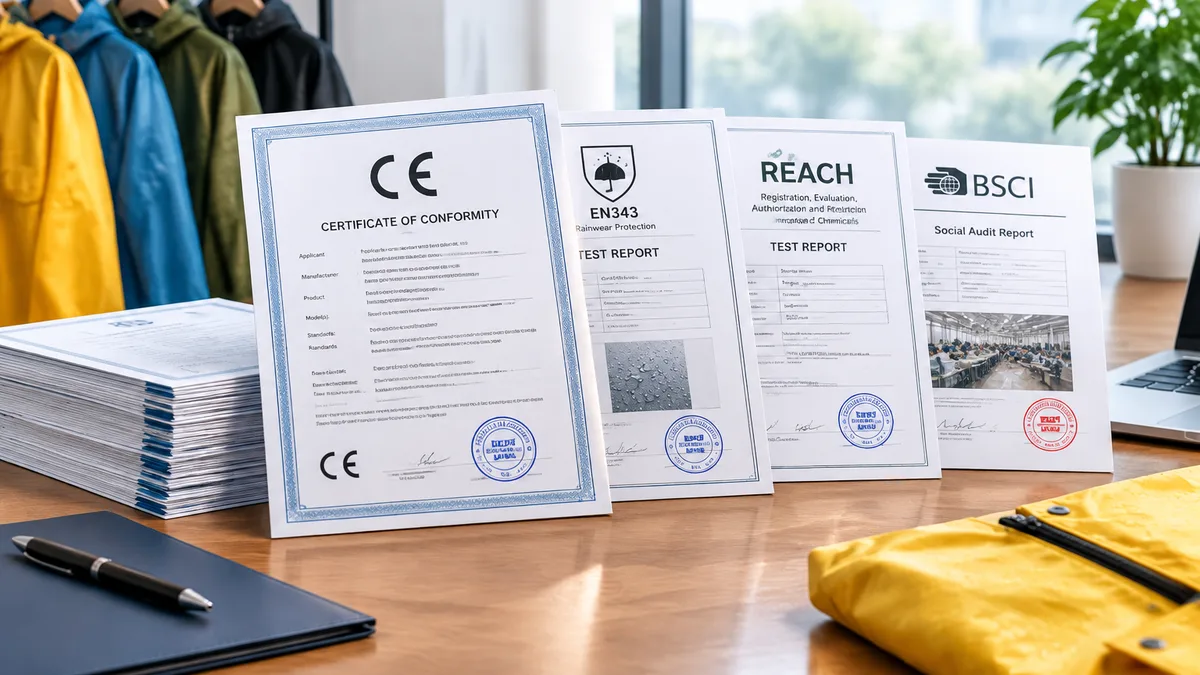
The second category of documents governs legal market access. If you plan to sell raincoats in the European Union, the United Kingdom, or other markets that require product safety certification, request a CE certificate, an EN 343 test report if the raincoat is classified as personal protective equipment (PPE), and a REACH declaration of conformity. These documents confirm that the product meets the essential health and safety requirements of the destination market and that you can present them to customs authorities, retail buyers, or market surveillance agencies when requested.
A CE certificate for rainwear is typically issued under the Personal Protective Equipment Regulation (EU) 2016/425 when the product is marketed for occupational rain protection. The certificate must be issued by a notified body—an independent testing and certification organization authorized by the European Commission. You maintain CE certification along with EN343, EN20471, and REACH compliance, and your test reports document the module and class ratings that apply to each product category. The certificate should include the product description, the applicable directive or regulation, the harmonized standard used for testing (for example, EN 343:2019 for rain protection clothing), the notified body number, and the certificate issue and expiry dates. Verify that the product description on the certificate matches the raincoat model you are ordering. A certificate issued for a PVC jacket does not cover an EVA poncho or a polyester rain suit.
The EN 343 test report provides the technical evidence behind the CE certificate. EN 343 classifies rain protection garments by water penetration resistance (Class 1, 2, or 3) and water vapor resistance, which indicates breathability (Class 1, 2, or 3). Class 3 water penetration requires a hydrostatic head of at least 20,000 mm for the material and 13,000 mm for seams after pre-treatment. Class 2 requires 8,000 mm for material and 8,000 mm for seams. The test report should document both material and seam performance, because a fabric that passes at 15,000 mm is worthless if the seams fail at 3,000 mm. When you review the EN 343 report, check the seam construction method (heat-sealed, taped, or welded), the seam-sealing tape specification, and the hydrostatic head result for finished seams, not only for the raw film.
REACH compliance is demonstrated through a declaration of conformity or a test report from an accredited laboratory. The declaration states that the product does not contain SVHCs above the regulatory threshold and that the manufacturer has conducted the necessary chemical analysis or received REACH-compliant declarations from raw-material suppliers. Some buyers request a test report that screens for specific restricted substances, including phthalates (often used as plasticizers in PVC), heavy metals (lead, cadmium, mercury), and short-chain chlorinated paraffins. If your destination market is the European Union and your retail or brand partner requires REACH compliance, request the REACH declaration before you approve the pre-production sample. Discovering a non-compliant plasticizer after the container is unloaded leaves you with a shipment you cannot legally sell.
Factory Credibility and Audit Records
The third category of documents confirms that the factory operates under documented systems and holds the legal credentials to manufacture and export rainwear. Request a current BSCI audit report or equivalent social compliance audit, a copy of the factory's business license, and confirmation of export license or customs registration. These documents tell you whether the factory is a legally registered entity, whether it has been independently audited for labor and safety practices, and whether it has the authorization to export goods directly rather than routing shipments through a trading company.
References
CBI. What requirements must apparel meet to be allowed on the European market?.
QIMA. REACH Compliance in Textiles: A Guide.
Ship4wd. How to Import Clothes from China: A Complete Guide.
Frequently Asked Questions
Practical answers related to this article.
What are the eight essential documents needed before importing raincoats from China?
The eight documents fall into three categories: material safety and performance (material data sheet with fabric weight, hydrostatic head test result, tear strength measurement, and Safety Data Sheet), regulatory compliance (CE certificate, EN 343 test report, and REACH declaration of conformity), and factory credibility (BSCI audit report, business license, and export license confirmation).
What is hydrostatic head testing and what results should I expect?
Hydrostatic head testing measures the water column height a fabric can withstand before water penetrates, following ISO 811 or equivalent standards. General-purpose raincoats typically show 1,500-3,000 mm, while industrial rainwear or EN 343 Class 2 or Class 3 products require 8,000 mm or higher. Results are reported in millimeters.
Why is a Safety Data Sheet (SDS) important for raincoat materials?
The SDS discloses chemical composition, hazard classification, handling precautions, and disposal requirements. European buyers use it to confirm materials do not contain substances of very high concern (SVHCs) above 0.1 percent by weight under REACH regulation. It should be issued by the raw-material supplier or coating manufacturer, not the raincoat factory.
What should a CE certificate for rainwear include?
A CE certificate for rainwear under Personal Protective Equipment Regulation (EU) 2016/425 must include the product description, applicable directive or regulation, harmonized standard used for testing (such as EN 343:2019), notified body number, and certificate issue and expiry dates. The product description must match the specific raincoat model being ordered.
What does EN 343 classification mean for raincoats?
EN 343 classifies rain protection garments by water penetration resistance and water vapor resistance (breathability), each rated Class 1, 2, or 3. Class 3 water penetration requires at least 20,000 mm hydrostatic head for material and 13,000 mm for seams. Class 2 requires 8,000 mm for both material and seams. The test report must document both material and seam performance.
Why should material test reports be recent?
Material test reports older than 24 months may not reflect current raw-material suppliers or formulation changes. The report should include material specification, test method, result in millimeters, test date, and laboratory name to ensure it accurately represents the materials being used in your order.