
How a Festival Organizer Procured 20,000 Disposable Rain Ponchos Under a Tight Deadline
A Pacific Northwest music festival with 20,000 attendees and a 30-day lead time sourced custom-printed PE ponchos to solve weather contingency planning, navigating MOQ requirements, production timelines, and on-site distribution logistics.
The Event Scenario: A Three-Day Outdoor Festival with Unpredictable Weather and a 30-Day Lead Time
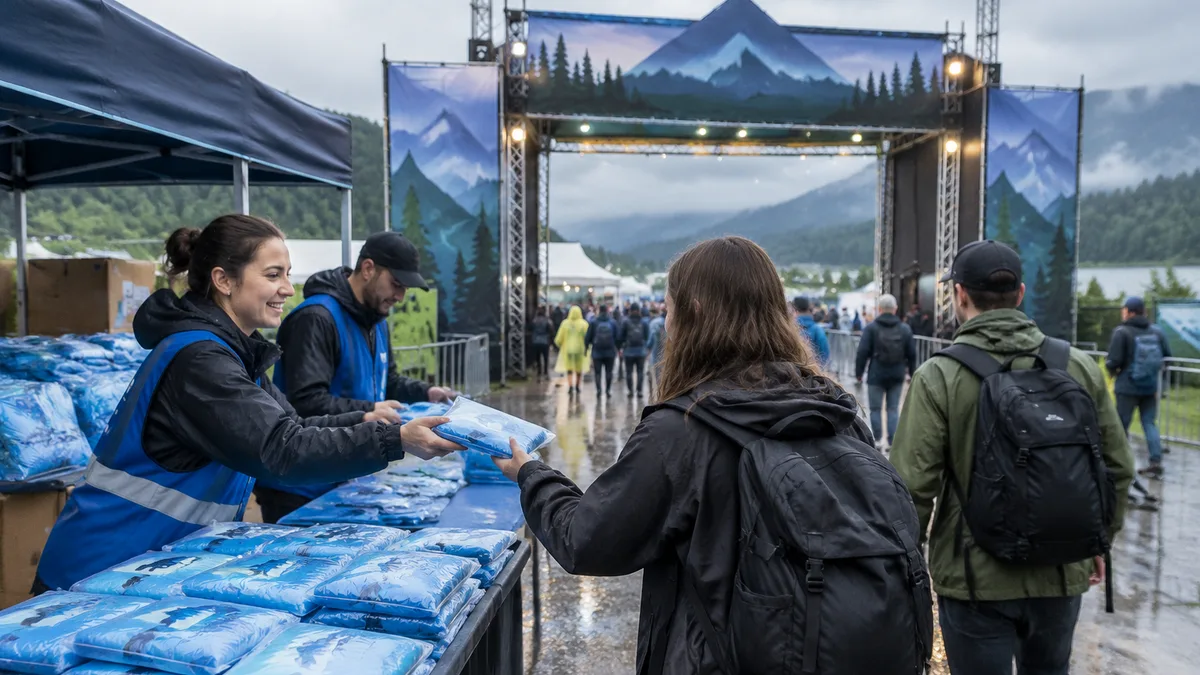
In early spring, a mid-sized music festival in the Pacific Northwest faced a familiar problem: thirty days before gates opened, the organizer had confirmed 20,000 attendees, booked six stages, and secured all permits—but had no contingency plan for rain. The festival spanned three days in late May, when regional weather can shift from clear skies to steady drizzle within hours. Previous years had seen muddy walkways and uncomfortable crowds when rain arrived unexpectedly, and post-event surveys consistently flagged lack of rain protection as a top complaint.
The operations team needed a solution that could be procured, shipped, and distributed in under a month. Budget constraints ruled out purchasing 20,000 reusable raincoats, and the festival's no-reentry policy meant attendees could not be asked to retrieve gear from their cars. The organizer required a product that could be handed out at entry gates, used once, and discarded by attendees without creating a return logistics burden. With a fixed timeline and a clear volume target, the procurement director began evaluating disposable rain ponchos as the only viable option.
Why Disposable Rain Ponchos Were the Optimal Choice: Cost, Weight, and Ease of Distribution
Disposable PE rain ponchos fit three decisive criteria. First, unit cost aligned with the event's per-attendee budget. A 20–30 micron polyethylene poncho typically costs a fraction of what a reusable EVA or PVC raincoat commands, allowing the organizer to cover all 20,000 attendees without exceeding the contingency line item. Second, weight and pack size mattered for logistics. Each poncho could be folded into a palm-sized pouch, which meant a single pallet could hold thousands of units. The festival's limited on-site storage made compact packaging non-negotiable. Third, distribution speed was critical. Gate staff needed to hand out ponchos to long queues of arriving guests in minutes, not conduct sizing checks or collect deposits. A one-size-fits-all poncho in a tear-open pouch met that requirement.
The alternative—reusable raincoats—introduced problems the event could not absorb. Reusable garments require size assortment, which multiplies SKU count and complicates inventory management. They also demand a return and cleaning system, neither of which the festival could support within its three-day run. Attendees who received a raincoat would either take it home, creating an unplanned giveaway cost, or leave it behind, generating waste the organizer would have to collect and dispose of. Disposable ponchos eliminated both issues. Attendees used them as needed and discarded them in on-site trash receptacles, where they were consolidated with other event waste. The procurement director confirmed that PE ponchos are not biodegradable, so the organizer planned for proper waste collection and disposal through the venue's contracted sanitation service.
Finding a Manufacturer: Criteria Included MOQ, Customization for Logo Printing, and Lead Time Commitment
With the product category settled, the next step was identifying a manufacturer who could meet three hard requirements: a minimum order quantity at or below 20,000 pieces, the ability to print a custom festival logo on each poncho, and a guaranteed delivery date no later than two weeks before the event. The procurement director contacted six rain-gear factories, four of which were based in China and two in Southeast Asia. Initial inquiries revealed that MOQ varied widely. Two suppliers quoted minimums of 50,000 pieces per design, which exceeded the festival's need and budget. A third factory offered a 10,000-piece minimum but could not commit to a 28-day production and shipping window.
TianCiGear, a Yiwu-based manufacturer with three decades of experience in OEM rain gear, responded with a proposal that fit the event's constraints. The factory's standard MOQ for custom-printed disposable PE ponchos was 5,000 pieces per design, which allowed the organizer to split the 20,000-unit order into four color variants if desired, or consolidate the entire volume into a single design. The procurement director chose the latter to simplify production and reduce per-unit cost. TianCiGear confirmed that its lead time for a custom PE poncho order of this size was 18 to 22 days from sample approval to ex-factory shipment, leaving enough buffer for ocean freight and customs clearance. The factory also provided references from two prior event clients, one of which had ordered 15,000 ponchos for a marathon with a similarly tight timeline.
Price negotiation was straightforward. The quoted unit cost included one-color screen printing of the festival logo on the chest, individual poly-bag packaging, and export cartons. The organizer requested a sample poncho with the printed logo before committing to the full order. TianCiGear produced a physical sample within five days and shipped it via express courier. The sample confirmed that the 25-micron PE film was lightweight but tear-resistant, the print was legible and centered, and the poncho's dimensions (roughly 130 cm length, 100 cm width) provided adequate coverage for most adult body types.
Navigating Customization: Limitations of Printing on PE Film, Color Options, and Packaging Decisions
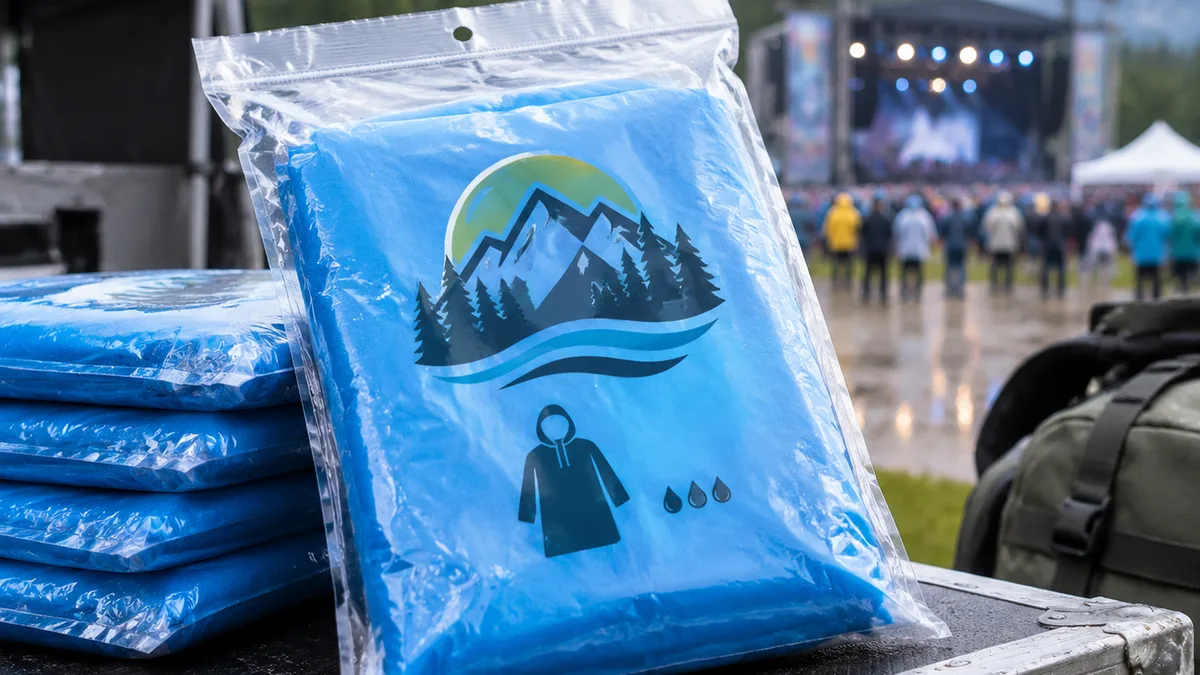
Custom printing on disposable PE ponchos operates within specific technical boundaries, and the procurement director learned these constraints during the sample approval phase. Screen printing is the standard method for applying logos and text to PE film. It supports one to three colors per design, but fine detail and photographic images do not reproduce well on the translucent, slightly textured surface of polyethylene. The festival's logo included a circular emblem with text and a simple graphic, which translated cleanly to a single-color print. TianCiGear recommended white ink on a colored poncho background for maximum contrast, and the organizer agreed.
Color selection was the next decision point. PE film can be produced in a range of solid colors—blue, yellow, green, red, and clear are the most common stock options—or custom-tinted using masterbatch pigment. Custom colors require a minimum film order because a masterbatch bag tints an entire roll, and any leftover film from a short run cannot be economically stored or reused. The organizer chose stock blue, which matched the festival's brand palette and avoided the lead-time penalty and cost premium associated with custom tinting. The factory confirmed that blue film was already in inventory and ready for immediate cutting and printing.
Packaging format directly affected distribution speed at the gate. TianCiGear offered three options: bulk cartons with loose ponchos, individual poly bags packed into export cartons, or heat-sealed pouches with a tear notch. The organizer selected individual poly bags because they were the fastest to hand out and protected each poncho from moisture during outdoor storage. Each poly bag measured approximately 10 cm by 12 cm and included a small printed label identifying the contents as a rain poncho with the festival logo. The factory packed 100 poly-bagged ponchos per export carton, which simplified counting and distribution planning. The organizer calculated that 200 cartons would be delivered, and each gate station would receive a pre-allocated share based on expected crowd flow.
Production Timeline: From Sample Approval to Factory QC and Shipment
Once the sample was approved, TianCiGear issued a proforma invoice and production schedule. The organizer wired a 30% deposit to initiate manufacturing. The production timeline broke down into five phases. Film preparation took two days; the factory confirmed that stock blue PE film was available in the required gauge and pulled sufficient material from inventory. Screen preparation and test printing occupied the next three days. The factory created a printing screen from the festival's vector logo file, ran test prints on scrap film to verify ink adhesion and color accuracy, and sent digital photos of the test prints to the organizer for final approval.
Bulk printing and cutting followed. TianCiGear's production line processed the full 20,000-unit run over four days. PE film was fed through a rotary screen printer that applied the logo to each poncho blank, then moved to a cutting station where automated blades trimmed the film to the specified dimensions and punched the head opening. Heat-sealed edges prevented fraying. Each completed poncho was folded and inserted into a poly bag, which was then sealed and labeled. The factory's quality control team inspected a random sample of 200 ponchos—one percent of the total order—checking for print alignment, film thickness, seal integrity, and correct folding. No defects were identified in the sample batch.
References
Rain Raver. "Best practices" at festivals/events.
Groups360. Outdoor Event Planning Best Practices and Contingency Tips.
Replica Printing. Custom Print Turnaround Times: Print Shop Lead Times Guide.
Frequently Asked Questions
Practical answers related to this article.
Why did the festival organizer choose disposable rain ponchos over reusable raincoats?
Reusable raincoats were ruled out due to budget constraints, the need for size assortment (multiplying SKU count), and the requirement for a return and cleaning system, which the three-day festival could not support. Disposable ponchos eliminated these issues, as they are one-size-fits-all, can be handed out quickly at gates, used once, and discarded in on-site trash receptacles without creating a return logistics burden.
Which manufacturer was selected for the order, and what were its key advantages?
The organizer selected TianCiGear, a Yiwu-based manufacturer with three decades of experience in OEM rain gear. Its key advantages included a standard MOQ of 5,000 pieces per design (fitting the 20,000-unit volume), a lead time of 18 to 22 days from sample approval to ex-factory shipment, and the ability to print a custom festival logo within that timeline.
What customization options were available for the disposable PE ponchos, and what choices did the organizer make?
Customization was limited to screen printing (supporting one to three colors per design) on PE film, which does not reproduce fine detail or photographic images well. The organizer chose a single-color white ink print on stock blue film (to match the festival's brand palette) and selected individual poly-bag packaging for fast distribution and moisture protection.
What was the production timeline and quality control process for the order?
After sample approval and a 30% deposit, production involved five phases: two days for film preparation, three days for screen preparation and test printing, four days for bulk printing and cutting, then folding and packing into poly bags and cartons. The factory's QC team inspected a random sample of 200 ponchos (1% of the total order) for print alignment, film thickness, seal integrity, and correct folding; no defects were found.